वर्णमात्रा-परिचयः
Class 7 Sanskrit · दीपकम् · Chapter 13
173 members in the CBSE community
View all






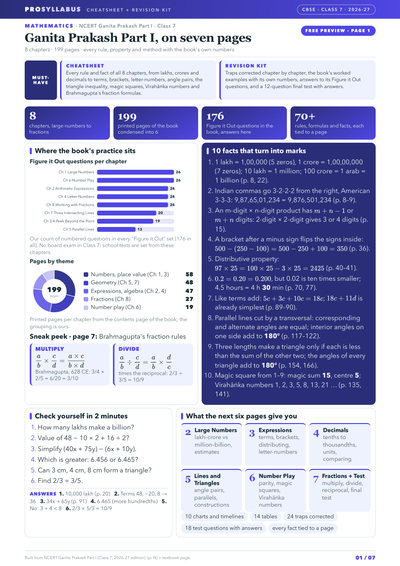
CBSE Class 7 · Mathematics
8 chapters: lakhs and crores to fractions- Marks booster + cheatsheet: key concepts in 2 lines each, common traps
- Triangle inequality, Ch 7
- Angle pairs of parallel lines, Ch 5
- Common traps, corrected
- Magic squares and Virahāṅka numbers, Ch 6
- Brahmagupta's fraction formulas, Ch 8
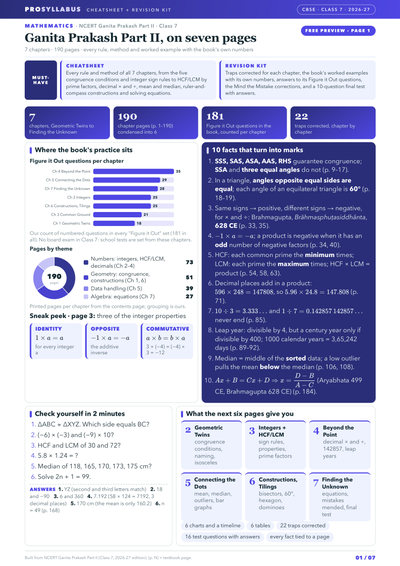
CBSE Class 7 · MathematicsTrending
Five congruence conditions to equations- Marks booster + cheatsheet: key concepts in 2 lines each
- Integer sign rules, Ch 2
- HCF and LCM by prime factors, Ch 3
- Multiplying and dividing decimals, Ch 4
- Mean, median and outliers, Ch 5
- Ruler-and-compass constructions, Ch 6
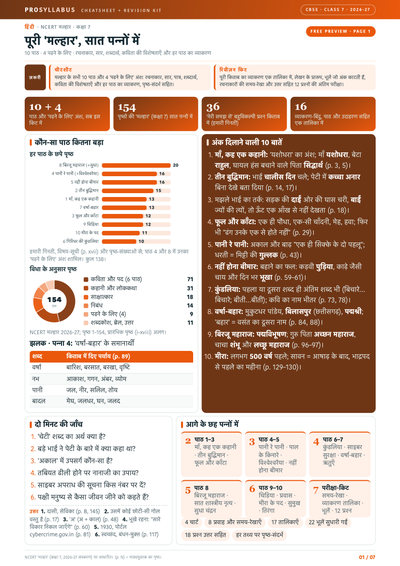
CBSE Class 7 · हिंदी
All 10 मल्हार lessons + 4 reading pieces- Marks booster + cheatsheet: key concepts in 2 lines each
- Writer and summary for every lesson
- Grammar of every lesson in one table
- 7 classical dances, Lesson 8
- MCQs across the whole book
- Common mistakes, corrected
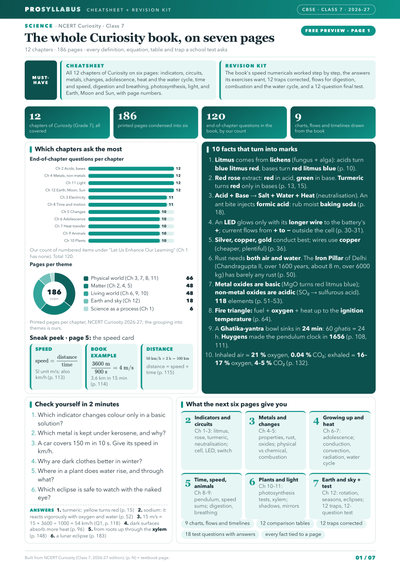
CBSE Class 7 · Science
12 chapters: indicators to Earth and Moon- Marks booster + cheatsheet: key concepts in 2 lines each
- 12 exam traps, listed
- Electric circuits and components, Ch 3
- Digestion and breathing, Ch 9
- Photosynthesis, Ch 10
- Time and speed, Ch 8
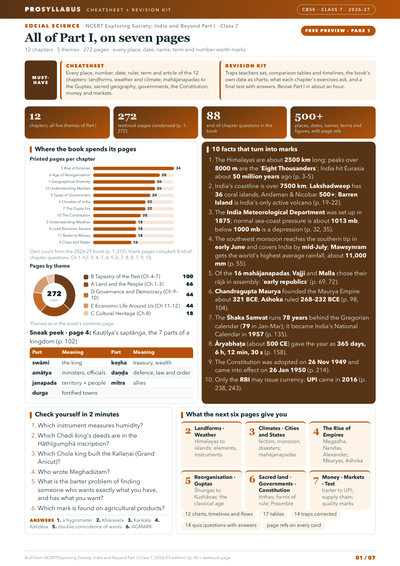
CBSE Class 7 · Social ScienceTrending
12 chapters: landforms to markets- Marks booster + cheatsheet: key concepts in 2 lines each
- Magadha to the Mauryas and Aśhoka, Ch 5
- Articles of the Constitution, Ch 10
- Types of government, Ch 9
- Weather and climates of India, Ch 2–3
- Barter to money, Ch 11
CBSE Class 7 · Social ScienceTrending
8 chapters: farming to banks- Marks booster + cheatsheet: key concepts in 2 lines each
- Crops, seasons and soils, Ch 1
- Land and maritime neighbours, Ch 2
- Harṣha and the Tripartite Struggle, Ch 3
- Ghaznavids, Cholas and Ghūrids, Ch 4
- Communities that made India home, Ch 5
CBSE Class 7 · English
All 15 Poorvi texts, unit by unit- Marks booster + cheatsheet: key concepts in 2 lines each
- 5 units: authors, plots and characters
- Poem devices for every poem
- Grammar each lesson teaches
- Word meanings with page numbers
- Writing formats a school test asks
The story in short
यह "अतिरिक्तम् अध्ययनम्" (पूरक अध्ययन) पाठ संस्कृत में वर्णों की मात्राओं (उच्चारण-काल) का परिचय देता है। छात्रा श्रद्धा का सन्देह दूर करते हुए अध्यापक बताते हैं कि सामान्यतः स्वरों की दो मात्राएँ (ह्रस्व = एकमात्र, दीर्घ = द्विमात्र) मानी जाती हैं, परन्तु संस्कृत में एक तीसरी मात्रा "प्लुत" (त्रिमात्र) भी होती है। इस प्रकार संस्कृत में कुल बाईस (२२) स्वर होते हैं। प्लुत-स्वर का प्रयोग प्रायः दो स्थानों पर होता है — दूर से बुलाने में (जैसे "हे३ राम!") तथा वेद-मन्त्र के आरम्भ में ओंकार के उच्चारण में (जैसे "ॐ")। ये तीन मात्राएँ केवल स्वरों में होती हैं; सभी व्यञ्जनों की सदा "अर्ध-मात्रा" होती है। पाठ प्रसिद्ध श्लोक "एकमात्रो भवेद् ह्रस्वः, द्विमात्रो दीर्घ उच्यते, त्रिमात्रश्च प्लुतो ज्ञेयः, व्यञ्जनं चार्धमात्रिकम्" से इसे पुष्ट करता है। पक्षियों के उदाहरण से समझाया गया है — चाष (नीलकण्ठ) एकमात्र, वायस (काक) द्विमात्र, शिखी (मयूर) त्रिमात्र तथा नकुल (नेवला) अर्धमात्र ध्वनि करता है। फिर "राम = ४½ मात्राएँ" जैसी मात्रा-गणना-क्रीडा कराई जाती है। पाठ श्लोक-रचना में मात्रा-गणना के महत्त्व तथा "ॐ" व "ऽ" (अवग्रह) चिह्नों का परिचय भी देता है।