Three Dimensional Geometry
Class 12 Mathematics · Mathematics Part II · Chapter 5
163 members in the CBSE community
View all









CBSE Class 12 · Mathematics
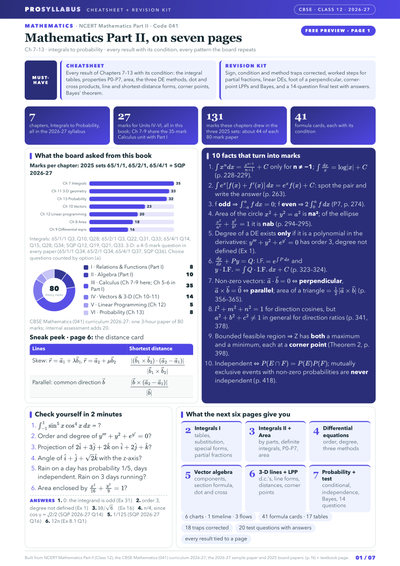
Integrals: 35 marks across the four papers- Marks booster + cheatsheet: key concepts in 2 lines each
- 23 marks in the four papers: Vector Algebra
- Integral tables with properties P0–P7
- 3 methods for differential equations
- 8 marks: Probability, with Bayes' theorem
- Patterns the board repeats, by chapter
CBSE Class 12 · Mathematics
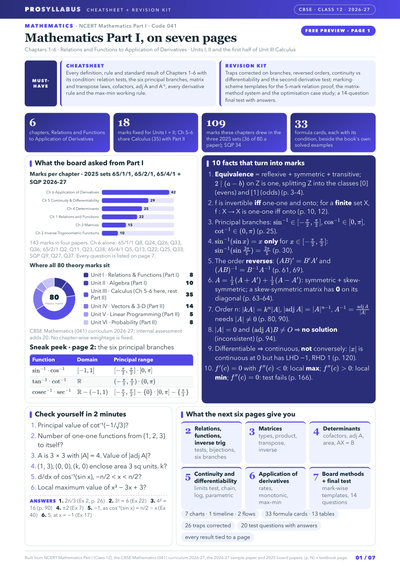
Every Part I question from 2025 + the SQP- Marks booster + cheatsheet: key concepts in 2 lines each, common traps
- 35 marks: Calculus, shared with Part II
- 10 marks: Algebra, Ch 3–4
- Common traps that cost marks, listed
- 6 principal branches of inverse trig
- Every derivative rule with its condition
Summary
This chapter extends coordinate geometry to three dimensions, describing lines and planes vectorially and in Cartesian form. A line is given by \(\vec{r}=\vec{a}+\lambda\vec{b}\), where \(\vec{a}\) is a point on it and \(\vec{b}\) its direction; in Cartesian form this is \(\dfrac{x-x_1}{a}=\dfrac{y-y_1}{b}=\dfrac{z-z_1}{c}\). The angle between two lines comes from the dot product of their direction vectors. A plane is written as \(\vec{r}\cdot\hat{n}=d\), where \(\hat{n}\) is the unit normal, or in Cartesian form \(ax+by+cz=d\). The chapter computes the angle between two planes, between a line and a plane, and the shortest distance between two skew lines. These results give a complete algebraic description of position and orientation in space.