Integrals
Class 12 Mathematics · Mathematics Part II · Chapter 1
163 members in the CBSE community
View all










CBSE Class 12 · Mathematics
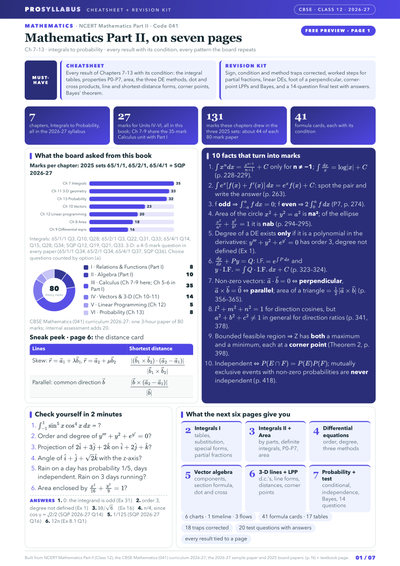
Integrals: 35 marks across the four papers- Marks booster + cheatsheet: key concepts in 2 lines each
- 23 marks in the four papers: Vector Algebra
- Integral tables with properties P0–P7
- 3 methods for differential equations
- 8 marks: Probability, with Bayes' theorem
- Patterns the board repeats, by chapter
CBSE Class 12 · Mathematics
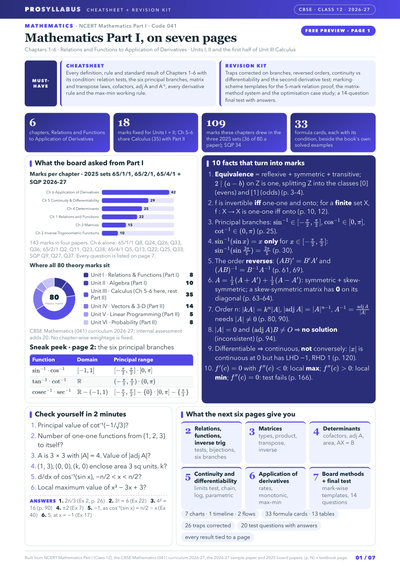
Every Part I question from 2025 + the SQP- Marks booster + cheatsheet: key concepts in 2 lines each, common traps
- 35 marks: Calculus, shared with Part II
- 10 marks: Algebra, Ch 3–4
- Common traps that cost marks, listed
- 6 principal branches of inverse trig
- Every derivative rule with its condition
Summary
Integration is the inverse process of differentiation. The indefinite integral \(\int f(x)\,dx=F(x)+C\) gives the family of antiderivatives of \(f\). This chapter builds a toolkit of methods: integration by substitution, integration using partial fractions, and integration by parts, \(\int u\,dv=uv-\int v\,du\). Standard forms for integrals of trigonometric, exponential and rational functions are tabulated. The definite integral \(\int_a^b f(x)\,dx\) is introduced as a limit of sums and evaluated using the Fundamental Theorem of Calculus, \(\int_a^b f(x)\,dx=F(b)-F(a)\), where \(F'=f\). Properties of definite integrals — additivity over intervals, symmetry over \([-a,a]\), and the king's rule \(\int_a^b f(x)\,dx=\int_a^b f(a+b-x)\,dx\) — simplify many evaluations.