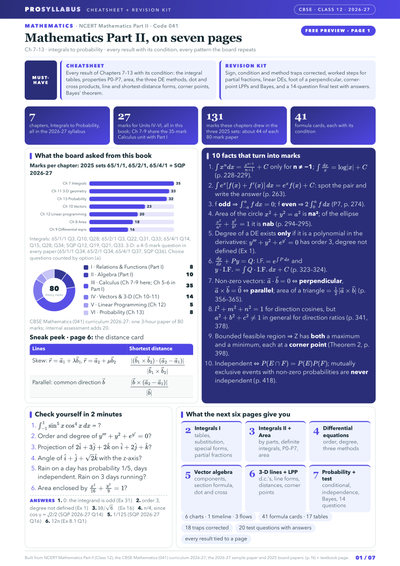
This chapter develops probability beyond simple counting. Conditional probability \(P(A\mid B)=\dfrac{P(A\cap B)}{P(B)}\) measures the chance of \(A\) given that \(B\) has occurred. The multiplication theorem follows: \(P(A\cap B)=P(B)\,P(A\mid B)\). Two events are independent when \(P(A\cap B)=P(A)\,P(B)\). The Theorem of Total Probability sums the contributions of mutually exclusive, exhaustive events, and Bayes' Theorem reverses conditioning to find \(P(E_i\mid A)\) from the prior probabilities and likelihoods. A random variable assigns a number to each outcome; its probability distribution leads to the mean (expectation) \(E(X)=\sum x_iP(x_i)\) and variance. The binomial distribution, modelling \(n\) independent Bernoulli trials with success probability \(p\), gives \(P(X=r)=\binom{n}{r}p^r(1-p)^{n-r}\).
Conditional probabilityMultiplication theorem and independenceTotal probability and Bayes' TheoremRandom variables and expectationBinomial distribution