Vector Algebra
Class 12 Mathematics · Mathematics Part II · Chapter 4
163 members in the CBSE community
View all










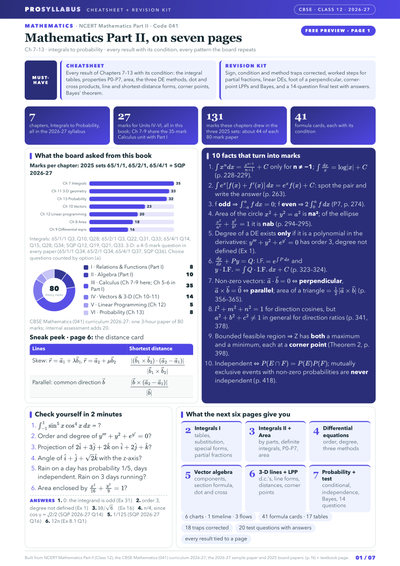
CBSE Class 12 · Mathematics
Integrals: 35 marks across the four papers- Marks booster + cheatsheet: key concepts in 2 lines each
- 23 marks in the four papers: Vector Algebra
- Integral tables with properties P0–P7
- 3 methods for differential equations
- 8 marks: Probability, with Bayes' theorem
- Patterns the board repeats, by chapter
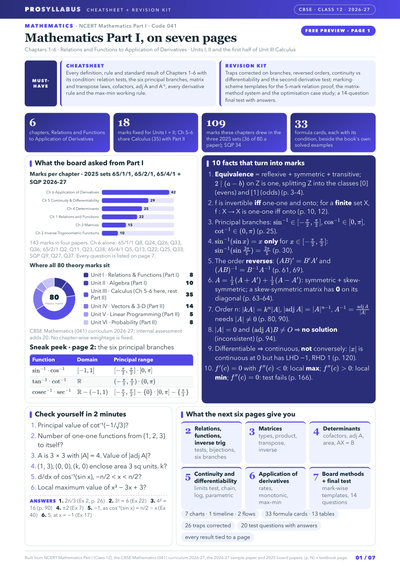
CBSE Class 12 · Mathematics
Every Part I question from 2025 + the SQP- Marks booster + cheatsheet: key concepts in 2 lines each, common traps
- 35 marks: Calculus, shared with Part II
- 10 marks: Algebra, Ch 3–4
- Common traps that cost marks, listed
- 6 principal branches of inverse trig
- Every derivative rule with its condition
Summary
A vector has both magnitude and direction, in contrast to a scalar. This chapter introduces position vectors, direction cosines and direction ratios, and the representation \(\vec{a}=a_1\hat{i}+a_2\hat{j}+a_3\hat{k}\). Vectors are added by the triangle and parallelogram laws and scaled by real numbers. Two products are central: the scalar (dot) product \(\vec{a}\cdot\vec{b}=|\vec{a}||\vec{b}|\cos\theta\), which measures projection and tests perpendicularity, and the vector (cross) product \(\vec{a}\times\vec{b}=|\vec{a}||\vec{b}|\sin\theta\,\hat{n}\), whose magnitude gives the area of the parallelogram spanned by the vectors and whose direction is perpendicular to both. The unit vector \(\hat{a}=\dfrac{\vec{a}}{|\vec{a}|}\) and the section formula are also covered. These tools underpin three-dimensional geometry and physics.