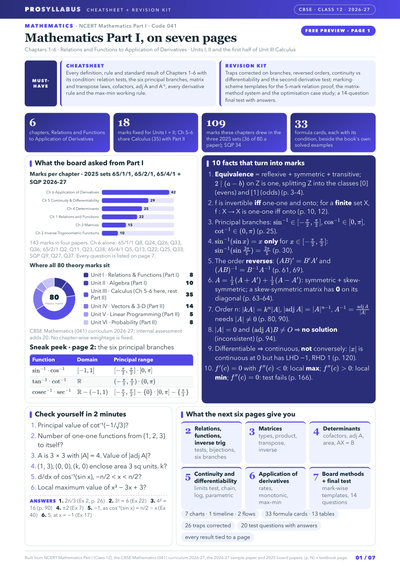
Trigonometric functions are periodic and therefore not one-one over their full domains. To define inverses, each is restricted to a principal-value branch on which it is bijective. The chapter defines \(\sin^{-1}x,\cos^{-1}x,\tan^{-1}x\) and their reciprocals, listing the principal ranges: \(\sin^{-1}x\in[-\tfrac{\pi}{2},\tfrac{\pi}{2}]\), \(\cos^{-1}x\in[0,\pi]\) and \(\tan^{-1}x\in(-\tfrac{\pi}{2},\tfrac{\pi}{2})\). Several identities follow, such as \(\sin^{-1}x+\cos^{-1}x=\tfrac{\pi}{2}\) and \(\tan^{-1}x+\tan^{-1}y=\tan^{-1}\dfrac{x+y}{1-xy}\) (for \(xy<1\)). These functions and identities are essential tools for simplifying expressions, solving equations and integrating, where inverse trig functions appear as antiderivatives.
Principal value branchesInverse sine, cosine and tangentProperties and identitiesSimplification of inverse trig expressions
Key terms
Principal value branch
The restricted interval on which a trig function is bijective so its inverse is defined.
\(\sin^{-1}x\)
Inverse sine, with range \([-\tfrac{\pi}{2},\tfrac{\pi}{2}]\) and domain \([-1,1]\).
\(\cos^{-1}x\)
Inverse cosine, with range \([0,\pi]\) and domain \([-1,1]\).
\(\tan^{-1}x\)
Inverse tangent, with range \((-\tfrac{\pi}{2},\tfrac{\pi}{2})\) and domain \(\mathbb{R}\).
Complementary identity
\(\sin^{-1}x+\cos^{-1}x=\tfrac{\pi}{2}\).
Addition formula
\(\tan^{-1}x+\tan^{-1}y=\tan^{-1}\dfrac{x+y}{1-xy}\) when \(xy<1\).
Extra questions & answers
Try one from this chapter
The principal value range of \(\sin^{-1}x\) is:
Flashcards & interactive practice
Practice quiz · Inverse Trigonometric Functions
Score on this chapter, climb the leaderboard, and get an AI diagnosis of your mistakes.
Double-checked questions Real exam pattern 1 free test every month, then ₹9 per test
#1
Inverse Trigonometric Functions
Start here
Maths 10 Qs · ~10 min
Instant score, answer review and weak-topic diagnosis
Data & insights
Trending in Class 12 this weekThe chapters students are reading most right now