Linear Programming
Class 12 Mathematics · Mathematics Part II · Chapter 6
163 members in the CBSE community
View all










CBSE Class 12 · Mathematics
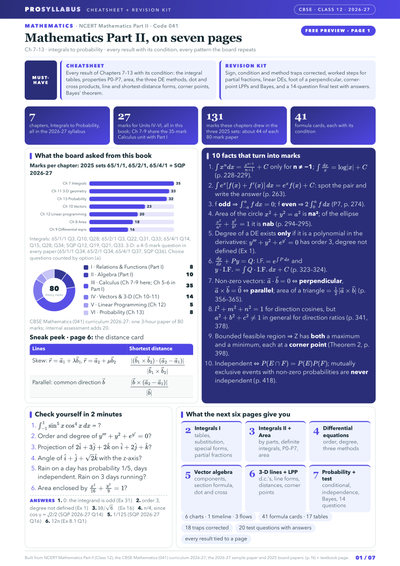
Integrals: 35 marks across the four papers- Marks booster + cheatsheet: key concepts in 2 lines each
- 23 marks in the four papers: Vector Algebra
- Integral tables with properties P0–P7
- 3 methods for differential equations
- 8 marks: Probability, with Bayes' theorem
- Patterns the board repeats, by chapter
CBSE Class 12 · Mathematics
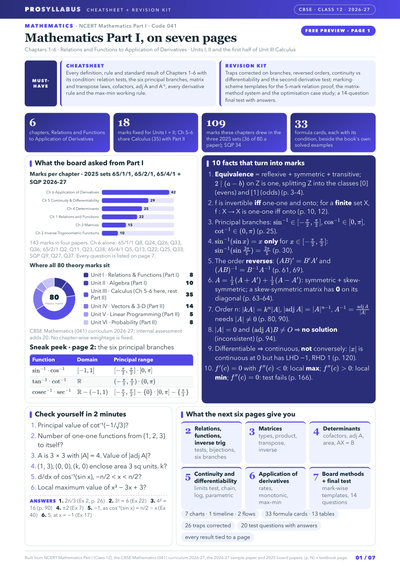
Every Part I question from 2025 + the SQP- Marks booster + cheatsheet: key concepts in 2 lines each, common traps
- 35 marks: Calculus, shared with Part II
- 10 marks: Algebra, Ch 3–4
- Common traps that cost marks, listed
- 6 principal branches of inverse trig
- Every derivative rule with its condition
Summary
Linear programming finds the optimal value of a linear objective function subject to linear constraints. A typical problem maximises or minimises \(Z=ax+by\) subject to inequalities such as \(c_1x+c_2y\leq k\) together with the non-negativity constraints \(x\geq0,\,y\geq0\). The set of points satisfying all constraints is the feasible region, a convex polygon (possibly unbounded). The key result is that an optimal value of \(Z\), when it exists, occurs at a corner (vertex) of the feasible region. The Corner Point Method therefore evaluates \(Z\) at each vertex and selects the largest or smallest value. For a bounded feasible region both a maximum and a minimum exist; for an unbounded region an optimum may fail to exist, which must be checked. The chapter solves such problems graphically in two variables.