Matrices
Class 12 Mathematics · Mathematics Part I · Chapter 3
163 members in the CBSE community
View all









CBSE Class 12 · Mathematics
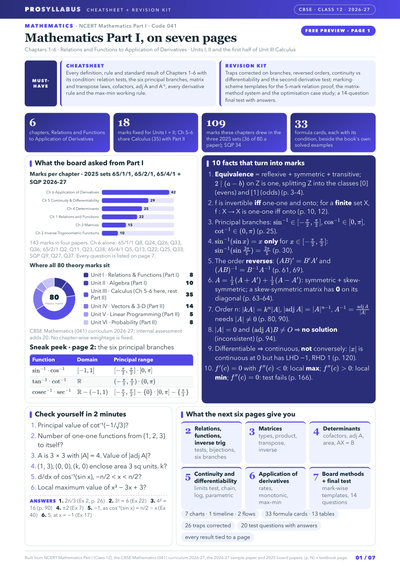
Every Part I question from 2025 + the SQP- Marks booster + cheatsheet: key concepts in 2 lines each, common traps
- 35 marks: Calculus, shared with Part II
- 10 marks: Algebra, Ch 3–4
- Common traps that cost marks, listed
- 6 principal branches of inverse trig
- Every derivative rule with its condition
CBSE Class 12 · Mathematics
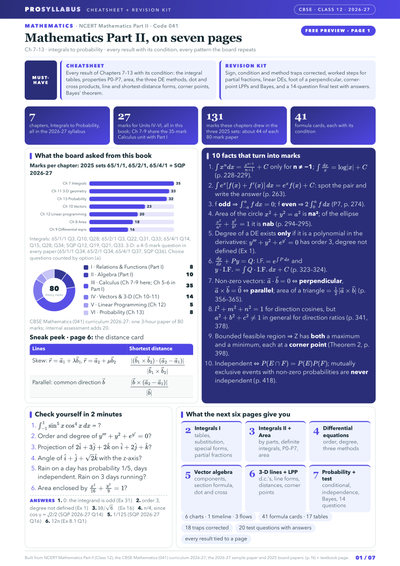
Integrals: 35 marks across the four papers- Marks booster + cheatsheet: key concepts in 2 lines each
- 23 marks in the four papers: Vector Algebra
- Integral tables with properties P0–P7
- 3 methods for differential equations
- 8 marks: Probability, with Bayes' theorem
- Patterns the board repeats, by chapter
Summary
A matrix is a rectangular array of numbers arranged in rows and columns; its order is \(m\times n\). This chapter develops matrix algebra: equality, addition, scalar multiplication and the row-by-column rule for matrix multiplication, where \((AB)_{ij}=\sum_k a_{ik}b_{kj}\). Matrix multiplication is associative and distributive but generally not commutative, so \(AB\neq BA\) in general. Special matrices are studied — diagonal, scalar, identity, symmetric (\(A^T=A\)) and skew-symmetric (\(A^T=-A\)). The transpose operation and its properties, such as \((AB)^T=B^TA^T\), are established. Elementary row and column operations are introduced and used to find the inverse of a matrix. Matrices provide a compact framework for representing and solving systems of linear equations.