Application of Derivatives
Class 12 Mathematics · Mathematics Part I · Chapter 6
163 members in the CBSE community
View all










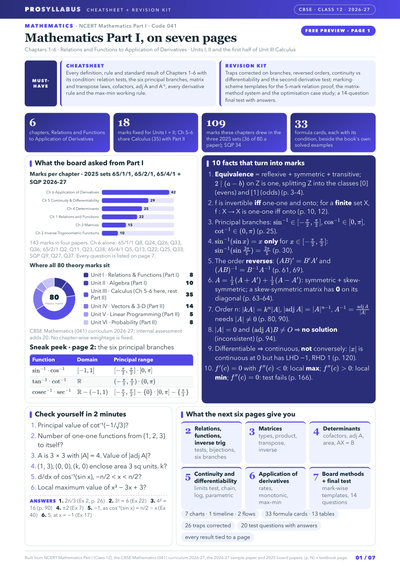
CBSE Class 12 · Mathematics
Every Part I question from 2025 + the SQP- Marks booster + cheatsheet: key concepts in 2 lines each, common traps
- 35 marks: Calculus, shared with Part II
- 10 marks: Algebra, Ch 3–4
- Common traps that cost marks, listed
- 6 principal branches of inverse trig
- Every derivative rule with its condition
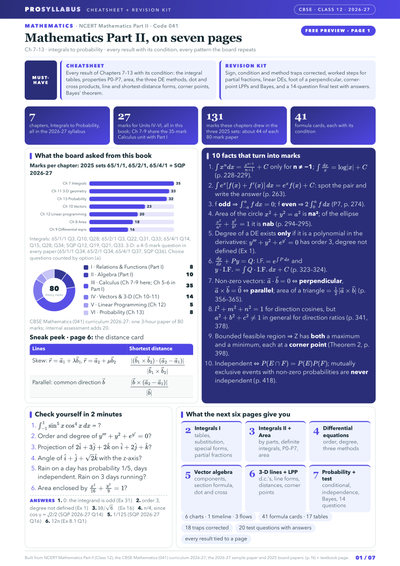
CBSE Class 12 · Mathematics
Integrals: 35 marks across the four papers- Marks booster + cheatsheet: key concepts in 2 lines each
- 23 marks in the four papers: Vector Algebra
- Integral tables with properties P0–P7
- 3 methods for differential equations
- 8 marks: Probability, with Bayes' theorem
- Patterns the board repeats, by chapter
Summary
Derivatives measure rates of change and the local behaviour of functions, and this chapter applies them widely. The derivative as a rate of change links related quantities (for example, how a sphere's volume changes with its radius). A function is increasing where \(f'(x)>0\) and decreasing where \(f'(x)<0\). The derivative also gives the slope of a tangent, so equations of tangents and normals follow at once. Maxima and minima are located using the first-derivative test and the second-derivative test: at a local maximum \(f'(x)=0\) and \(f''(x)<0\), while at a local minimum \(f'(x)=0\) and \(f''(x)>0\). These ideas drive optimisation problems — maximising area, minimising cost or material — that appear throughout applied mathematics.