Determinants
Class 12 Mathematics · Mathematics Part I · Chapter 4
163 members in the CBSE community
View all










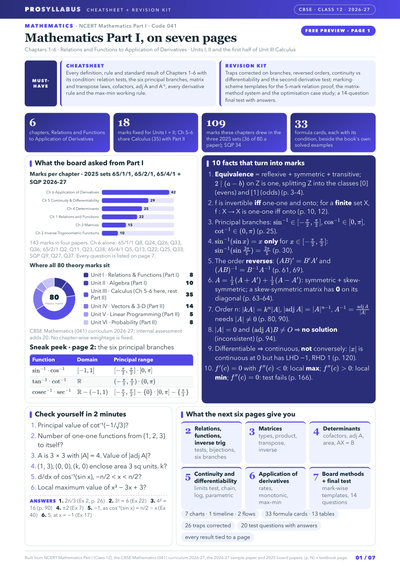
CBSE Class 12 · Mathematics
Every Part I question from 2025 + the SQP- Marks booster + cheatsheet: key concepts in 2 lines each, common traps
- 35 marks: Calculus, shared with Part II
- 10 marks: Algebra, Ch 3–4
- Common traps that cost marks, listed
- 6 principal branches of inverse trig
- Every derivative rule with its condition
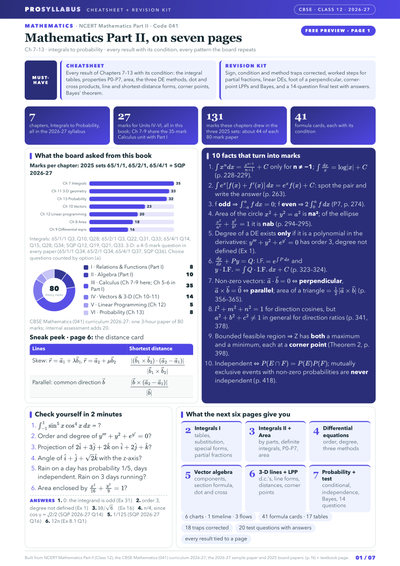
CBSE Class 12 · Mathematics
Integrals: 35 marks across the four papers- Marks booster + cheatsheet: key concepts in 2 lines each
- 23 marks in the four papers: Vector Algebra
- Integral tables with properties P0–P7
- 3 methods for differential equations
- 8 marks: Probability, with Bayes' theorem
- Patterns the board repeats, by chapter
Summary
The determinant is a scalar associated with a square matrix that captures key information about it. For a \(2\times2\) matrix \(\begin{bmatrix}a&b\\c&d\end{bmatrix}\) the determinant is \(ad-bc\); for larger matrices it is computed by expansion along a row or column using minors and cofactors. This chapter covers properties of determinants, the use of determinants to find the area of a triangle, the adjoint (\(\text{adj }A\)) of a matrix, and the inverse via \(A^{-1}=\dfrac{1}{|A|}\,\text{adj }A\), valid when \(|A|\neq0\). A matrix is invertible (non-singular) exactly when its determinant is non-zero. Determinants are then applied to solve systems of linear equations using Cramer's-style matrix methods (\(AX=B\Rightarrow X=A^{-1}B\)), linking algebra to geometry and to consistency of equations.