Relations and Functions
Class 12 Mathematics · Mathematics Part I · Chapter 1
173 members in the CBSE community
View all










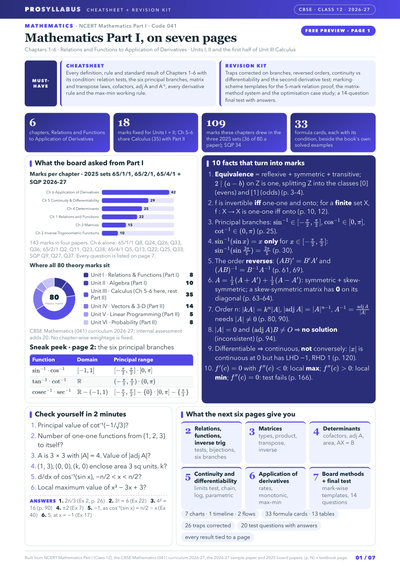
CBSE Class 12 · Mathematics
Every Part I question from 2025 + the SQP- Marks booster + cheatsheet: key concepts in 2 lines each, common traps
- 35 marks: Calculus, shared with Part II
- 10 marks: Algebra, Ch 3–4
- Common traps that cost marks, listed
- 6 principal branches of inverse trig
- Every derivative rule with its condition
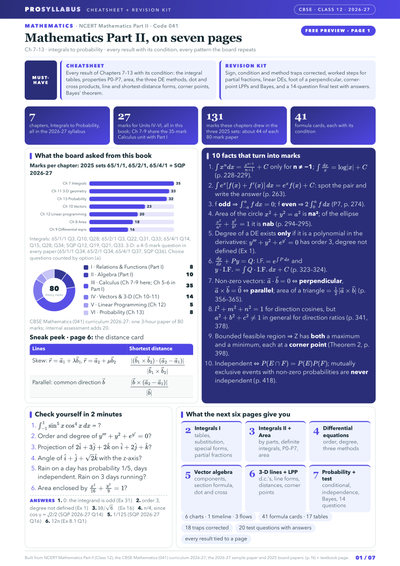
CBSE Class 12 · Mathematics
Integrals: 35 marks across the four papers- Marks booster + cheatsheet: key concepts in 2 lines each
- 23 marks in the four papers: Vector Algebra
- Integral tables with properties P0–P7
- 3 methods for differential equations
- 8 marks: Probability, with Bayes' theorem
- Patterns the board repeats, by chapter
Summary
This chapter deepens the study of relations and functions begun in Class 11. A relation on a set is examined for the properties of being reflexive, symmetric and transitive; a relation that is all three is called an equivalence relation, and it partitions the set into disjoint equivalence classes. The chapter then classifies functions as one-one (injective), onto (surjective) and bijective. A function \(f:A\to B\) is one-one if \(f(x_1)=f(x_2)\Rightarrow x_1=x_2\), and onto if every element of \(B\) is the image of some element of \(A\). Composition of functions \((g\circ f)(x)=g(f(x))\) is introduced, and a bijection is shown to have an inverse \(f^{-1}\) satisfying \(f^{-1}\circ f=I\). These ideas form the backbone for inverse trigonometric functions and for understanding invertibility throughout calculus and algebra.