Probability

Class 12 Mathematics · Mathematics Part II · Chapter 7

173 members in the CBSE community

View all
  • Marks booster + cheatsheet: key concepts in 2 lines each
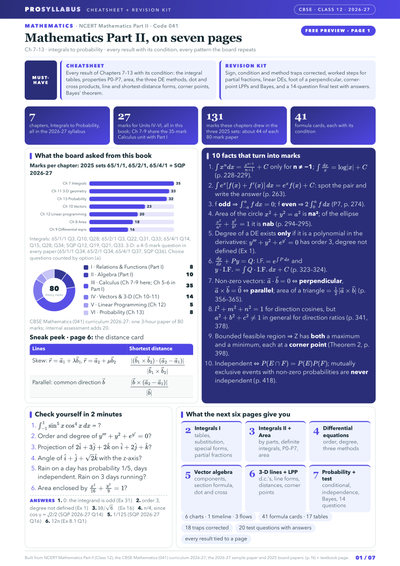
  • 23 marks in the four papers: Vector Algebra
  • Integral tables with properties P0–P7
  • 3 methods for differential equations
  • 8 marks: Probability, with Bayes' theorem
  • Patterns the board repeats, by chapter
Page 1 free about 8 min read, Full kit about 55 min read
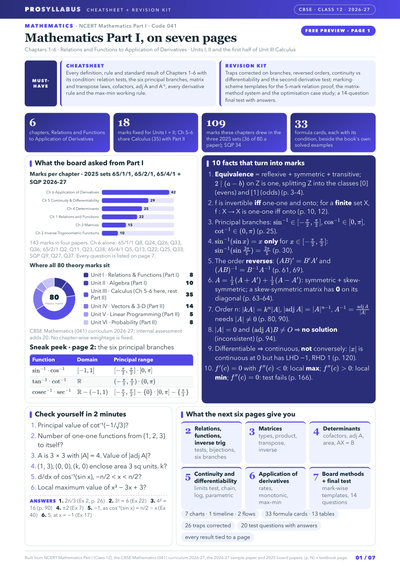
  • Marks booster + cheatsheet: key concepts in 2 lines each, common traps
  • 35 marks: Calculus, shared with Part II
  • 10 marks: Algebra, Ch 3–4
  • Common traps that cost marks, listed
  • 6 principal branches of inverse trig
  • Every derivative rule with its condition
Page 1 free about 8 min read, Full kit about 55 min read
View all 46 amazing Marks Booster kits →

Summary

This chapter develops probability beyond simple counting. Conditional probability \(P(A\mid B)=\dfrac{P(A\cap B)}{P(B)}\) measures the chance of \(A\) given that \(B\) has occurred. The multiplication theorem follows: \(P(A\cap B)=P(B)\,P(A\mid B)\). Two events are independent when \(P(A\cap B)=P(A)\,P(B)\). The Theorem of Total Probability sums the contributions of mutually exclusive, exhaustive events, and Bayes' Theorem reverses conditioning to find \(P(E_i\mid A)\) from the prior probabilities and likelihoods. A random variable assigns a number to each outcome; its probability distribution leads to the mean (expectation) \(E(X)=\sum x_iP(x_i)\) and variance. The binomial distribution, modelling \(n\) independent Bernoulli trials with success probability \(p\), gives \(P(X=r)=\binom{n}{r}p^r(1-p)^{n-r}\).

Conditional probabilityMultiplication theorem and independenceTotal probability and Bayes' TheoremRandom variables and expectationBinomial distribution

Key terms

Conditional probability
\(P(A\mid B)=\dfrac{P(A\cap B)}{P(B)}\), \(P(B)\neq0\).
Independent events
Events with \(P(A\cap B)=P(A)P(B)\).
Total probability
Summing \(P(E_i)P(A\mid E_i)\) over exhaustive events.
Bayes' Theorem
Reverses conditioning to find \(P(E_i\mid A)\).
Random variable
A function assigning a real number to each outcome.
Binomial distribution
\(P(X=r)=\binom{n}{r}p^r(1-p)^{n-r}\).

Extra questions & answers

Try one from this chapter
Conditional probability \(P(A\mid B)\) equals:
Flashcards & interactive practice

Practice quiz · Probability

Score on this chapter, climb the leaderboard, and get an AI diagnosis of your mistakes.

Double-checked questions Real exam pattern 1 free test every month, then ₹9 per test

#1

Probability

Start here
Maths 10 Qs · ~10 min

Instant score, answer review and weak-topic diagnosis

Data & insights

Trending in Class 12 this monthThe chapters students are reading most right now
  1. 1IndigoEnglish
  2. 2The InterviewEnglish
  3. 3Deep WaterEnglish
See the full ranking