शब्दरूपाणि (परिशिष्टम् २)
Class 8 Sanskrit · दीपकम् · Chapter 15
173 members in the CBSE community
View all












CBSE Class 8 · Mathematics
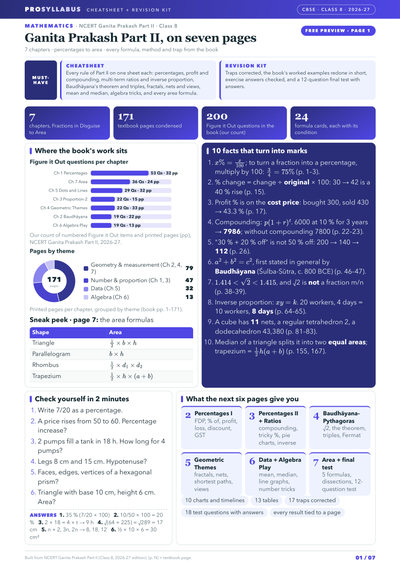
Percentages to area: 7 chapters of rules- Marks booster + cheatsheet: key concepts in 2 lines each, common traps
- Profit, loss and GST, Ch 1
- Baudhāyana's theorem and triples, Ch 2
- Common traps that cost marks, listed
- Inverse proportion, Ch 3
- Fractals, nets and views, Ch 4
CBSE Class 8 · ScienceTrending
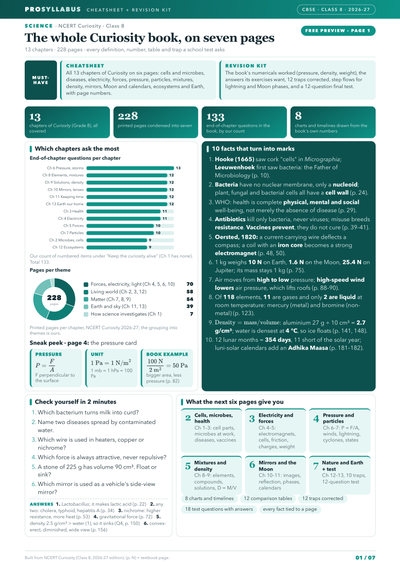
13 chapters: cells to Our Home: Earth- Marks booster + cheatsheet: key concepts in 2 lines each, common traps
- Cells and microbes, Ch 2
- Magnetic and heating effects, Ch 4
- Common traps, corrected
- Pressure, winds and cyclones, Ch 6
- Mirrors and lenses, Ch 10
CBSE Class 8 · Mathematics
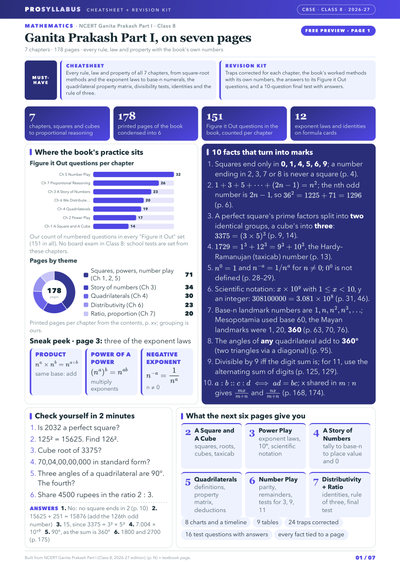
7 chapters: square roots to rule of three- Marks booster + cheatsheet: key concepts in 2 lines each
- Exponent laws, Ch 2
- Quadrilateral property matrix, Ch 4
- Divisibility tests, Ch 5
- Base-n numerals, Ch 3
- Identities by distributivity, Ch 6
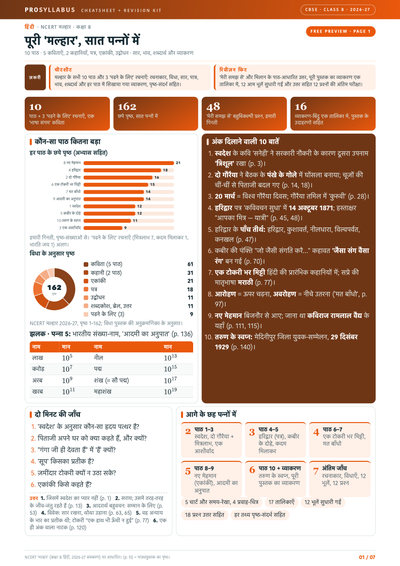
CBSE Class 8 · हिंदी
All 10 मल्हार lessons + 3 extra readings- Marks booster + cheatsheet: key concepts in 2 lines each
- Author, form and summary for every पाठ
- 5 कविताएँ and 2 कहानियाँ, each with its भाव
- Every भाषा-बिंदु the book teaches, together
- रचनाकार table for the whole book
- 12 भूलें students make, corrected
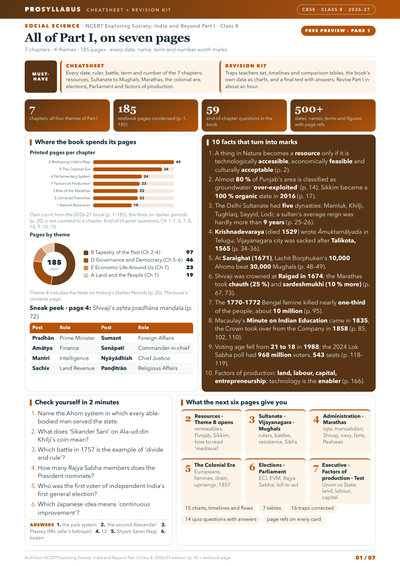
CBSE Class 8 · Social ScienceTrending
7 chapters: Sultanate to Parliament- Marks booster + cheatsheet: key concepts in 2 lines each
- Sultanate, Vijayanagara and Mughals, Ch 2
- Rise of the Marathas, Ch 3
- Colonial era: famines, the drain, 1857
- Universal franchise and elections, Ch 5
- Factors of production, Ch 7
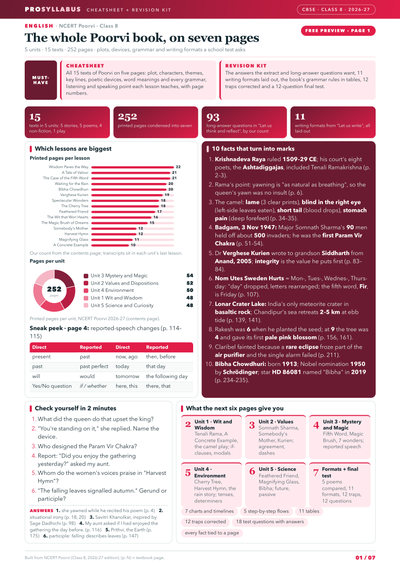
CBSE Class 8 · English
All 15 Poorvi texts across 5 units- Marks booster + cheatsheet: key concepts in 2 lines each
- 12 exam traps, listed
- Plot, characters and themes for each text
- 5 poems compared side by side
- 11 writing formats in one place
- Grammar point of each lesson, page-numbered
The story in short
यह परिशिष्ट कक्षा 8 के लिए आवश्यक शब्दरूपों (विभक्ति-रूपों) का संग्रह है। इसमें विभिन्न लिंगों और अन्तों के संज्ञा-शब्दों के सातों विभक्तियों एवं तीनों वचनों में रूप दिए गए हैं — जैसे इकारान्त नपुंसक "दधि" और "वारि", उकारान्त नपुंसक "मधु", तकारान्त पुंलिंग "मरुत्", नकारान्त पुंलिंग "राजन्" और "आत्मन्", सकारान्त पुंलिंग "विद्वस्", तथा शतृ-प्रत्ययान्त "गच्छत्/गच्छन्ती"। इसके बाद सर्वनाम-शब्दरूप दिए गए हैं — सम्मानार्थक "भवत्/भवती", सापेक्ष "यद्" (तीनों लिंगों में) और "इदम्" (तीनों लिंगों में)। फिर विशेषण "कीदृश" तथा संख्यावाचक शब्द — एक (नित्य एकवचन), द्वि (नित्य द्विवचन), त्रि और चतुर् (नित्य बहुवचन, तीनों लिंगों में) के रूप दिए गए हैं। ये शब्दरूप संस्कृत-वाक्य-रचना और अनुवाद के लिए आधारभूत हैं; इन्हें कण्ठस्थ करना विद्यार्थी के लिए अत्यन्त उपयोगी है। (तालिकाओं के लिए NCERT पाठ्यपुस्तक में दिए चित्र/तालिकाएँ देखें।)