Transport and Communication
Class 12 Geography · Fundamentals of Human Geography · Chapter 7
173 members in the CBSE community
View all











CBSE Class 12 · Geography
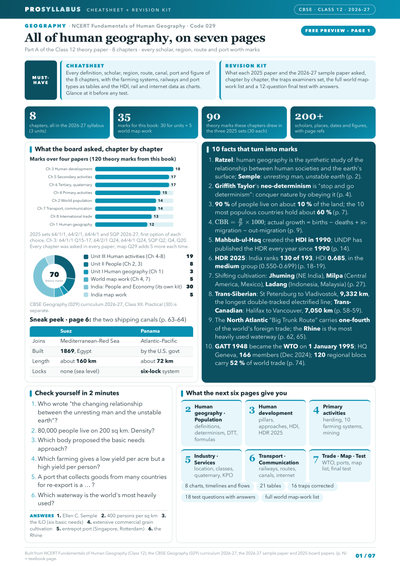
Human Development: 18 of 120 marks asked- Marks booster + cheatsheet: key concepts in 2 lines each
- 17 of 120 marks each: industry, services
- 15 of 120 marks: Primary Activities
- 14 of 120 marks: Transport
- 5 marks: world map work
- HDI, rail and internet data as charts
CBSE Class 12 · Geography
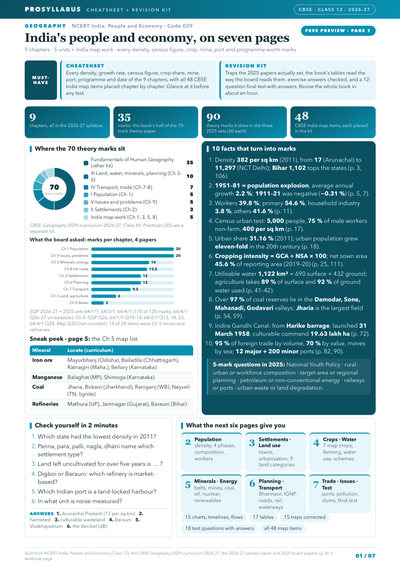
All 48 CBSE India map items, by chapter- Marks booster + cheatsheet: key concepts in 2 lines each, common traps
- 20 board marks in 4 papers: Population
- 14 board marks: Minerals and Energy
- 13 of the 28 map items asked: minerals
- 10 marks: Unit III, Ch 3–6
- Common traps, corrected
CBSE Class 12 · Geography
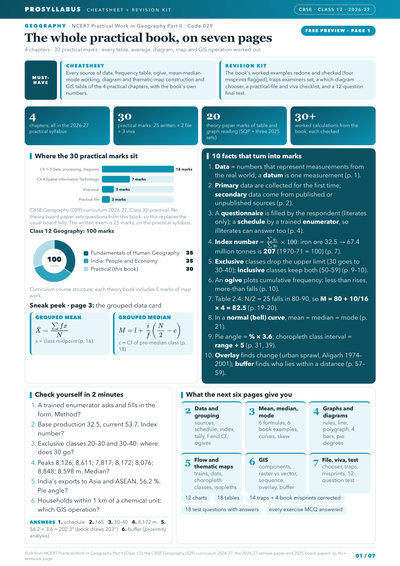
30 practical marks: where each one sits- Marks booster + cheatsheet: key concepts in 2 lines each, common traps
- 18 marks: Ch 1–3, data and diagrams
- 7 marks: GIS, Ch 4
- Common traps that cost marks, listed
- 5 marks: file and viva
- Mean, median and mode, fully worked
Summary
Transport, communication and trade link producing centres with consuming centres, and transport provides the network of carriers through which trade takes place. The principal modes are land, water, air and pipelines; their significance depends on the type of goods, cost and availability. Road transport is economical for short, door-to-door movement, but quality varies greatly between developed and developing countries; highways connect distant places, as with India's Golden Quadrilateral, while border roads serve remote and strategic areas. Railways suit bulky goods over long distances within a country, and great trans-continental railways such as the Trans-Siberian, Trans-Canadian, Union and Pacific, Australian Trans-Continental and the Orient Express opened up continental interiors. Water transport is cheap because it needs no route construction; major sea routes include the busy Northern Atlantic (Big Trunk) route, the Mediterranean-Indian Ocean route (shortened by the Suez Canal), the Cape of Good Hope route, and the North and South Pacific routes, while the Suez and Panama Canals are vital man-made waterways. Inland waterways such as the Rhine, Danube, Volga, Great Lakes-St Lawrence Seaway and Mississippi carry heavy cargo. Air transport is the fastest but costly, with dense routes in the Northern Hemisphere. Pipelines carry liquids and gases like the Big Inch. Communication has advanced from the telegraph and telephone to optic-fibre cables, satellite communication and the internet or cyberspace, making the global village a reality.