Human Settlements
Class 12 Geography · India People and Economy · Chapter 2
CBSE Class 12 Board Examination community
View all

 3
3
 8
8- Mathematics
- Physics
- + 3 more
 9
9- Accountancy
- Business Studies
- + 3 more
- Space weighted by unit marks
- Charts from the book's own data
- Traps corrected
- Space weighted by unit marks
- Charts from the book's own data
- Traps corrected
- Space weighted by unit marks
- Charts from the book's own data
- Traps corrected
 3
3
 2
2
 2
2
 2
2
 2
2
 2
2
 2
2
 2
2
 2
2 2
2
 2
2
 2
2- Space weighted by unit marks
- Charts from the book's own data
- Traps corrected
- Space weighted by unit marks
- Charts from the book's own data
- Traps corrected
- Space weighted by unit marks
- Charts from the book's own data
- Traps corrected
- Space weighted by unit marks
- Charts from the book's own data
- Traps corrected
- Space weighted by unit marks
- Charts from the book's own data
- Traps corrected
- Space weighted by unit marks
- Charts from the book's own data
- Traps corrected
- Space weighted by unit marks
- Charts from the book's own data
- Traps corrected
- Space weighted by unit marks
- Charts from the book's own data
- Traps corrected
- Space weighted by unit marks
- Charts from the book's own data
- Traps corrected
- Space weighted by unit marks
- Charts from the book's own data
- Traps corrected
- Space weighted by unit marks
- Charts from the book's own data
- Traps corrected
- Space weighted by unit marks
- Charts from the book's own data
- Traps corrected
- Space weighted by unit marks
- Charts from the book's own data
- Traps corrected
- Space weighted by unit marks
- Charts from the book's own data
- Traps corrected
- Space weighted by unit marks
- Charts from the book's own data
- Traps corrected
- Space weighted by unit marks
- Charts from the book's own data
- Traps corrected
- Space weighted by unit marks
- Charts from the book's own data
- Traps corrected
- Space weighted by unit marks
- Charts from the book's own data
- Traps corrected
- Space weighted by unit marks
- Charts from the book's own data
- Traps corrected
- Space weighted by unit marks
- Charts from the book's own data
- Traps corrected
- Space weighted by unit marks
- Charts from the book's own data
- Traps corrected
- Space weighted by unit marks
- Charts from the book's own data
- Traps corrected
- Space weighted by unit marks
- Charts from the book's own data
- Traps corrected
- Space weighted by unit marks
- Charts from the book's own data
- Traps corrected
- Space weighted by unit marks
- Charts from the book's own data
- Traps corrected
- Space weighted by unit marks
- Charts from the book's own data
- Traps corrected
- Space weighted by unit marks
- Charts from the book's own data
- Traps corrected
- Space weighted by unit marks
- Charts from the book's own data
- Traps corrected
- Space weighted by unit marks
- Charts from the book's own data
- Traps corrected
- Space weighted by unit marks
- Charts from the book's own data
- Traps corrected
- Space weighted by unit marks
- Charts from the book's own data
- Traps corrected
- Space weighted by unit marks
- Charts from the book's own data
- Traps corrected
- Space weighted by unit marks
- Charts from the book's own data
- Traps corrected
- Space weighted by unit marks
- Charts from the book's own data
- Traps corrected
- Space weighted by unit marks
- Charts from the book's own data
- Traps corrected
- Space weighted by unit marks
- Charts from the book's own data
- Traps corrected
- Space weighted by unit marks
- Charts from the book's own data
- Traps corrected
- Space weighted by unit marks
- Charts from the book's own data
- Traps corrected
- Space weighted by unit marks
- Charts from the book's own data
- Traps corrected
- Space weighted by unit marks
- Charts from the book's own data
- Traps corrected
- Space weighted by unit marks
- Charts from the book's own data
- Traps corrected
- Space weighted by unit marks
- Charts from the book's own data
- Traps corrected
- Space weighted by unit marks
- Charts from the book's own data
- Traps corrected
Summary
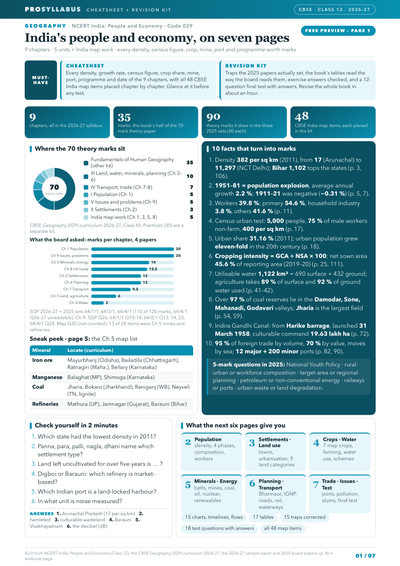
A human settlement is a cluster of dwellings of any type or size where people live, involving the grouping of people and the apportioning of territory as their economic support base. Settlements range from a hamlet to a metropolis and are broadly rural or urban. Rural settlements draw their living from land-based primary activities and have intimate, less mobile social relations, while urban settlements depend on processing, manufacturing and services and have complex, formal and fast social relations; cities act as nodes of economic growth serving their rural hinterlands through transport and communication. Rural settlements in India are of four types — clustered or nucleated, semi-clustered or fragmented, hamleted, and dispersed or isolated — shaped by physical features, cultural and ethnic factors, and security. The Census defines an urban settlement by its administrative status, a minimum population of 5,000, at least 75 per cent of male workers in non-agricultural pursuits, and a density of at least 400 persons per square kilometre. Indian towns are classified by their period of evolution as ancient (Varanasi, Prayag, Patna), medieval (Delhi, Hyderabad, Jaipur) and modern (Mumbai, Chennai, Kolkata, and post-independence administrative and industrial towns). The level of urbanisation in 2011 was 31.16 per cent. Functionally, towns are classified as administrative, industrial, transport, commercial, mining, garrison, educational, religious and cultural, and tourist towns, though most large cities eventually become multifunctional.