Mineral and Energy Resources
Class 12 Geography · India People and Economy · Chapter 5
CBSE Class 12 Board Examination community
View all

 3
3
 8
8- Mathematics
- Physics
- + 3 more
 9
9- Accountancy
- Business Studies
- + 3 more
- Space weighted by unit marks
- Charts from the book's own data
- Traps corrected
- Space weighted by unit marks
- Charts from the book's own data
- Traps corrected
- Space weighted by unit marks
- Charts from the book's own data
- Traps corrected
 3
3
 2
2
 2
2
 2
2
 2
2
 2
2
 2
2
 2
2
 2
2 2
2
 2
2
 2
2- Space weighted by unit marks
- Charts from the book's own data
- Traps corrected
- Space weighted by unit marks
- Charts from the book's own data
- Traps corrected
- Space weighted by unit marks
- Charts from the book's own data
- Traps corrected
- Space weighted by unit marks
- Charts from the book's own data
- Traps corrected
- Space weighted by unit marks
- Charts from the book's own data
- Traps corrected
- Space weighted by unit marks
- Charts from the book's own data
- Traps corrected
- Space weighted by unit marks
- Charts from the book's own data
- Traps corrected
- Space weighted by unit marks
- Charts from the book's own data
- Traps corrected
- Space weighted by unit marks
- Charts from the book's own data
- Traps corrected
- Space weighted by unit marks
- Charts from the book's own data
- Traps corrected
- Space weighted by unit marks
- Charts from the book's own data
- Traps corrected
- Space weighted by unit marks
- Charts from the book's own data
- Traps corrected
- Space weighted by unit marks
- Charts from the book's own data
- Traps corrected
- Space weighted by unit marks
- Charts from the book's own data
- Traps corrected
- Space weighted by unit marks
- Charts from the book's own data
- Traps corrected
- Space weighted by unit marks
- Charts from the book's own data
- Traps corrected
- Space weighted by unit marks
- Charts from the book's own data
- Traps corrected
- Space weighted by unit marks
- Charts from the book's own data
- Traps corrected
- Space weighted by unit marks
- Charts from the book's own data
- Traps corrected
- Space weighted by unit marks
- Charts from the book's own data
- Traps corrected
- Space weighted by unit marks
- Charts from the book's own data
- Traps corrected
- Space weighted by unit marks
- Charts from the book's own data
- Traps corrected
- Space weighted by unit marks
- Charts from the book's own data
- Traps corrected
- Space weighted by unit marks
- Charts from the book's own data
- Traps corrected
- Space weighted by unit marks
- Charts from the book's own data
- Traps corrected
- Space weighted by unit marks
- Charts from the book's own data
- Traps corrected
- Space weighted by unit marks
- Charts from the book's own data
- Traps corrected
- Space weighted by unit marks
- Charts from the book's own data
- Traps corrected
- Space weighted by unit marks
- Charts from the book's own data
- Traps corrected
- Space weighted by unit marks
- Charts from the book's own data
- Traps corrected
- Space weighted by unit marks
- Charts from the book's own data
- Traps corrected
- Space weighted by unit marks
- Charts from the book's own data
- Traps corrected
- Space weighted by unit marks
- Charts from the book's own data
- Traps corrected
- Space weighted by unit marks
- Charts from the book's own data
- Traps corrected
- Space weighted by unit marks
- Charts from the book's own data
- Traps corrected
- Space weighted by unit marks
- Charts from the book's own data
- Traps corrected
- Space weighted by unit marks
- Charts from the book's own data
- Traps corrected
- Space weighted by unit marks
- Charts from the book's own data
- Traps corrected
- Space weighted by unit marks
- Charts from the book's own data
- Traps corrected
- Space weighted by unit marks
- Charts from the book's own data
- Traps corrected
- Space weighted by unit marks
- Charts from the book's own data
- Traps corrected
- Space weighted by unit marks
- Charts from the book's own data
- Traps corrected
- Space weighted by unit marks
- Charts from the book's own data
- Traps corrected
Summary
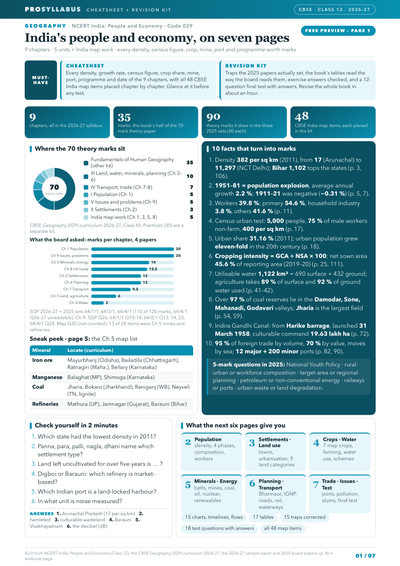
India has a rich variety of mineral resources because of its varied geological structure, with valuable minerals mostly in the metamorphic and igneous rocks of the peninsular plateau, while the alluvial northern plains lack minerals of economic use. A mineral is a natural substance with definite chemical and physical properties; minerals are grouped as metallic (ferrous and non-ferrous) and non-metallic (organic mineral fuels and inorganic minerals like mica and limestone). Minerals are unevenly distributed, show an inverse relation between quality and quantity, and are exhaustible, so they must be conserved. They are concentrated in three broad belts — the north-eastern plateau (Chhotanagpur, Odisha), the south-western plateau (Karnataka, Goa), and the north-western region (Aravali in Rajasthan and Gujarat). Ferrous minerals include iron ore (haematite and magnetite, mainly in Odisha, Jharkhand, Chhattisgarh and Karnataka) and manganese; non-ferrous minerals include bauxite (for aluminium) and copper; non-metallic minerals include mica. Energy resources are conventional (coal, petroleum, natural gas, nuclear) or non-conventional (solar, wind, tidal, geothermal and bio-energy). Coal occurs in Gondwana and tertiary deposits, petroleum is the liquid gold found in Assam, Gujarat and Mumbai High, and natural gas accompanies petroleum. Nuclear energy uses uranium and thorium, while non-conventional, renewable and eco-friendly sources are vital for sustainable development, and minerals must be conserved through recycling and substitutes.