Land Resources and Agriculture
Class 12 Geography · India People and Economy · Chapter 3
CBSE Class 12 Board Examination community
View all

 3
3
 8
8- Mathematics
- Physics
- + 3 more
 9
9- Accountancy
- Business Studies
- + 3 more
- Space weighted by unit marks
- Charts from the book's own data
- Traps corrected
- Space weighted by unit marks
- Charts from the book's own data
- Traps corrected
- Space weighted by unit marks
- Charts from the book's own data
- Traps corrected
 3
3
 2
2
 2
2
 2
2
 2
2
 2
2
 2
2
 2
2
 2
2 2
2
 2
2
 2
2- Space weighted by unit marks
- Charts from the book's own data
- Traps corrected
- Space weighted by unit marks
- Charts from the book's own data
- Traps corrected
- Space weighted by unit marks
- Charts from the book's own data
- Traps corrected
- Space weighted by unit marks
- Charts from the book's own data
- Traps corrected
- Space weighted by unit marks
- Charts from the book's own data
- Traps corrected
- Space weighted by unit marks
- Charts from the book's own data
- Traps corrected
- Space weighted by unit marks
- Charts from the book's own data
- Traps corrected
- Space weighted by unit marks
- Charts from the book's own data
- Traps corrected
- Space weighted by unit marks
- Charts from the book's own data
- Traps corrected
- Space weighted by unit marks
- Charts from the book's own data
- Traps corrected
- Space weighted by unit marks
- Charts from the book's own data
- Traps corrected
- Space weighted by unit marks
- Charts from the book's own data
- Traps corrected
- Space weighted by unit marks
- Charts from the book's own data
- Traps corrected
- Space weighted by unit marks
- Charts from the book's own data
- Traps corrected
- Space weighted by unit marks
- Charts from the book's own data
- Traps corrected
- Space weighted by unit marks
- Charts from the book's own data
- Traps corrected
- Space weighted by unit marks
- Charts from the book's own data
- Traps corrected
- Space weighted by unit marks
- Charts from the book's own data
- Traps corrected
- Space weighted by unit marks
- Charts from the book's own data
- Traps corrected
- Space weighted by unit marks
- Charts from the book's own data
- Traps corrected
- Space weighted by unit marks
- Charts from the book's own data
- Traps corrected
- Space weighted by unit marks
- Charts from the book's own data
- Traps corrected
- Space weighted by unit marks
- Charts from the book's own data
- Traps corrected
- Space weighted by unit marks
- Charts from the book's own data
- Traps corrected
- Space weighted by unit marks
- Charts from the book's own data
- Traps corrected
- Space weighted by unit marks
- Charts from the book's own data
- Traps corrected
- Space weighted by unit marks
- Charts from the book's own data
- Traps corrected
- Space weighted by unit marks
- Charts from the book's own data
- Traps corrected
- Space weighted by unit marks
- Charts from the book's own data
- Traps corrected
- Space weighted by unit marks
- Charts from the book's own data
- Traps corrected
- Space weighted by unit marks
- Charts from the book's own data
- Traps corrected
- Space weighted by unit marks
- Charts from the book's own data
- Traps corrected
- Space weighted by unit marks
- Charts from the book's own data
- Traps corrected
- Space weighted by unit marks
- Charts from the book's own data
- Traps corrected
- Space weighted by unit marks
- Charts from the book's own data
- Traps corrected
- Space weighted by unit marks
- Charts from the book's own data
- Traps corrected
- Space weighted by unit marks
- Charts from the book's own data
- Traps corrected
- Space weighted by unit marks
- Charts from the book's own data
- Traps corrected
- Space weighted by unit marks
- Charts from the book's own data
- Traps corrected
- Space weighted by unit marks
- Charts from the book's own data
- Traps corrected
- Space weighted by unit marks
- Charts from the book's own data
- Traps corrected
- Space weighted by unit marks
- Charts from the book's own data
- Traps corrected
- Space weighted by unit marks
- Charts from the book's own data
- Traps corrected
Summary
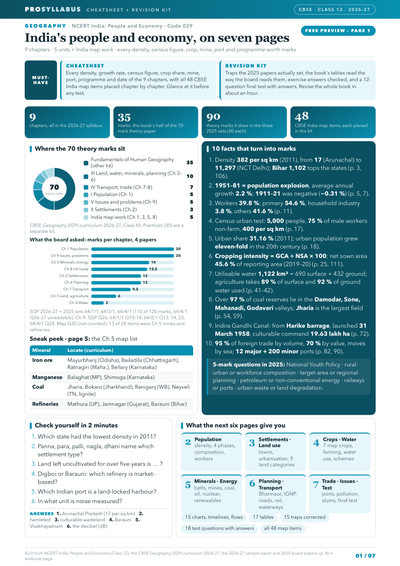
Land is used for production, residence and recreation, and land-use records maintained by the land revenue department classify land into categories such as forests, barren and wastelands, land put to non-agricultural uses, permanent pastures, miscellaneous tree crops, culturable wasteland, current and other fallow, and net area sown. Land-use changes as the economy grows, its composition shifts towards secondary and tertiary sectors, and pressure on agricultural land continues. Common property resources, owned by the state for community use, provide fodder, fuel and minor forest products vital to the poor. Total cultivable land is found by adding net sown area, fallow lands and culturable wasteland, and cropping intensity (gross cropped area over net sown area) is raised to use scarce land better. India has three cropping seasons — kharif, rabi and zaid — and farming is irrigated or rainfed (dryland and wetland). Foodgrains occupy about two-thirds of cropped area: cereals include rice, wheat, jowar, bajra and maize, while pulses include gram and tur. Oilseeds (groundnut, rapeseed and mustard, soyabean, sunflower), fibre crops (cotton and jute) and other crops (sugarcane, tea, coffee) are also important. After independence, agricultural strategy moved from food shortage to the Green Revolution using HYV seeds, irrigation, fertilisers and pesticides. Indian agriculture faces problems such as dependence on erratic monsoon, low productivity, indebtedness, lack of land reforms, small fragmented holdings, lack of commercialisation, underemployment and land degradation.