Water Resources
Class 12 Geography · India People and Economy · Chapter 4
CBSE Class 12 Board Examination community
View all

 3
3
 8
8- Mathematics
- Physics
- + 3 more
 9
9- Accountancy
- Business Studies
- + 3 more
- Space weighted by unit marks
- Charts from the book's own data
- Traps corrected
- Space weighted by unit marks
- Charts from the book's own data
- Traps corrected
- Space weighted by unit marks
- Charts from the book's own data
- Traps corrected
 3
3
 2
2
 2
2
 2
2
 2
2
 2
2
 2
2
 2
2
 2
2 2
2
 2
2
 2
2- Space weighted by unit marks
- Charts from the book's own data
- Traps corrected
- Space weighted by unit marks
- Charts from the book's own data
- Traps corrected
- Space weighted by unit marks
- Charts from the book's own data
- Traps corrected
- Space weighted by unit marks
- Charts from the book's own data
- Traps corrected
- Space weighted by unit marks
- Charts from the book's own data
- Traps corrected
- Space weighted by unit marks
- Charts from the book's own data
- Traps corrected
- Space weighted by unit marks
- Charts from the book's own data
- Traps corrected
- Space weighted by unit marks
- Charts from the book's own data
- Traps corrected
- Space weighted by unit marks
- Charts from the book's own data
- Traps corrected
- Space weighted by unit marks
- Charts from the book's own data
- Traps corrected
- Space weighted by unit marks
- Charts from the book's own data
- Traps corrected
- Space weighted by unit marks
- Charts from the book's own data
- Traps corrected
- Space weighted by unit marks
- Charts from the book's own data
- Traps corrected
- Space weighted by unit marks
- Charts from the book's own data
- Traps corrected
- Space weighted by unit marks
- Charts from the book's own data
- Traps corrected
- Space weighted by unit marks
- Charts from the book's own data
- Traps corrected
- Space weighted by unit marks
- Charts from the book's own data
- Traps corrected
- Space weighted by unit marks
- Charts from the book's own data
- Traps corrected
- Space weighted by unit marks
- Charts from the book's own data
- Traps corrected
- Space weighted by unit marks
- Charts from the book's own data
- Traps corrected
- Space weighted by unit marks
- Charts from the book's own data
- Traps corrected
- Space weighted by unit marks
- Charts from the book's own data
- Traps corrected
- Space weighted by unit marks
- Charts from the book's own data
- Traps corrected
- Space weighted by unit marks
- Charts from the book's own data
- Traps corrected
- Space weighted by unit marks
- Charts from the book's own data
- Traps corrected
- Space weighted by unit marks
- Charts from the book's own data
- Traps corrected
- Space weighted by unit marks
- Charts from the book's own data
- Traps corrected
- Space weighted by unit marks
- Charts from the book's own data
- Traps corrected
- Space weighted by unit marks
- Charts from the book's own data
- Traps corrected
- Space weighted by unit marks
- Charts from the book's own data
- Traps corrected
- Space weighted by unit marks
- Charts from the book's own data
- Traps corrected
- Space weighted by unit marks
- Charts from the book's own data
- Traps corrected
- Space weighted by unit marks
- Charts from the book's own data
- Traps corrected
- Space weighted by unit marks
- Charts from the book's own data
- Traps corrected
- Space weighted by unit marks
- Charts from the book's own data
- Traps corrected
- Space weighted by unit marks
- Charts from the book's own data
- Traps corrected
- Space weighted by unit marks
- Charts from the book's own data
- Traps corrected
- Space weighted by unit marks
- Charts from the book's own data
- Traps corrected
- Space weighted by unit marks
- Charts from the book's own data
- Traps corrected
- Space weighted by unit marks
- Charts from the book's own data
- Traps corrected
- Space weighted by unit marks
- Charts from the book's own data
- Traps corrected
- Space weighted by unit marks
- Charts from the book's own data
- Traps corrected
- Space weighted by unit marks
- Charts from the book's own data
- Traps corrected
Summary
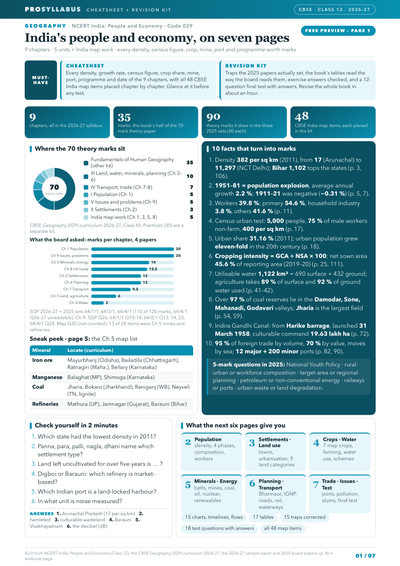
Water is a cyclic resource that covers about 71 per cent of the earth, yet freshwater is only about 3 per cent of the total and very little is available for human use. India has about 4 per cent of the world's water resources but over 17 per cent of its population, so water scarcity is a major challenge. The total water from precipitation is about 4,000 cubic km a year, of which the utilisable resource is about 1,122 cubic km. Surface water comes from rivers, lakes, ponds and tanks, with the Ganga, Brahmaputra and Barak basins holding 60 per cent of surface water; replenishable groundwater is about 432 cubic km, heavily used in Punjab, Haryana, Rajasthan and Tamil Nadu. Agriculture dominates water use, taking about 89 per cent of surface water and 92 per cent of groundwater, mainly for irrigation, which makes multiple cropping and the Green Revolution possible but has caused groundwater depletion and rising fluoride and arsenic levels. Emerging problems include falling per-capita availability and deterioration of water quality, with the Yamuna and Ganga among the most polluted rivers. Conservation and management require watershed development, rainwater harvesting, recycling and reuse, and prevention of pollution, supported by programmes and the National Water Policy. Success stories such as Ralegan Siddhi and traditional structures like the kund or tanka show the value of community participation.