Transport and Communication
Class 12 Geography · India People and Economy · Chapter 7
173 members in the CBSE community
View all











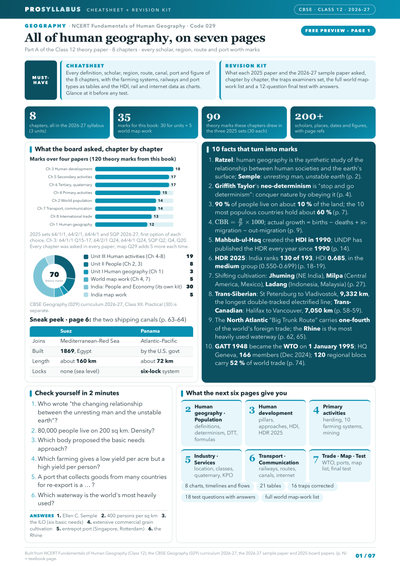
CBSE Class 12 · Geography
Human Development: 18 of 120 marks asked- Marks booster + cheatsheet: key concepts in 2 lines each
- 17 of 120 marks each: industry, services
- 15 of 120 marks: Primary Activities
- 14 of 120 marks: Transport
- 5 marks: world map work
- HDI, rail and internet data as charts
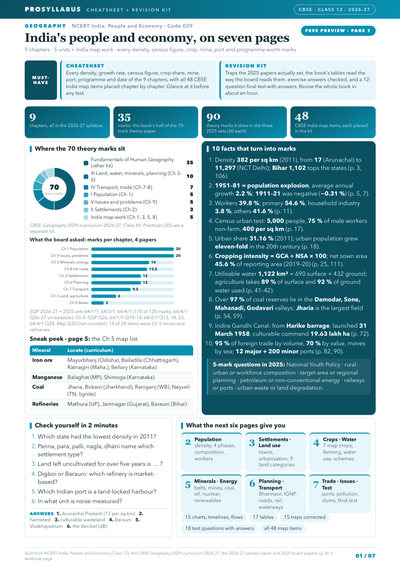
CBSE Class 12 · Geography
All 48 CBSE India map items, by chapter- Marks booster + cheatsheet: key concepts in 2 lines each, common traps
- 20 board marks in 4 papers: Population
- 14 board marks: Minerals and Energy
- 13 of the 28 map items asked: minerals
- 10 marks: Unit III, Ch 3–6
- Common traps, corrected
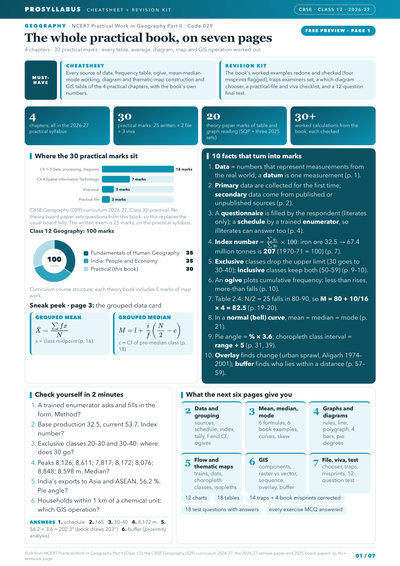
CBSE Class 12 · Geography
30 practical marks: where each one sits- Marks booster + cheatsheet: key concepts in 2 lines each, common traps
- 18 marks: Ch 1–3, data and diagrams
- 7 marks: GIS, Ch 4
- Common traps that cost marks, listed
- 5 marks: file and viva
- Mean, median and mode, fully worked
Summary
Transport carries goods from their site of production to consumers, while communication carries ideas, views and messages. India has one of the largest road networks in the world, carrying about 85 per cent of passenger and 70 per cent of freight traffic; roads are classified as National Highways (maintained by the centre and managed by the NHAI), State Highways, major district roads, rural roads and other roads such as border and international highways built by the Border Roads Organisation. Major projects include the Golden Quadrilateral linking Delhi, Mumbai, Chennai and Kolkata, the North-South and East-West Corridors, and Bharatmala Pariyojana. Indian Railways, introduced in 1853 between Bombay and Thane, is one of the longest networks, divided into 17 zones, with broad, metre and narrow gauges; the Konkan Railway is an engineering marvel. Water transport includes inland waterways (national waterways on the Ganga, Brahmaputra and the west-coast canal) and oceanic routes, through which about 95 per cent of foreign trade by volume moves. Air transport, begun in 1911 between Prayagraj and Naini, is the fastest mode, supported by the Airports Authority of India, the UDAN scheme and Pawan Hans helicopter services. Oil and gas pipelines, run by OIL and GAIL, efficiently carry liquids and gases. Communication networks range from personal systems like the internet to mass systems like radio (Akashwani), television (Doordarshan) and satellite systems INSAT and IRS.