Tertiary and Quaternary Activities
Class 12 Geography · Fundamentals of Human Geography · Chapter 6
173 members in the CBSE community
View all











CBSE Class 12 · Geography
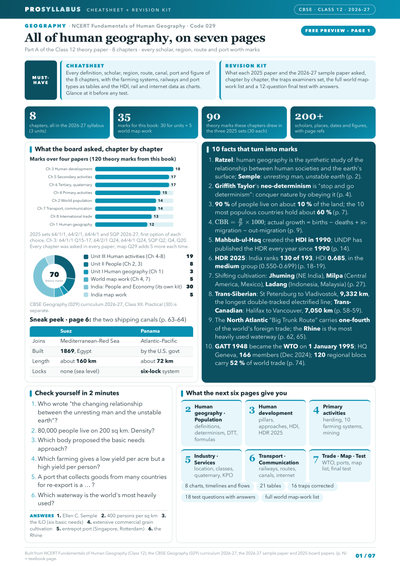
Human Development: 18 of 120 marks asked- Marks booster + cheatsheet: key concepts in 2 lines each
- 17 of 120 marks each: industry, services
- 15 of 120 marks: Primary Activities
- 14 of 120 marks: Transport
- 5 marks: world map work
- HDI, rail and internet data as charts
CBSE Class 12 · Geography
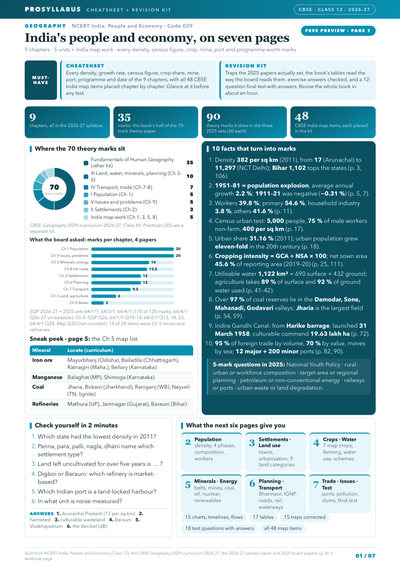
All 48 CBSE India map items, by chapter- Marks booster + cheatsheet: key concepts in 2 lines each, common traps
- 20 board marks in 4 papers: Population
- 14 board marks: Minerals and Energy
- 13 of the 28 map items asked: minerals
- 10 marks: Unit III, Ch 3–6
- Common traps, corrected
CBSE Class 12 · Geography
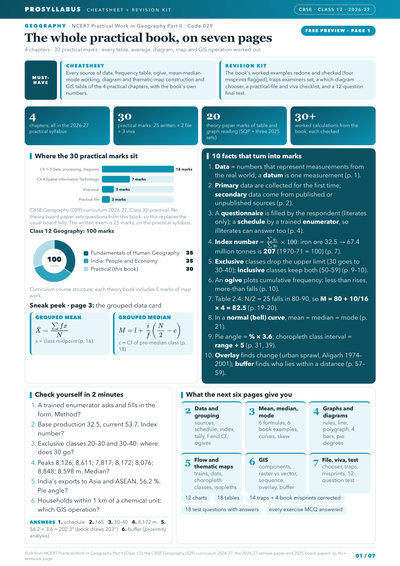
30 practical marks: where each one sits- Marks booster + cheatsheet: key concepts in 2 lines each, common traps
- 18 marks: Ch 1–3, data and diagrams
- 7 marks: GIS, Ch 4
- Common traps that cost marks, listed
- 5 marks: file and viva
- Mean, median and mode, fully worked
Summary
Tertiary activities are services that rely on specialised skills, experience and knowledge rather than on processing raw materials, and they include both the production of services and their exchange through trade, transport and communication. As economies develop, most workers shift into the service sector. Trade and commerce involve buying and selling, organised through rural marketing centres, periodic markets and specialised urban marketing centres, and through retail trading (in stores or non-store forms like the internet) and wholesale trading. Transport carries people and goods, measured as km-distance, time-distance or cost-distance, and forms networks of nodes and links. Communication transmits words and ideas, and telecommunications, satellites and the internet have made it nearly instantaneous and independent of transport. Services range from low-order ones like grocery shops to high-order specialised ones like consultants and physicians; tourism is the world's largest tertiary activity and medical tourism is growing in countries such as India. Quaternary activities are knowledge-oriented, centred on research, development and the collection, production and dissemination of information; over half the workers in developed economies are in this knowledge sector. Quinary activities are the highest-level decision-making and policy services, often called gold-collar professions. Outsourcing and off-shoring of IT-enabled work, including BPO and KPO, have created new jobs in countries with cheap skilled labour, while unequal access to information and communication technology creates a digital divide between and within countries.