Secondary Activities
Class 12 Geography · Fundamentals of Human Geography · Chapter 5
173 members in the CBSE community
View all











CBSE Class 12 · Geography
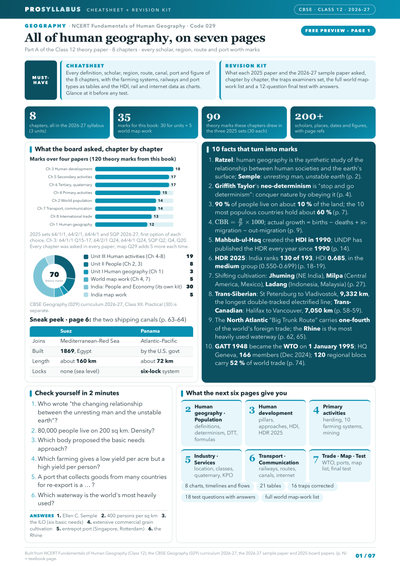
Human Development: 18 of 120 marks asked- Marks booster + cheatsheet: key concepts in 2 lines each
- 17 of 120 marks each: industry, services
- 15 of 120 marks: Primary Activities
- 14 of 120 marks: Transport
- 5 marks: world map work
- HDI, rail and internet data as charts
CBSE Class 12 · Geography
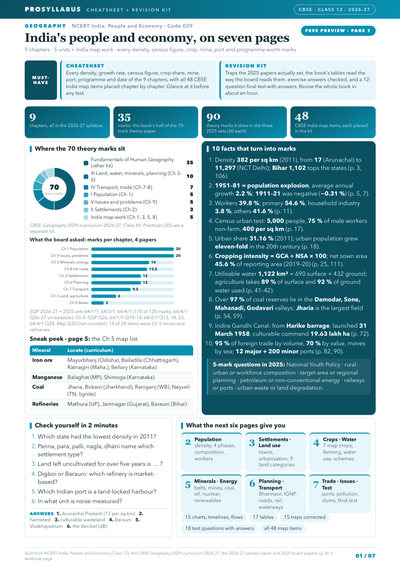
All 48 CBSE India map items, by chapter- Marks booster + cheatsheet: key concepts in 2 lines each, common traps
- 20 board marks in 4 papers: Population
- 14 board marks: Minerals and Energy
- 13 of the 28 map items asked: minerals
- 10 marks: Unit III, Ch 3–6
- Common traps, corrected
CBSE Class 12 · Geography
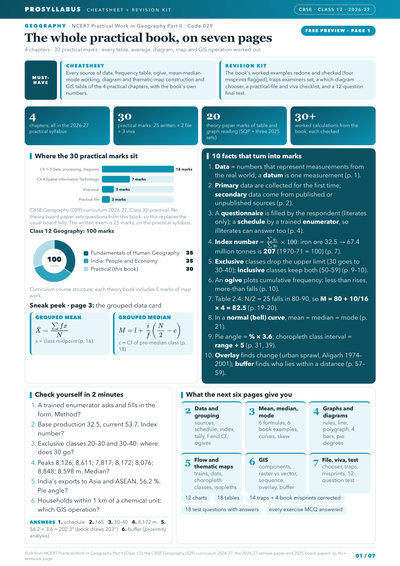
30 practical marks: where each one sits- Marks booster + cheatsheet: key concepts in 2 lines each, common traps
- 18 marks: Ch 1–3, data and diagrams
- 7 marks: GIS, Ch 4
- Common traps that cost marks, listed
- 5 marks: file and viva
- Mean, median and mode, fully worked
Summary
Secondary activities add value to natural resources by transforming raw materials into more valuable products — cotton becomes yarn and cloth, iron ore becomes steel. They cover manufacturing, processing and construction. Modern large-scale manufacturing is marked by specialisation of skills and mass production, mechanisation and automation, technological innovation, complex organisational structure with division of labour, and a very uneven geographic distribution concentrated on a small share of the world's land. Industries seek to minimise cost, so location is influenced by access to market, raw material, labour, energy, transport and communication, government policy and agglomeration economies; footloose industries can locate almost anywhere because they depend on components and road access rather than heavy raw materials. Industries are classified by size (household or cottage, small-scale, large-scale), by inputs or raw materials (agro-based, mineral-based, chemical-based, forest-based, animal-based), by output (basic industries supplying other industries versus consumer-goods industries), and by ownership (public, private and joint sector). Household industry is the smallest unit using local materials and family labour; small-scale manufacturing uses a workshop, local materials and semi-skilled labour; large-scale manufacturing needs a large market, varied raw materials, energy, advanced technology and assembly-line production. High-technology (high-tech) industry applies intensive research and development with professional white-collar workers, robotics and computer-aided design, and regionally concentrated, specialised high-tech complexes are called technopolies, such as Silicon Valley.