Primary Activities
Class 12 Geography · Fundamentals of Human Geography · Chapter 4
173 members in the CBSE community
View all











CBSE Class 12 · Geography
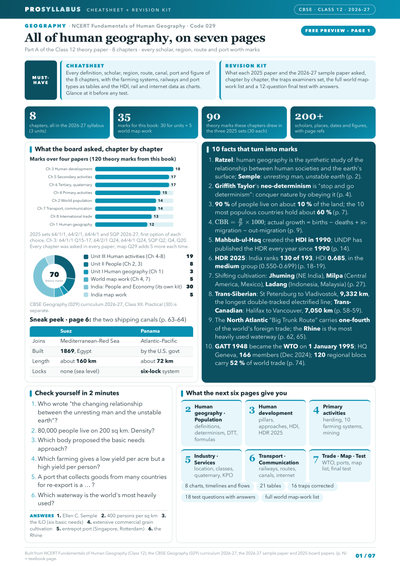
Human Development: 18 of 120 marks asked- Marks booster + cheatsheet: key concepts in 2 lines each
- 17 of 120 marks each: industry, services
- 15 of 120 marks: Primary Activities
- 14 of 120 marks: Transport
- 5 marks: world map work
- HDI, rail and internet data as charts
CBSE Class 12 · Geography
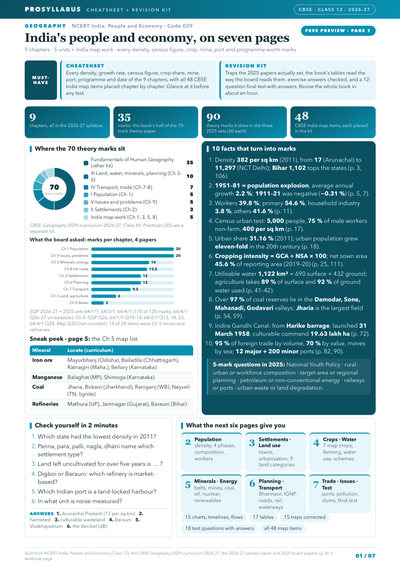
All 48 CBSE India map items, by chapter- Marks booster + cheatsheet: key concepts in 2 lines each, common traps
- 20 board marks in 4 papers: Population
- 14 board marks: Minerals and Energy
- 13 of the 28 map items asked: minerals
- 10 marks: Unit III, Ch 3–6
- Common traps, corrected
CBSE Class 12 · Geography
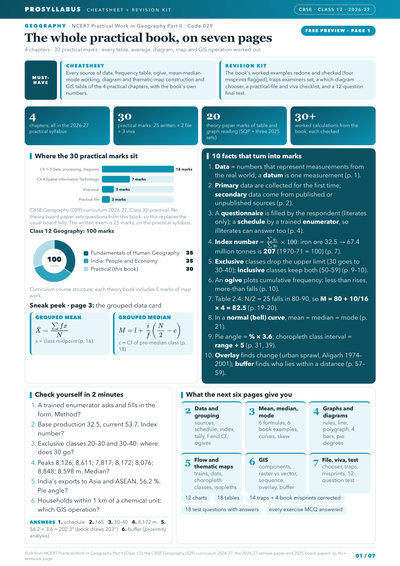
30 practical marks: where each one sits- Marks booster + cheatsheet: key concepts in 2 lines each, common traps
- 18 marks: Ch 1–3, data and diagrams
- 7 marks: GIS, Ch 4
- Common traps that cost marks, listed
- 5 marks: file and viva
- Mean, median and mode, fully worked
Summary
Economic activities are grouped into primary, secondary, tertiary and quaternary, and primary activities depend directly on the environment by using earth's resources such as land, water, vegetation and minerals. They include hunting and gathering, pastoralism, agriculture, and mining. Gathering and hunting are the oldest activities, practised in harsh climates with low technology, little capital and almost no surplus; modern market-oriented gathering supplies leaves, bark and medicinal plants but cannot compete with synthetics. Pastoralism ranges from nomadic herding, a subsistence activity involving transhumance between mountains and plains, to capital-intensive commercial livestock ranching on fenced ranches in countries like Australia and the USA. Agriculture takes many forms: primitive subsistence or shifting (slash-and-burn) cultivation called jhum or milpa; intensive subsistence agriculture of monsoon Asia (often wet-paddy); plantation agriculture of single cash crops introduced by Europeans; extensive commercial grain farming on huge mechanised mid-latitude farms; mixed farming combining crops and livestock; dairy farming near urban markets; Mediterranean agriculture famous for viticulture and citrus; and market gardening and horticulture of high-value vegetables, fruits and flowers, including truck and factory farming. Farming may also be organised as co-operative or collective (Kolkhoz) farming. Mining, which expanded with the Industrial Revolution, depends on physical factors (size, grade, mode of occurrence) and economic factors (demand, technology, capital, labour and transport), and uses surface (open-cast) or underground (shaft) methods.