Human Development
Class 12 Geography · Fundamentals of Human Geography · Chapter 3
173 members in the CBSE community
View all










CBSE Class 12 · Geography
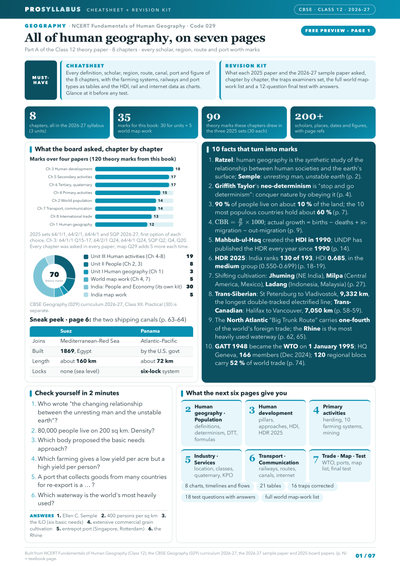
Human Development: 18 of 120 marks asked- Marks booster + cheatsheet: key concepts in 2 lines each
- 17 of 120 marks each: industry, services
- 15 of 120 marks: Primary Activities
- 14 of 120 marks: Transport
- 5 marks: world map work
- HDI, rail and internet data as charts
CBSE Class 12 · Geography
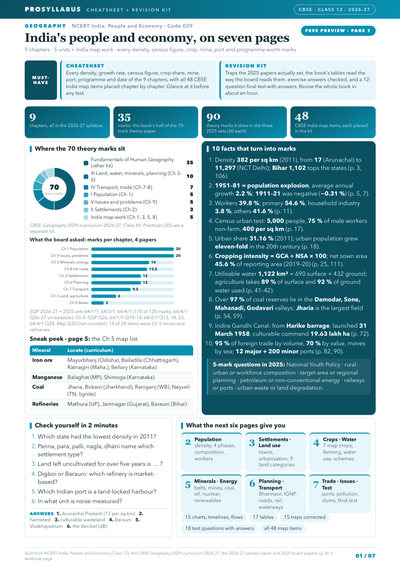
All 48 CBSE India map items, by chapter- Marks booster + cheatsheet: key concepts in 2 lines each, common traps
- 20 board marks in 4 papers: Population
- 14 board marks: Minerals and Energy
- 13 of the 28 map items asked: minerals
- 10 marks: Unit III, Ch 3–6
- Common traps, corrected
CBSE Class 12 · Geography
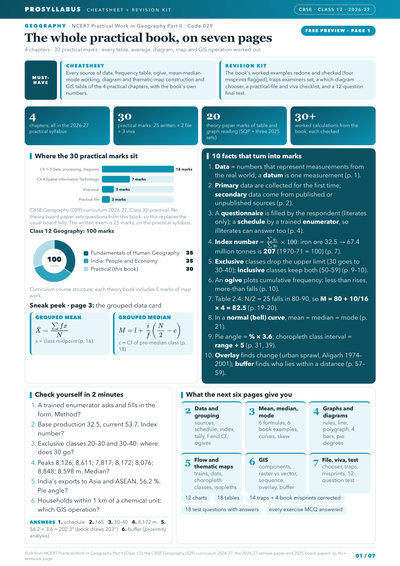
30 practical marks: where each one sits- Marks booster + cheatsheet: key concepts in 2 lines each, common traps
- 18 marks: Ch 1–3, data and diagrams
- 7 marks: GIS, Ch 4
- Common traps that cost marks, listed
- 5 marks: file and viva
- Mean, median and mode, fully worked
Summary
Growth and development both refer to change over time, but growth is a quantitative, value-neutral change that may be positive or negative, while development is a qualitative, value-positive change that improves conditions. For decades a country's progress was judged only by economic growth, but the concept of human development, introduced by Dr Mahbub-ul-Haq with contributions from Prof Amartya Sen, places people at the centre. Human development enlarges people's choices and improves their lives so they can lead long, healthy and meaningful lives. Its three key areas are access to resources, health and education, and building people's capabilities in these areas widens their freedom and choices. Human development rests on four pillars: equity (equal access to opportunities), sustainability (continuity of opportunities for future generations), productivity (enriching human labour), and empowerment (the power to make choices). There are four approaches — the income approach, the welfare approach, the basic needs approach and Amartya Sen's capability approach. Human development is measured by the Human Development Index (HDI), which scores countries from 0 to 1 on life expectancy, education (adult literacy and enrolment) and access to resources (purchasing power), each weighted one-third. The Human Poverty Index measures shortfalls in development. Countries are grouped into very high, high, medium and low human development, and Bhutan uniquely uses Gross National Happiness as a measure of progress.