Reconstitution of a Partnership Firm – Admission of a Partner
Class 12 Accountancy · Accountancy Part I · Chapter 2
163 members in the CBSE community
View all










CBSE Class 12 · Accountancy
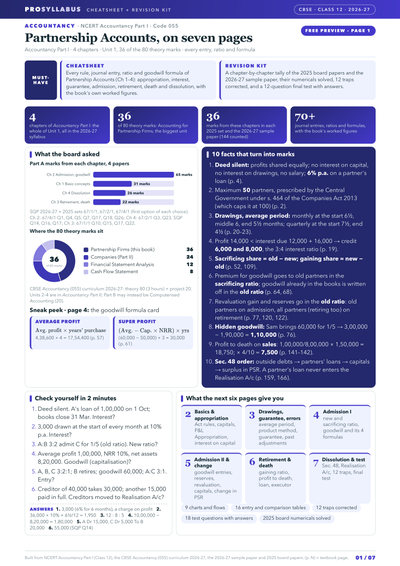
Partnership Accounts: 36 of 80 theory marks- Marks booster + cheatsheet: key concepts in 2 lines each
- 12 exam traps, listed
- 65 board marks: Admission of a Partner
- 26 board marks: Dissolution
- 22 board marks: Retirement/Death
- Goodwill formulas with the book's figures
CBSE Class 12 · Accountancy
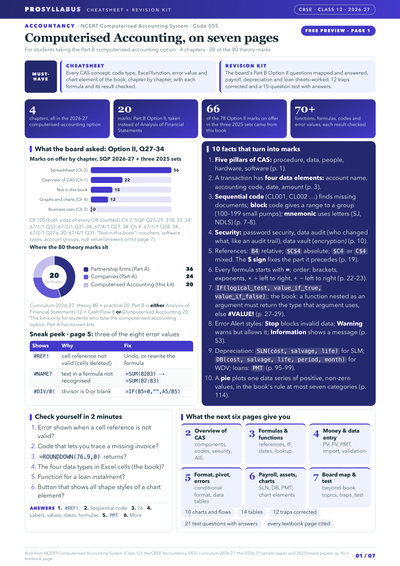
Spreadsheet: 56 of 105 Option II marks- Marks booster + cheatsheet: key concepts in 2 lines each
- 12 exam traps, listed
- 22 of 105 marks on offer: CAS overview
- Most asked item: error values
- What Q27–34 ask, answer by answer
- Every Excel function, result checked
CBSE Class 12 · Accountancy
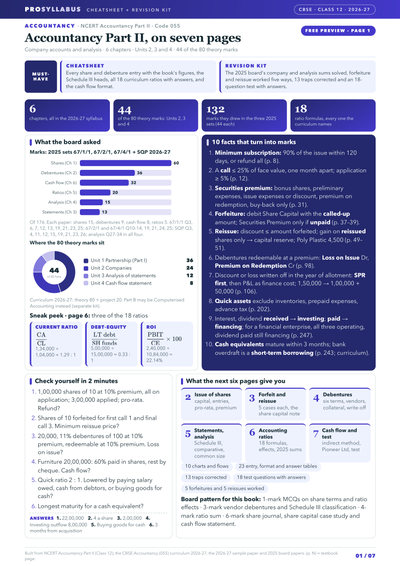
All 18 ratios, with the book's answers- Marks booster + cheatsheet: key concepts in 2 lines each, common traps
- 15 marks in every 2025 set: share capital
- 9 marks in every 2025 set: debentures
- Common traps that cost marks, listed
- 6-mark cash flow in every paper
- 5 marks in every 2025 set: ratios
Summary
Any change in the existing agreement among partners results in the reconstitution of a partnership firm. One of the most common forms is the admission of a new partner, who is admitted to bring in additional capital, managerial skill or business connections. On admission, the new partner acquires two rights: a share in the future profits and a share in the assets of the firm. Because the new partner gains a share of profit, the existing partners sacrifice part of theirs, so a new profit-sharing ratio and the sacrificing ratio must be calculated. The incoming partner usually pays a premium for goodwill to compensate the sacrificing partners; goodwill is valued by the average profit, super profit or capitalisation methods and is treated according to whether it is paid privately, brought in cash or adjusted through capital accounts. At the time of admission the firm also revalues its assets and reassesses its liabilities through a Revaluation Account, so that profits or losses up to the date of admission belong to the old partners. Accumulated reserves and the balance of the Profit and Loss Account are distributed among the old partners in their old ratio, and the capital accounts may be adjusted to make them proportionate to the new profit-sharing ratio. Finally, a new balance sheet of the reconstituted firm is prepared.