Accounting for Partnership: Basic Concepts
Class 12 Accountancy · Accountancy Part I · Chapter 1
163 members in the CBSE community
View all










CBSE Class 12 · Accountancy
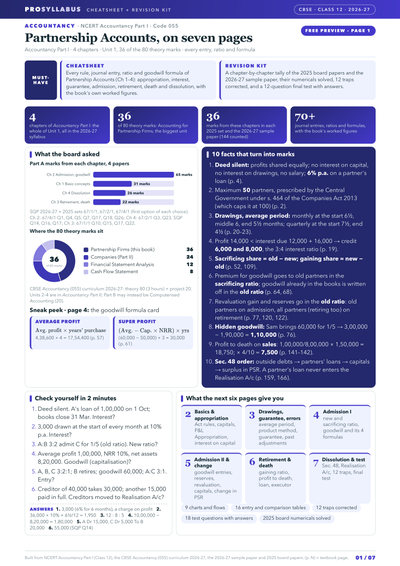
Partnership Accounts: 36 of 80 theory marks- Marks booster + cheatsheet: key concepts in 2 lines each
- 12 exam traps, listed
- 65 board marks: Admission of a Partner
- 26 board marks: Dissolution
- 22 board marks: Retirement/Death
- Goodwill formulas with the book's figures
CBSE Class 12 · Accountancy
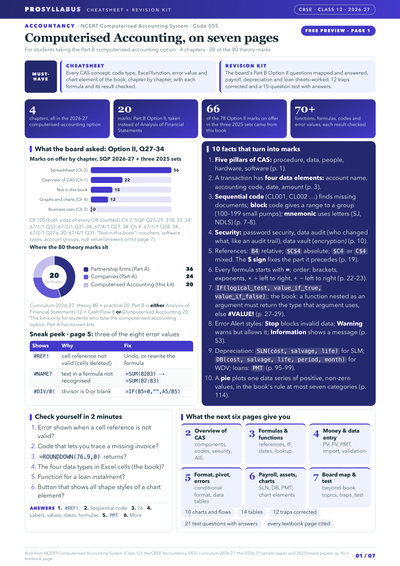
Spreadsheet: 56 of 105 Option II marks- Marks booster + cheatsheet: key concepts in 2 lines each
- 12 exam traps, listed
- 22 of 105 marks on offer: CAS overview
- Most asked item: error values
- What Q27–34 ask, answer by answer
- Every Excel function, result checked
CBSE Class 12 · Accountancy
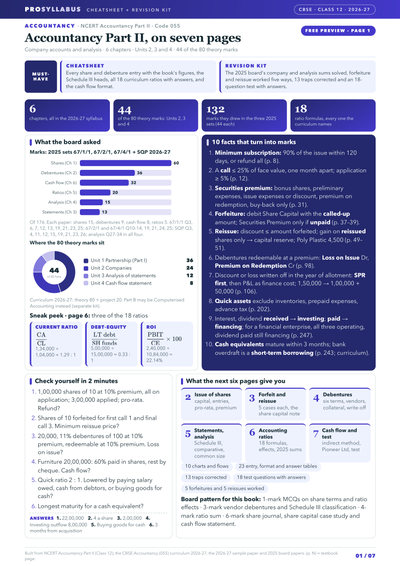
All 18 ratios, with the book's answers- Marks booster + cheatsheet: key concepts in 2 lines each, common traps
- 15 marks in every 2025 set: share capital
- 9 marks in every 2025 set: debentures
- Common traps that cost marks, listed
- 6-mark cash flow in every paper
- 5 marks in every 2025 set: ratios
Summary
When two or more persons agree to carry on a business and share its profits and losses, they form a partnership, as defined in Section 4 of the Indian Partnership Act 1932. The essential features are an association of two or more persons (maximum 50), an agreement, a lawful business, mutual agency and the sharing of profits. The agreement among partners is recorded in a written partnership deed; where the deed is silent, the provisions of the Act apply, so profits and losses are shared equally, no interest is allowed on capital or charged on drawings, no salary is paid to any partner, and a partner who advances a loan to the firm earns interest at 6% per annum. Partners may keep their capital accounts under the fixed capital method (separate capital and current accounts) or the fluctuating capital method (a single capital account). Profits are distributed through a Profit and Loss Appropriation Account, which records interest on capital, partners' salary or commission, interest on drawings and the final division of the remaining profit in the agreed ratio. The chapter also explains the guarantee of a minimum profit to a partner and the use of a past adjustment entry to rectify errors or omissions in earlier appropriations.