Financial Statements of a Company
Class 12 Accountancy · Accountancy Part II · Chapter 3
163 members in the CBSE community
View all










CBSE Class 12 · Accountancy
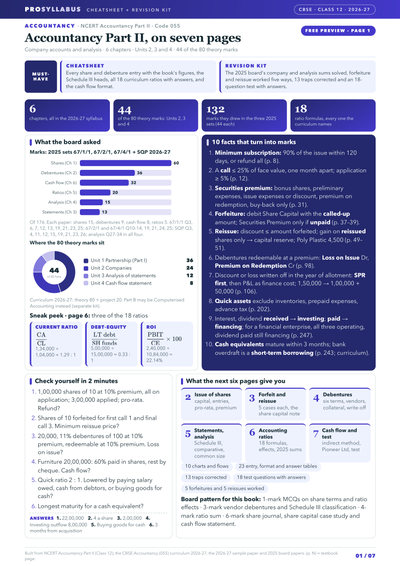
All 18 ratios, with the book's answers- Marks booster + cheatsheet: key concepts in 2 lines each, common traps
- 15 marks in every 2025 set: share capital
- 9 marks in every 2025 set: debentures
- Common traps that cost marks, listed
- 6-mark cash flow in every paper
- 5 marks in every 2025 set: ratios
CBSE Class 12 · Accountancy
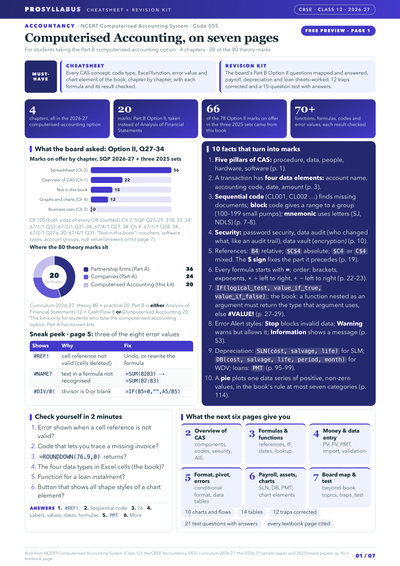
Spreadsheet: 56 of 105 Option II marks- Marks booster + cheatsheet: key concepts in 2 lines each
- 12 exam traps, listed
- 22 of 105 marks on offer: CAS overview
- Most asked item: error values
- What Q27–34 ask, answer by answer
- Every Excel function, result checked
CBSE Class 12 · Accountancy
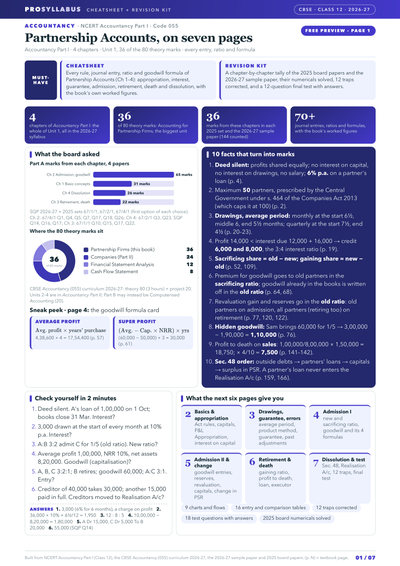
Partnership Accounts: 36 of 80 theory marks- Marks booster + cheatsheet: key concepts in 2 lines each
- 12 exam traps, listed
- 65 board marks: Admission of a Partner
- 26 board marks: Dissolution
- 22 board marks: Retirement/Death
- Goodwill formulas with the book's figures
Summary
Financial statements are the basic and formal annual reports through which a company's management communicates financial information to its owners and to external parties such as investors, lenders, tax authorities and the government. They are the end products of the accounting process and include the balance sheet (position statement), the statement of profit and loss and the cash flow statement. Their nature combines recorded facts, accounting conventions, postulates such as the going-concern and money-measurement assumptions, and personal judgements about matters like depreciation and provisions. Every company registered under the Companies Act 2013 must prepare its balance sheet and statement of profit and loss in the format prescribed by Schedule III. The balance sheet is presented in a vertical form, classifying items into shareholders' funds, non-current and current liabilities, and non-current and current assets, with detailed disclosures given in the Notes to Accounts. The statement of profit and loss shows revenue from operations, other income, and expenses such as cost of materials consumed, employee benefits, finance costs and depreciation, leading to profit before and after tax and earnings per share. Financial statements help users assess profitability and financial position, but they are limited because they rely on historical cost, contain only aggregate and monetary information, involve personal bias, and are only interim reports.