Analysis of Financial Statements
Class 12 Accountancy · Accountancy Part II · Chapter 4
163 members in the CBSE community
View all










CBSE Class 12 · Accountancy
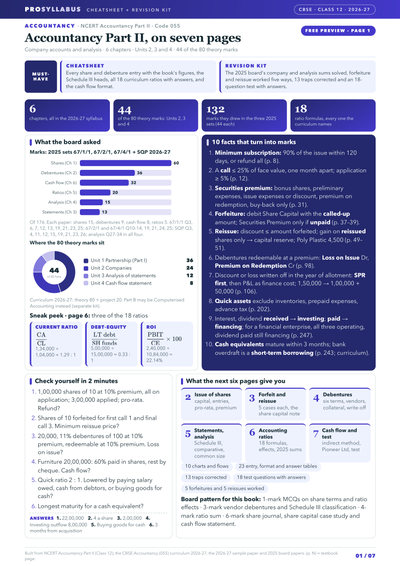
All 18 ratios, with the book's answers- Marks booster + cheatsheet: key concepts in 2 lines each, common traps
- 15 marks in every 2025 set: share capital
- 9 marks in every 2025 set: debentures
- Common traps that cost marks, listed
- 6-mark cash flow in every paper
- 5 marks in every 2025 set: ratios
CBSE Class 12 · Accountancy
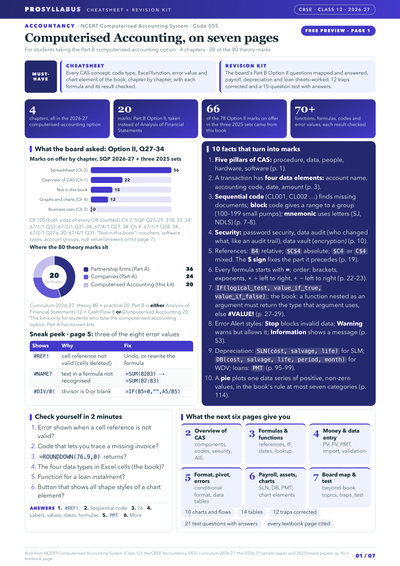
Spreadsheet: 56 of 105 Option II marks- Marks booster + cheatsheet: key concepts in 2 lines each
- 12 exam traps, listed
- 22 of 105 marks on offer: CAS overview
- Most asked item: error values
- What Q27–34 ask, answer by answer
- Every Excel function, result checked
CBSE Class 12 · Accountancy
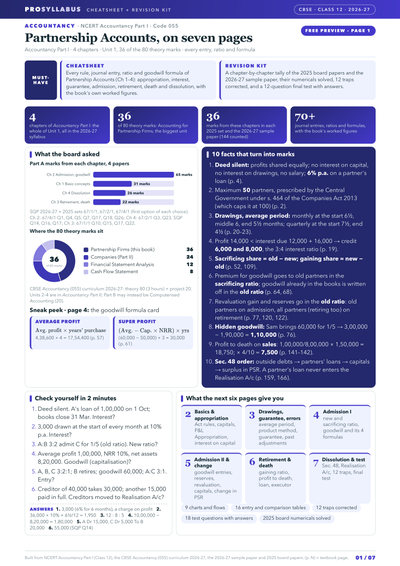
Partnership Accounts: 36 of 80 theory marks- Marks booster + cheatsheet: key concepts in 2 lines each
- 12 exam traps, listed
- 65 board marks: Admission of a Partner
- 26 board marks: Dissolution
- 22 board marks: Retirement/Death
- Goodwill formulas with the book's figures
Summary
Analysis of financial statements is the process of critically evaluating the information in the financial statements to understand the operations of a firm and to make decisions about it. It studies the relationship among various financial facts and interprets them to gain insight into the firm's profitability and operational efficiency. The term includes both analysis, the methodical classification and simplification of data, and interpretation, the explanation of its meaning and significance; the two are complementary. Financial analysis is useful to finance managers, top management, trade payables, lenders, investors, labour unions and others, each with a different purpose. The main tools are comparative statements, common-size statements, trend analysis, ratio analysis and cash-flow analysis. Comparative statements, a form of horizontal analysis, show the figures for two or more periods together with the absolute and percentage changes between them. Common-size statements, a form of vertical analysis, express each item as a percentage of a common base—revenue from operations for the statement of profit and loss and total assets for the balance sheet—so that firms of different sizes can be compared. Trend analysis studies the percentage change in items over several years relative to a base year. Financial analysis is limited because it ignores price-level changes and qualitative factors, and depends on the reliability of the underlying statements.