Accounting Ratios
Class 12 Accountancy · Accountancy Part II · Chapter 5
163 members in the CBSE community
View all










CBSE Class 12 · Accountancy
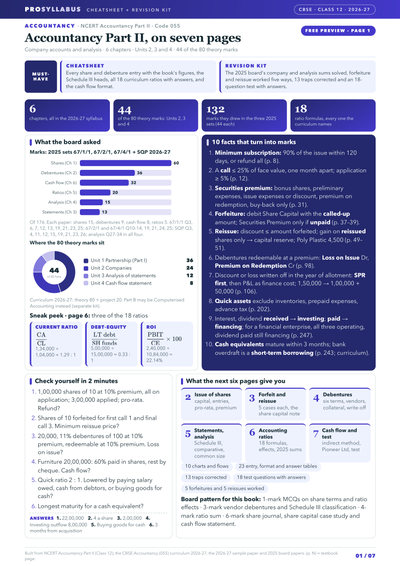
All 18 ratios, with the book's answers- Marks booster + cheatsheet: key concepts in 2 lines each, common traps
- 15 marks in every 2025 set: share capital
- 9 marks in every 2025 set: debentures
- Common traps that cost marks, listed
- 6-mark cash flow in every paper
- 5 marks in every 2025 set: ratios
CBSE Class 12 · Accountancy
Spreadsheet: 56 of 105 Option II marks- Marks booster + cheatsheet: key concepts in 2 lines each
- 12 exam traps, listed
- 22 of 105 marks on offer: CAS overview
- Most asked item: error values
- What Q27–34 ask, answer by answer
- Every Excel function, result checked
CBSE Class 12 · Accountancy
Partnership Accounts: 36 of 80 theory marks- Marks booster + cheatsheet: key concepts in 2 lines each
- 12 exam traps, listed
- 65 board marks: Admission of a Partner
- 26 board marks: Dissolution
- 22 board marks: Retirement/Death
- Goodwill formulas with the book's figures
Summary
An accounting ratio is a mathematical relationship between two accounting figures drawn from the financial statements, expressed as a fraction, proportion, percentage or number of times. Ratio analysis is a major tool of financial statement analysis used to assess the solvency, liquidity, efficiency and profitability of an enterprise and to make intra-firm and inter-firm comparisons. Ratios are commonly classified into liquidity ratios, solvency ratios, activity or turnover ratios and profitability ratios. Liquidity ratios test short-term financial position: the current ratio relates current assets to current liabilities (\(\text{Current Ratio}=\dfrac{\text{Current Assets}}{\text{Current Liabilities}}\)) and the quick ratio relates quick assets to current liabilities (\(\text{Quick Ratio}=\dfrac{\text{Quick Assets}}{\text{Current Liabilities}}\)). Solvency ratios test long-term financial position, the chief example being the debt-equity ratio (\(\text{Debt-Equity Ratio}=\dfrac{\text{Long-term Debts}}{\text{Shareholders Funds}}\)). Activity ratios measure how efficiently resources are used, such as the inventory turnover ratio (\(\text{Inventory Turnover Ratio}=\dfrac{\text{Cost of Revenue from Operations}}{\text{Average Inventory}}\)) and the trade-receivables turnover ratio. Profitability ratios measure earning capacity, including the gross profit ratio, operating ratio, net profit ratio and return on investment. The chapter explains the meaning, objectives and limitations of ratio analysis and shows how each ratio is computed and interpreted.