Social Responsibilities of Business and Business Ethics
Class 11 Business Studies · Business Studies · Chapter 6
163 members in the CBSE community
View all










CBSE Class 11 · Business Studies
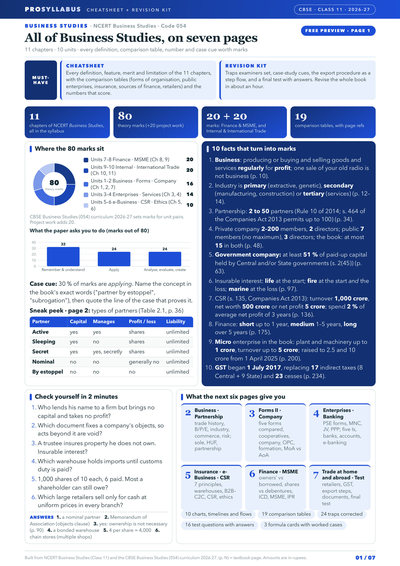
Every merit and limitation of 11 chapters- Marks booster + cheatsheet: key concepts in 2 lines each, common traps
- 20 marks: finance and MSME units
- 20 marks: internal and international trade
- Five comparison tables, insurance to retail
- Case cues for each chapter
- Common traps, corrected
Summary
Social responsibility of business is the obligation of business to take decisions and perform actions that are desirable in terms of the objectives and values of society; it is broader than legal responsibility because it goes beyond mere compliance with law and contains a voluntary element. The case for social responsibility rests on arguments such as the justification for the existence and growth of business, its long-term interest, avoidance of government regulation, maintenance of society and the conversion of problems into opportunities; the case against it includes violation of profit maximisation, burden on consumers, lack of social skills and lack of public support. Several forces — public regulation, the labour movement, consumer consciousness, business education and a professional managerial class — have made businesses more socially responsible. Social responsibility is of four kinds: economic, legal, ethical and discretionary, and is owed to shareholders, workers, consumers, and the government and community. Business must also protect the environment from air, water, land and noise pollution by committing to pollution control through top-management commitment, clear policies, compliance with laws such as the Environment (Protection) Act 1986 and participation in government programmes. Business ethics are the socially determined moral principles that should govern business, with elements such as top management commitment, a published code of conduct, compliance mechanisms, involvement of employees and measurement of results. Under the Companies Act 2013, qualifying companies must spend at least 2% of their average net profit on CSR.