Internal Trade
Class 11 Business Studies · Business Studies · Chapter 10
163 members in the CBSE community
View all









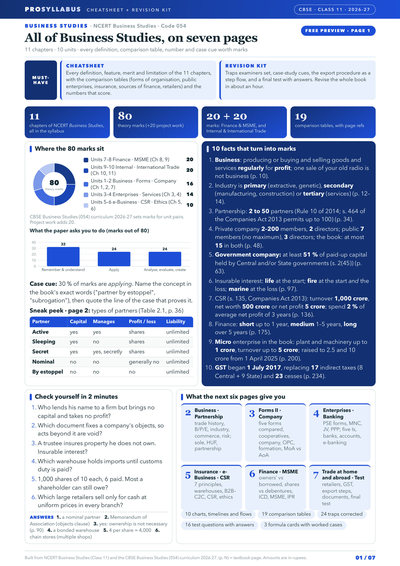
CBSE Class 11 · Business Studies
Every merit and limitation of 11 chapters- Marks booster + cheatsheet: key concepts in 2 lines each, common traps
- 20 marks: finance and MSME units
- 20 marks: internal and international trade
- Five comparison tables, insurance to retail
- Case cues for each chapter
- Common traps, corrected
Summary
Internal trade is the buying and selling of goods and services within the boundaries of a country, free of custom or import duty, and consists of wholesale trade and retail trade. Wholesale trade is the purchase and sale of goods in large quantities for resale or intermediate use; wholesalers serve manufacturers by facilitating large-scale production, bearing risk, providing finance and expert advice, helping in marketing, ensuring continuity of production and storage, and serve retailers by making goods available, providing marketing support, granting credit, sharing specialised knowledge and sharing risk. Retail trade is the sale of goods in small quantities to ultimate consumers; retailers help manufacturers and wholesalers in distribution, personal selling, large-scale operations, collecting information and promotion, and help consumers by ensuring regular availability, giving product information, convenience, wide selection, after-sales service and credit. Retailers are of two broad types: itinerant retailers without a fixed place of business (peddlers and hawkers, market traders, street traders and cheap jacks) and fixed-shop retailers, which range from small shopkeepers (general stores, speciality shops, street stalls, second-hand goods shops, single-line stores) to large stores (departmental stores, chain or multiple shops, mail order houses, consumer cooperative stores, super markets and vending machines). The Goods and Services Tax (GST), implemented on 1 July 2017 under the slogan One Nation One Tax, is a destination-based consumption tax that replaced many indirect taxes. Chambers of commerce and industry associations such as ASSOCHAM, CII and FICCI promote internal trade.