Forms of Business Organisation
Class 11 Business Studies · Business Studies · Chapter 2
163 members in the CBSE community
View all











CBSE Class 11 · Business Studies
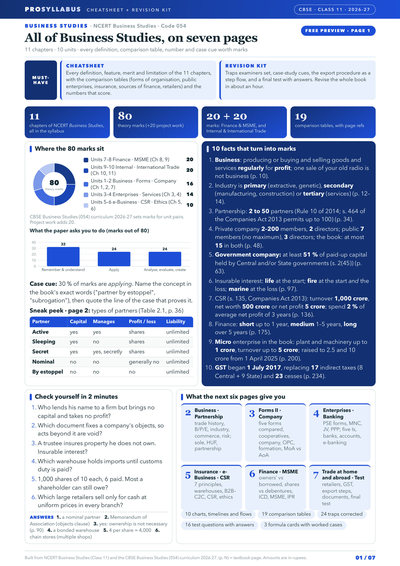
Every merit and limitation of 11 chapters- Marks booster + cheatsheet: key concepts in 2 lines each, common traps
- 20 marks: finance and MSME units
- 20 marks: internal and international trade
- Five comparison tables, insurance to retail
- Case cues for each chapter
- Common traps, corrected
Summary
When starting or expanding a business, an important decision is the choice of the form of organisation, weighing the merits and limitations of each. The main forms are sole proprietorship, joint Hindu family business, partnership, cooperative society and joint stock company. A sole proprietorship is owned, managed and controlled by one individual who bears all risk and gets all profit; it offers ease of formation, quick decisions and confidentiality but suffers unlimited liability, limited resources and lack of continuity. A joint Hindu family business, found only in India, is owned by members of a Hindu Undivided Family by virtue of birth and controlled by the eldest member, the karta, who alone has unlimited liability while the co-parceners have limited liability. A partnership, governed by the Indian Partnership Act 1932, is the relation between persons who agree to share the profits of a business carried on by all or any of them acting for all; its features include unlimited liability, mutual agency and a partnership deed, with various types of partners and optional registration. A cooperative society is a voluntary association formed for mutual welfare, with compulsory registration, limited liability, democratic control and a service motive. A joint stock company is an artificial person created by law with a separate legal entity, perpetual succession, limited liability and transferable shares, and may be private or public. The choice depends on cost, liability, continuity, management ability, capital and control.