Business Services
Class 11 Business Studies · Business Studies · Chapter 4
163 members in the CBSE community
View all









CBSE Class 11 · Business Studies
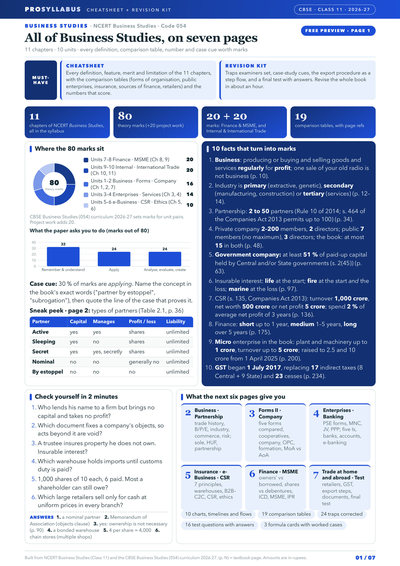
Every merit and limitation of 11 chapters- Marks booster + cheatsheet: key concepts in 2 lines each, common traps
- 20 marks: finance and MSME units
- 20 marks: internal and international trade
- Five comparison tables, insurance to retail
- Case cues for each chapter
- Common traps, corrected
Summary
Services are separately identifiable, essentially intangible activities that satisfy wants and are not necessarily linked to the sale of a product, distinguished from goods by their five characteristics — intangibility, inconsistency, inseparability, inventory (perishability) and involvement of the customer. Services are of three types: business services (banking, insurance, transportation, warehousing and communication), social services and personal services. Banking, governed mainly by the Banking Regulation Act 1949, is provided by commercial, cooperative, specialised and central banks; commercial banks accept deposits, lend funds, provide cheque and remittance facilities and offer e-banking services such as ATMs, EFT, NEFT and RTGS. Insurance spreads the loss caused by an uncertain event over many persons exposed to it and rests on principles of utmost good faith, insurable interest, indemnity, proximate cause, subrogation, contribution and mitigation; its main types are life, fire and marine insurance. Communication services link business with the outside world through postal services (financial and mail facilities) and telecom services (cellular, fixed line, cable, VSAT and DTH). Transportation removes the hindrance of place by carrying goods by rail, road, air and sea, while warehousing removes the hindrance of time by storing goods. Warehouses may be private, public, bonded, government or cooperative, and perform functions such as consolidation, breaking bulk, stockpiling, value-added services, price stabilisation and financing.