MSME and Business Entrepreneurship
Class 11 Business Studies · Business Studies · Chapter 9
163 members in the CBSE community
View all











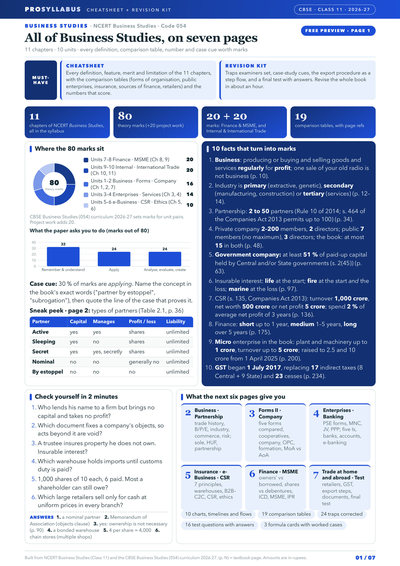
CBSE Class 11 · Business Studies
Every merit and limitation of 11 chapters- Marks booster + cheatsheet: key concepts in 2 lines each, common traps
- 20 marks: finance and MSME units
- 20 marks: internal and international trade
- Five comparison tables, insurance to retail
- Case cues for each chapter
- Common traps, corrected
Summary
Micro, Small and Medium Enterprises (MSMEs) contribute a large share of India's GDP, exports and employment and form, after agriculture, the second largest employer, comprising subgroups such as handlooms, handicrafts, coir, sericulture, khadi and village industries, small-scale industries and powerlooms. Under the MSMED Act 2006, enterprises are classified as micro, small and medium on the basis of investment in plant and machinery and turnover. A village industry produces goods or services in a rural area within a prescribed limit of fixed capital per artisan, while cottage industries are traditional rural industries not defined by investment criteria. The role of MSMEs includes balanced regional development, large-scale employment, supply of a wide variety of products, freedom from locational constraints, opportunity for entrepreneurship with little capital, low cost of production and quick decisions; their problems include finance, raw materials, managerial and marketing weaknesses, quality, capacity utilisation and global competition. Entrepreneurship is the systematic, lawful and purposeful activity of innovation and organisation of production involving calculated risk-taking; the entrepreneur is the person, entrepreneurship the process and the enterprise the output. Intellectual Property Rights protect the products of the human mind and include copyright, trademark, geographical indication, patent (granted for 20 years), design (10 years, renewable for 5), plant variety and semiconductor layout designs, along with traditional knowledge and trade secrets. The Startup India scheme aims to trigger an entrepreneurial culture and broaden the supply of entrepreneurs.