Business, Trade and Commerce
Class 11 Business Studies · Business Studies · Chapter 1
163 members in the CBSE community
View all











CBSE Class 11 · Business Studies
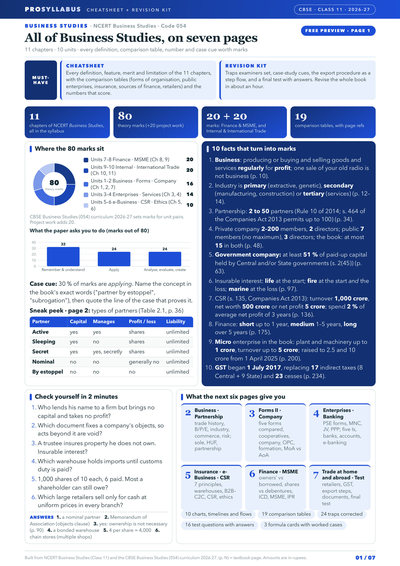
Every merit and limitation of 11 chapters- Marks booster + cheatsheet: key concepts in 2 lines each, common traps
- 20 marks: finance and MSME units
- 20 marks: internal and international trade
- Five comparison tables, insurance to retail
- Case cues for each chapter
- Common traps, corrected
Summary
All human beings require goods and services to satisfy their needs, which are supplied by people engaged in economic activities such as production, exchange and distribution. The chapter traces the role of business in the development of the economy, recalling India's golden trading past, the Silk Route, indigenous instruments like Hundi and Chitties, leading ancient trade centres and the impact of the East India Company and the 1991 economic liberalisation. Business is an economic activity involving the regular production or purchase and sale of goods and services with a view to earning profit by satisfying human wants. Its characteristics include being an economic activity, production or procurement of goods and services, sale or exchange for value, regularity of dealings, profit earning, uncertainty of return and an element of risk. Economic activities are divided into business, profession and employment. Business activities are classified into industry (primary — extractive and genetic; secondary — manufacturing and construction; tertiary — services) and commerce (trade and the auxiliaries to trade: transport and communication, banking and finance, insurance, warehousing, and advertising). Besides profit, the objectives of business include market standing, innovation, productivity, physical and financial resources and social responsibility. Business risk — speculative and pure — arises from natural, human, economic and other causes, and profit is the reward for risk-taking. Factors to consider before starting a business include selection of type and size, location, financing, physical facilities, workforce, tax planning and launching the enterprise.