International Business
Class 11 Business Studies · Business Studies · Chapter 11
163 members in the CBSE community
View all











CBSE Class 11 · Business Studies
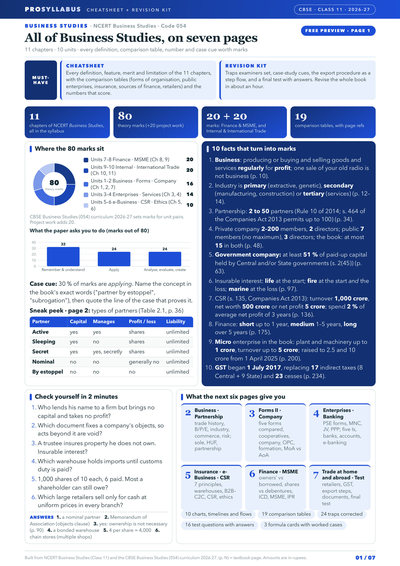
Every merit and limitation of 11 chapters- Marks booster + cheatsheet: key concepts in 2 lines each, common traps
- 20 marks: finance and MSME units
- 20 marks: internal and international trade
- Five comparison tables, insurance to retail
- Case cues for each chapter
- Common traps, corrected
Summary
International business refers to business activities that take place across national frontiers, involving the movement of goods, services, capital, personnel, technology and intellectual property; it is broader than international trade, which covers only the exports and imports of goods. Nations trade because they cannot produce equally well or cheaply all that they need, owing to the unequal distribution of natural resources, differing productivity and factor availability, leading to geographical specialisation. International business differs from domestic business in the nationality of buyers, sellers and stakeholders, mobility of factors of production, customer heterogeneity, business systems, political risk, regulations and the currency used. Its scope covers merchandise exports and imports, service (invisible) trade, licensing and franchising and foreign investments, both direct (FDI) and portfolio. It benefits countries through foreign exchange earnings, efficient use of resources, growth and employment and a higher standard of living, and benefits firms through higher profits, capacity utilisation, growth prospects, escape from domestic competition and improved business vision. Firms enter international markets through exporting and importing, contract manufacturing (outsourcing), licensing and franchising, joint ventures and wholly owned subsidiaries, each with its advantages and limitations. The export procedure involves receiving enquiries and orders, obtaining a licence and pre-shipment finance, producing and inspecting goods, customs clearance, obtaining a bill of lading and securing payment through a letter of credit, while the import procedure involves enquiry, licence, foreign exchange, indent, letter of credit and customs clearance.