Introduction to Accounting
Class 11 Accountancy · Financial Accounting Part I · Chapter 1
163 members in the CBSE community
View all










CBSE Class 11 · AccountancyTrending
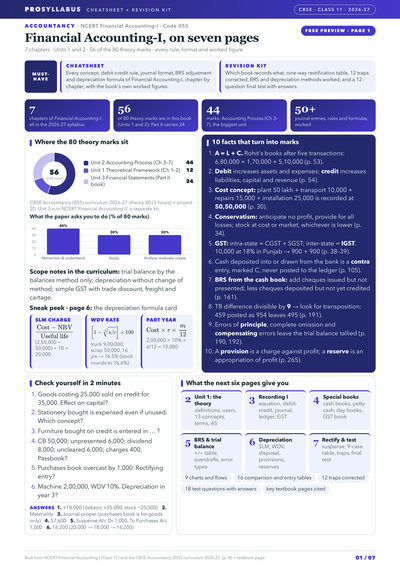
Financial Accounting-I: 56 of 80 theory marks- Marks booster + cheatsheet: key concepts in 2 lines each, common traps
- 44 marks: Unit 2, recording to depreciation
- Journal formats and special purpose books
- Traps from all seven chapters
- Bank reconciliation adjustments
- Depreciation formulas, book's worked figures
CBSE Class 11 · Accountancy
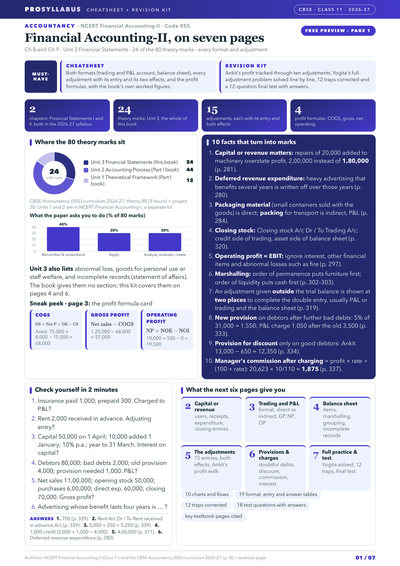
Financial statements: 24 of 80 theory marks- Marks booster + cheatsheet: key concepts in 2 lines each
- 12 exam traps, listed
- Five calculations the paper keeps asking
- Each adjustment: one entry, two effects
- Both formats: trading and P&L, balance sheet
- Yogita illustration solved line by line
Summary
Accounting is the process of identifying, measuring, recording and communicating the economic events of an organisation to the interested users of such information. The AICPA in 1941 described it as the art of recording, classifying and summarising transactions of a financial character, while the American Accounting Association in 1966 stressed identifying, measuring and communicating economic information for informed decisions. The accounting process begins with the identification of business transactions, then measures them in monetary terms, records them in a chronological manner, and finally communicates the summarised information through reports. Because it conveys financial information, accounting is called the language of business. Its users are grouped into internal users (chief executive, managers, supervisors) and external users (investors, creditors, banks, tax authorities, regulators, customers). The discipline has branched into financial accounting, cost accounting and management accounting. Useful accounting information should possess the qualitative characteristics of reliability, relevance, understandability and comparability. The main objectives of accounting are to maintain systematic records of transactions, calculate profit or loss, depict the financial position through a balance sheet, and provide information to its users. The chapter also introduces basic terms such as entity, transaction, assets, liabilities, capital, drawings, sales, revenue, expenses, profit, gain, loss, debtors, creditors, stock, voucher and goods.