Depreciation, Provisions and Reserves
Class 11 Accountancy · Financial Accounting Part I · Chapter 7
163 members in the CBSE community
View all











CBSE Class 11 · AccountancyTrending
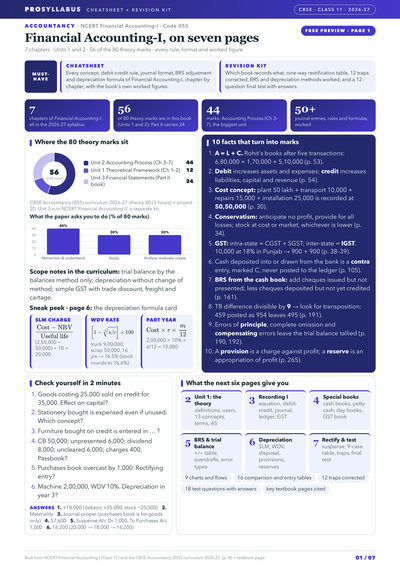
Financial Accounting-I: 56 of 80 theory marks- Marks booster + cheatsheet: key concepts in 2 lines each, common traps
- 44 marks: Unit 2, recording to depreciation
- Journal formats and special purpose books
- Traps from all seven chapters
- Bank reconciliation adjustments
- Depreciation formulas, book's worked figures
CBSE Class 11 · Accountancy
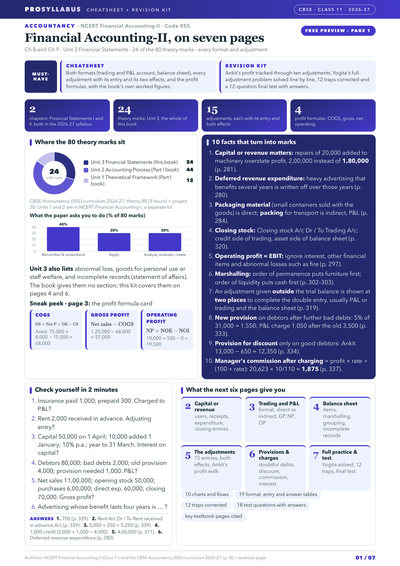
Financial statements: 24 of 80 theory marks- Marks booster + cheatsheet: key concepts in 2 lines each
- 12 exam traps, listed
- Five calculations the paper keeps asking
- Each adjustment: one entry, two effects
- Both formats: trading and P&L, balance sheet
- Yogita illustration solved line by line
Summary
This chapter deals with depreciation in its first section and with provisions and reserves in its second. Depreciation is the systematic allocation of the cost of a fixed asset over its useful life, following the matching principle so that only the part of the cost consumed in a period is charged against that period's revenue. It is distinguished from depletion, which relates to natural resources, and amortisation, which relates to intangible assets. The causes of depreciation include wear and tear from use or passage of time, expiration of legal rights, obsolescence and abnormal factors. Charging depreciation is needed to match costs with revenue, for tax purposes, to show a true and fair financial position, and to comply with law. The amount of depreciation depends on the cost of the asset, its estimated net residual value and its estimated useful life. The two common methods of calculating depreciation are the straight line method, which charges a fixed amount each year on the original cost, and the written down value (diminishing balance) method, which charges a fixed percentage on the reducing book value. Provisions are amounts set aside to meet known liabilities of uncertain amount, such as a provision for doubtful debts, while reserves are appropriations of profit to strengthen the financial position. Reserves include revenue reserves and capital reserves, and undisclosed reserves are called secret reserves.