Introducing Indian Society
Class 12 Sociology · Indian Society · Chapter 1
163 members in the CBSE community
View all








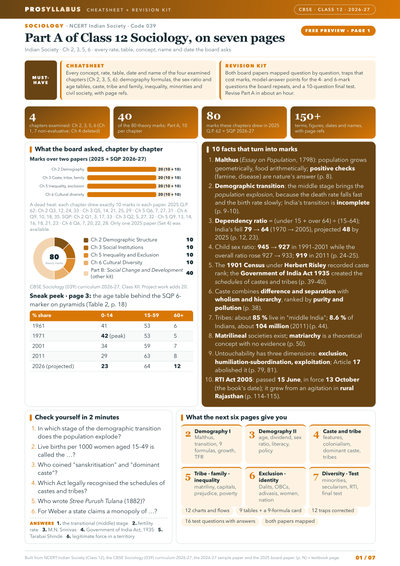
CBSE Class 12 · Sociology
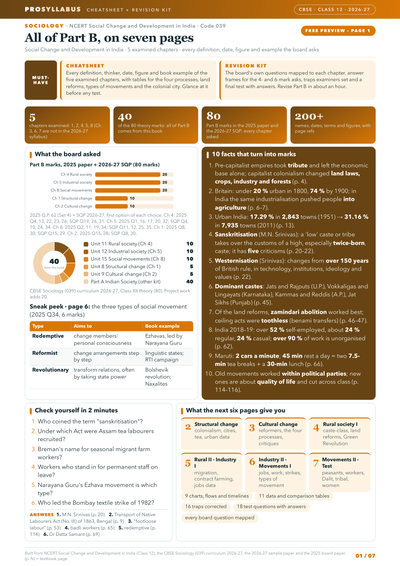
Ch 2, 3, 5, 6: the four examined chapters- Marks booster + cheatsheet: key concepts in 2 lines each, common traps
- 10 marks for each of the four chapters
- Demography formulas for Ch 2
- Sex-ratio and age tables from the book
- 10 must-know facts with a self-check
- Common traps, corrected
CBSE Class 12 · Sociology
Five examined chapters, 2025 Qs mapped- Marks booster + cheatsheet: most-asked concepts in 2 lines each
- 10 marks each: Units 11, 12 and 15
- 5 marks each: Units 8 and 9
- 4 processes of cultural change, in a table
- Land reforms table, Chapter 4
- Types of social movements, in one table
Summary
Sociology differs from other school subjects because no one starts from zero — everyone already knows something about society simply from growing up in it. This familiarity is both an advantage and a disadvantage: our common-sense knowledge is partial, in the double sense of being incomplete and being biased towards the viewpoint of the social group into which we are socialised. Learning sociology therefore begins with a process of 'unlearning' this taken-for-granted knowledge so that we can see social reality more fully and impartially. A central skill the discipline teaches is self-reflexivity — the ability to turn one's critical gaze back on oneself and to see how one appears to others. Sociology also locates each individual on a social map of groups defined by age, region, language, class, religion, caste or tribe, and shows how these groups relate to one another. Following C. Wright Mills, the chapter explains the sociological imagination as the ability to connect 'personal troubles' (an individual's private worries) with 'public issues' (problems affecting large groups). The chapter previews the rest of the book: India's demographic structure, the institutions of caste, tribe and family, the market as a social institution, patterns of inequality and exclusion, and the challenges of cultural diversity in a nation that prizes unity in diversity.