Nature and Significance of Management
Class 12 Business Studies · Business Studies Part I · Chapter 1
163 members in the CBSE community
View all










CBSE Class 12 · Business Studies
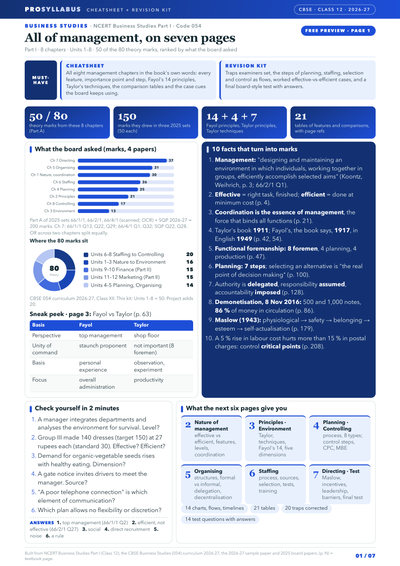
Directing: 37 marks in 4 papers, the most- Marks booster + cheatsheet: most-asked concepts in 2 lines each
- 8 chapters ranked by what the board asked
- 31 marks: Organising, a 6-marker every set
- 30 marks in 4 papers: nature of management
- 14 principles of Fayol
- Case cues the board keeps using
CBSE Class 12 · Business Studies
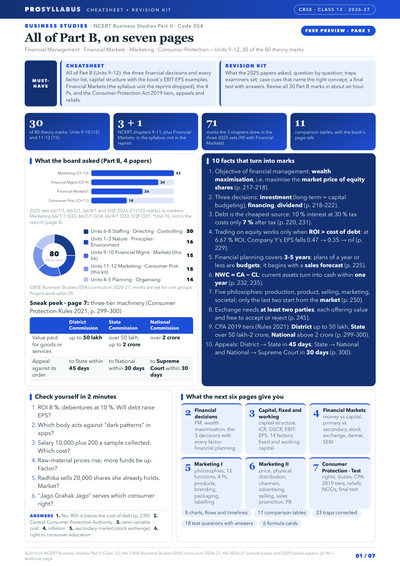
Financial Markets: 26 marks, not in NCERT- Marks booster + cheatsheet: key concepts in 2 lines each
- 15 marks each: Units 9–10 and 11–12
- 4 Ps of marketing, Unit 11
- Consumer Protection Act 2019 tiers, appeals
- Capital structure with EBIT-EPS examples
- The three financial decisions, every factor
Summary
Management is the process of getting things done with the aim of achieving organisational goals effectively and efficiently. Effectiveness means completing the task and reaching the goal, while efficiency means doing the task with the least cost of resources; good management balances both. Management is characterised as a goal-oriented, pervasive, multidimensional, continuous, group and dynamic activity that is also an intangible force seen through its results. It works at three levels — top management which sets objectives and strategy, middle management which interprets policies and links top and lower levels, and supervisory or operational management which oversees workers directly. The basic functions of management are planning, organising, staffing, directing and controlling, performed in a sequence yet interrelated. Management is studied as a science (a systematised body of knowledge with principles), an art (personalised skilful application of that knowledge) and a developing profession (it has a knowledge base, training and codes of conduct but lacks restricted entry). Coordination is the orchestration of group effort to provide unity of action; it is not a separate function but the essence of management, integrating the work of departments and individuals towards common goals. It is needed at every level and runs through all managerial functions.