Marketing
Class 12 Business Studies · Business Studies Part II · Chapter 2
163 members in the CBSE community
View all










CBSE Class 12 · Business Studies
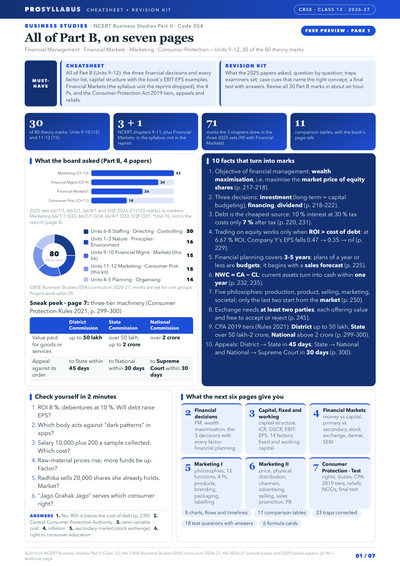
Financial Markets: 26 marks, not in NCERT- Marks booster + cheatsheet: key concepts in 2 lines each
- 15 marks each: Units 9–10 and 11–12
- 4 Ps of marketing, Unit 11
- Consumer Protection Act 2019 tiers, appeals
- Capital structure with EBIT-EPS examples
- The three financial decisions, every factor
CBSE Class 12 · Business Studies
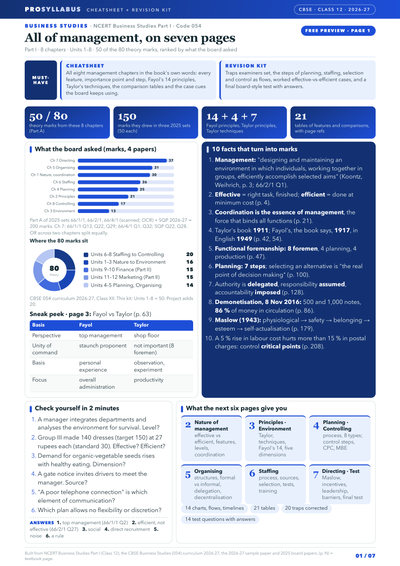
Directing: 37 marks in 4 papers, the most- Marks booster + cheatsheet: most-asked concepts in 2 lines each
- 8 chapters ranked by what the board asked
- 31 marks: Organising, a 6-marker every set
- 30 marks in 4 papers: nature of management
- 14 principles of Fayol
- Case cues the board keeps using
Summary
Marketing is a social process by which individuals and groups obtain what they need and want by creating offerings and freely exchanging products and services of value with others. Its features are needs and wants, creating a market offering, customer value and the exchange mechanism. Marketing must be distinguished from selling: selling is only a part of marketing focused on transferring title and earning profit from sales volume, while marketing is a wider concept that begins before production by identifying customer needs and continues after sale through customer relations. Marketing management is the management of the marketing function — choosing target markets and getting, keeping and growing customers by creating, delivering and communicating superior value. Marketing philosophies have evolved through the production, product, selling, marketing and societal marketing concepts. The functions of marketing include gathering market information, marketing planning, product designing, standardisation and grading, packaging and labelling, branding, customer support, pricing, promotion, physical distribution, transportation and storage. The marketing mix is the set of controllable variables a firm uses to influence buyers, made up of four elements — Product, Price, Place and Promotion (the four Ps). Product decisions cover features, quality, branding, packaging and labelling. Pricing is affected by cost, demand, competition, marketing objectives and government regulation. Place or physical distribution covers channels of distribution (direct and indirect) and physical movement. Promotion uses a promotion mix of advertising, personal selling, sales promotion and publicity. Branding, packaging and labelling help identify products, protect them and promote them.