Business Environment
Class 12 Business Studies · Business Studies Part I · Chapter 3
163 members in the CBSE community
View all










CBSE Class 12 · Business Studies
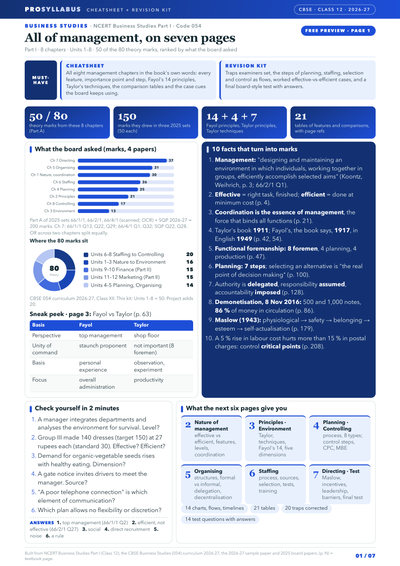
Directing: 37 marks in 4 papers, the most- Marks booster + cheatsheet: most-asked concepts in 2 lines each
- 8 chapters ranked by what the board asked
- 31 marks: Organising, a 6-marker every set
- 30 marks in 4 papers: nature of management
- 14 principles of Fayol
- Case cues the board keeps using
CBSE Class 12 · Business Studies
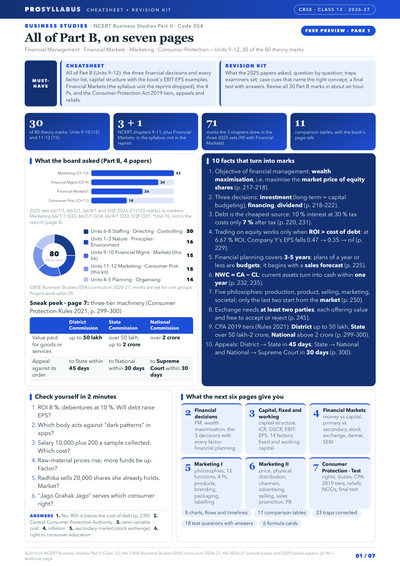
Financial Markets: 26 marks, not in NCERT- Marks booster + cheatsheet: key concepts in 2 lines each
- 15 marks each: Units 9–10 and 11–12
- 4 Ps of marketing, Unit 11
- Consumer Protection Act 2019 tiers, appeals
- Capital structure with EBIT-EPS examples
- The three financial decisions, every factor
Summary
Business environment means the sum total of all individuals, institutions and other forces that lie outside a business enterprise but may affect its performance. Its features are: it is the totality of external forces; it includes both specific forces (customers, competitors, suppliers, investors) and general forces (social, political, legal, technological); it is inter-related, dynamic, uncertain, complex and relative to country and region. Understanding the environment is important because it helps a firm identify opportunities and gain first-mover advantage, identify threats and early warning signals, tap useful resources, cope with rapid change, assist in planning and policy, and improve performance. The dimensions of business environment are economic, social, technological, political and legal. The chapter also studies the economic environment in India, especially the New Economic Policy of 1991 introduced after the foreign-exchange crisis, built on liberalisation (ending the licence-permit-quota raj), privatisation (a greater role for the private sector and disinvestment) and globalisation (integration with the world economy). The impact of these reforms on business and industry includes increasing competition, more demanding customers, rapidly changing technology, the need for change and human resource development, market orientation and loss of budgetary support to the public sector. Demonetisation of 2016 is studied as a recent policy with tax, digitisation and wealth effects.