Sequences and Series
Class 11 Mathematics · Chapter 8
163 members in the CBSE community
View all











CBSE Class 11 · MathematicsTrending
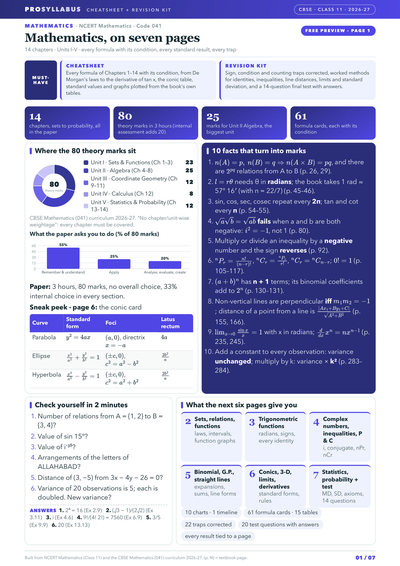
Every formula of Ch 1–14, with its condition- Marks booster + cheatsheet: key concepts in 2 lines each, common traps
- 25 marks: Unit II, Ch 4–8
- 23 marks: Unit I, Ch 1–3
- Common traps, corrected
- Conic table and standard values
- Graphs plotted from the book's own tables
Summary
A sequence is an ordered list of numbers \(a_1,a_2,a_3,\dots\) whose terms follow a rule, often a formula for the \(n\)th (general) term \(a_n\) or a recurrence such as the Fibonacci relation \(a_n=a_{n-1}+a_{n-2}\). A sequence is finite or infinite; the associated series is the sum \(a_1+a_2+\cdots\), written compactly with sigma notation \(\sum_{k=1}^{n}a_k\). The chapter focuses on the geometric progression (G.P.), in which each term bears a constant ratio \(r\) to its predecessor, so \(a_n=ar^{n-1}\). The sum of the first \(n\) terms is \(S_n=\dfrac{a(r^n-1)}{r-1}\) for \(r\ne1\) (and \(S_n=na\) when \(r=1\)). Between two positive numbers \(a,b\) the geometric mean is \(\sqrt{ab}\), and we can insert several geometric means to form a G.P. For two positive numbers the arithmetic and geometric means satisfy \(\text{A.M.}\ge\text{G.M.}\). Between two positive numbers we can also insert any number of geometric means \(G_1,G_2,\dots,G_n\) so that \(a,G_1,\dots,G_n,b\) is a G.P. with \(r=(b/a)^{1/(n+1)}\). These results model growth such as compound interest, doubling populations of bacteria and the count of ancestors over successive generations, and they connect with the arithmetic mean studied earlier through the inequality \(\text{A.M.}\ge\text{G.M.}\).