Complex Numbers and Quadratic Equations
Class 11 Mathematics · Chapter 4
163 members in the CBSE community
View all










CBSE Class 11 · MathematicsTrending
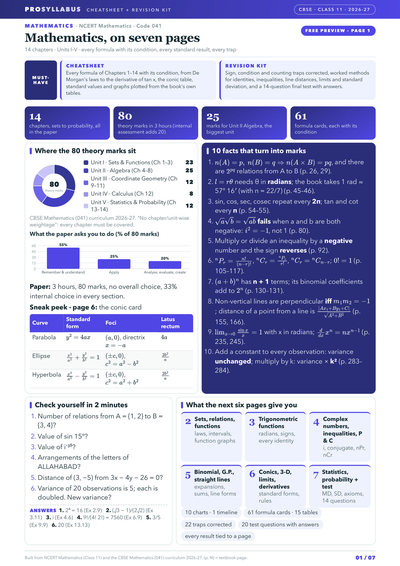
Every formula of Ch 1–14, with its condition- Marks booster + cheatsheet: key concepts in 2 lines each, common traps
- 25 marks: Unit II, Ch 4–8
- 23 marks: Unit I, Ch 1–3
- Common traps, corrected
- Conic table and standard values
- Graphs plotted from the book's own tables
Summary
The real number system is extended so that equations like \(x^2+1=0\) have solutions. Defining \(i=\sqrt{-1}\) with \(i^2=-1\), a complex number has the form \(z=a+ib\) where \(a=\operatorname{Re}z\) and \(b=\operatorname{Im}z\). Two complex numbers are equal iff their real and imaginary parts match. Addition, subtraction and multiplication follow term-by-term rules, e.g. \((a+ib)(c+id)=(ac-bd)+i(ad+bc)\), and every non-zero \(z\) has a multiplicative inverse \(z^{-1}=\bar z/|z|^2\). Powers of \(i\) cycle: \(i^{4k}=1,\ i^{4k+1}=i,\ i^{4k+2}=-1,\ i^{4k+3}=-i\). The modulus \(|z|=\sqrt{a^2+b^2}\) and conjugate \(\bar z=a-ib\) satisfy \(z\bar z=|z|^2\). Addition obeys the closure, commutative, associative laws, with additive identity \(0+i0\) and additive inverse \(-z\); multiplication has identity \(1+i0\) and is distributive over addition. The square root of a negative number \(-a\) (with \(a>0\)) is \(\sqrt a\,i\), but the rule \(\sqrt a\,\sqrt b=\sqrt{ab}\) fails when both are negative. Geometrically a complex number \(x+iy\) corresponds to the point \((x,y)\) in the Argand (complex) plane, where the real axis and imaginary axis replace the coordinate axes, \(|z|\) is the distance from the origin and \(\bar z\) is the mirror image of \(z\) in the real axis. Useful properties include \(|z_1 z_2|=|z_1||z_2|\) and \(\overline{z_1\pm z_2}=\bar z_1\pm\bar z_2\). These tools provide solutions to quadratic equations whose discriminant is negative.