Sets
Class 11 Mathematics · Chapter 1
163 members in the CBSE community
View all










CBSE Class 11 · MathematicsTrending
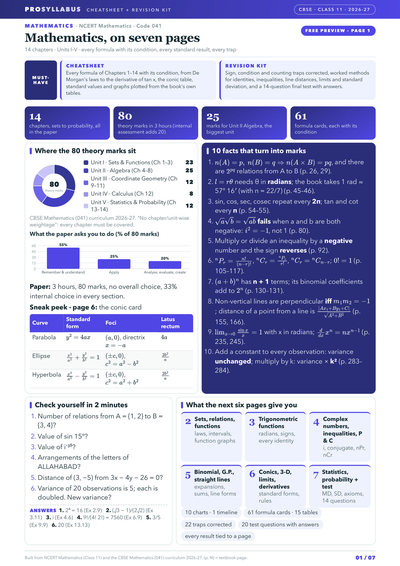
Every formula of Ch 1–14, with its condition- Marks booster + cheatsheet: key concepts in 2 lines each, common traps
- 25 marks: Unit II, Ch 4–8
- 23 marks: Unit I, Ch 1–3
- Common traps, corrected
- Conic table and standard values
- Graphs plotted from the book's own tables
Summary
A set is a well-defined collection of distinct objects, so one can always decide whether a given object belongs to it. Sets are written in roster form, listing elements within braces, or in set-builder form, stating a common property such as \(\{x : x\text{ is a vowel}\}\). Special number sets \(\mathbb{N},\mathbb{Z},\mathbb{Q},\mathbb{R}\) recur throughout the book. The empty set \(\varphi\) has no element; a set is finite or infinite by its count \(n(S)\). Two sets are equal when they have exactly the same elements, and \(A\subset B\) means every element of \(A\) lies in \(B\). Intervals like \((a,b)\) and \([a,b]\) are subsets of \(\mathbb{R}\). Operations on sets — union \(A\cup B\), intersection \(A\cap B\), difference \(A-B\) and complement \(A'\) with respect to a universal set \(U\) — obey commutative, associative, distributive, idempotent and De Morgan's laws \((A\cup B)'=A'\cap B'\). Venn diagrams picture these relationships, making the theory of sets the foundation for relations, functions and probability that follow.