Relations and Functions
Class 11 Mathematics · Chapter 2
163 members in the CBSE community
View all











CBSE Class 11 · MathematicsTrending
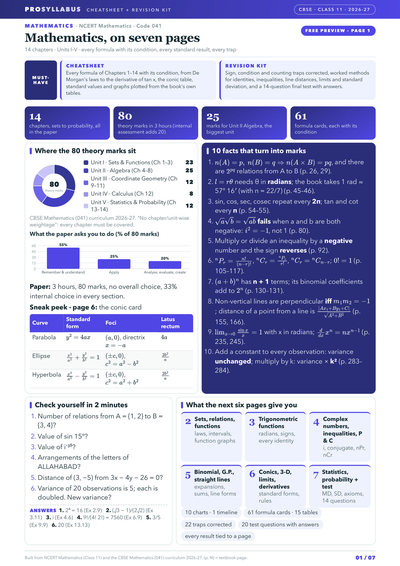
Every formula of Ch 1–14, with its condition- Marks booster + cheatsheet: key concepts in 2 lines each, common traps
- 25 marks: Unit II, Ch 4–8
- 23 marks: Unit I, Ch 1–3
- Common traps, corrected
- Conic table and standard values
- Graphs plotted from the book's own tables
Summary
This chapter links pairs of objects from two sets. The Cartesian product \(A\times B=\{(a,b):a\in A,\ b\in B\}\) collects all ordered pairs; two ordered pairs are equal iff their first and second elements match, and if \(n(A)=p,\ n(B)=q\) then \(n(A\times B)=pq\). A relation \(R\) from \(A\) to \(B\) is any subset of \(A\times B\); its domain is the set of first elements, its range the set of second elements, with the whole \(B\) as codomain (range \(\subset\) codomain). The total number of relations is \(2^{pq}\). A function is a special relation in which every element of the domain has exactly one image. The book studies real functions and graphs of the identity, constant, polynomial, rational, modulus \(|x|\), signum and greatest-integer \([x]\) functions. It also defines algebra of real functions: for \(f,g:X\to\mathbb{R}\), \((f+g)(x)=f(x)+g(x)\), \((f-g)(x)=f(x)-g(x)\), \((fg)(x)=f(x)g(x)\), \((kf)(x)=kf(x)\) and \((f/g)(x)=f(x)/g(x)\) when \(g(x)\ne 0\). These ideas make functions a precise language for the rest of mathematics.