Straight Lines
Class 11 Mathematics · Chapter 9
163 members in the CBSE community
View all











CBSE Class 11 · MathematicsTrending
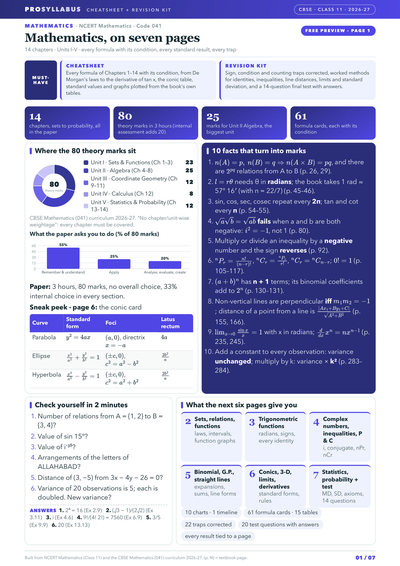
Every formula of Ch 1–14, with its condition- Marks booster + cheatsheet: key concepts in 2 lines each, common traps
- 25 marks: Unit II, Ch 4–8
- 23 marks: Unit I, Ch 1–3
- Common traps, corrected
- Conic table and standard values
- Graphs plotted from the book's own tables
Summary
Coordinate geometry represents the straight line algebraically, building on the distance, section and area formulae from earlier classes. The inclination \(\theta\) of a line gives its slope \(m=\tan\theta\), and for two points the slope is \(m=\dfrac{y_2-y_1}{x_2-x_1}\). Two lines are parallel iff their slopes are equal and perpendicular iff \(m_1 m_2=-1\); the acute angle between them satisfies \(\tan\theta=\left|\dfrac{m_2-m_1}{1+m_1 m_2}\right|\). The chapter derives several forms of a line's equation: point-slope \(y-y_0=m(x-x_0)\), two-point, slope-intercept \(y=mx+c\), intercept \(\dfrac{x}{a}+\dfrac{y}{b}=1\), and the general form \(Ax+By+C=0\). The distance of a point \((x_1,y_1)\) from the line \(Ax+By+C=0\) is \(\dfrac{|Ax_1+By_1+C|}{\sqrt{A^2+B^2}}\), and the distance between parallel lines \(Ax+By+C_1=0\) and \(Ax+By+C_2=0\) is \(\dfrac{|C_1-C_2|}{\sqrt{A^2+B^2}}\). Special cases include horizontal lines \(y=a\) and vertical lines \(x=b\), while three points are collinear iff the slope of \(AB\) equals the slope of \(BC\) (equivalently, the area of triangle \(ABC\) is zero). Any first-degree equation \(Ax+By+C=0\), with \(A,B\) not both zero, represents a straight line and can be reduced to any of these standard forms. These tools handle collinearity, concurrency of lines, reflections of a point in a line, and many geometric and real-life applications such as relating two linearly varying quantities.