Linear Inequalities
Class 11 Mathematics · Chapter 5
163 members in the CBSE community
View all











CBSE Class 11 · MathematicsTrending
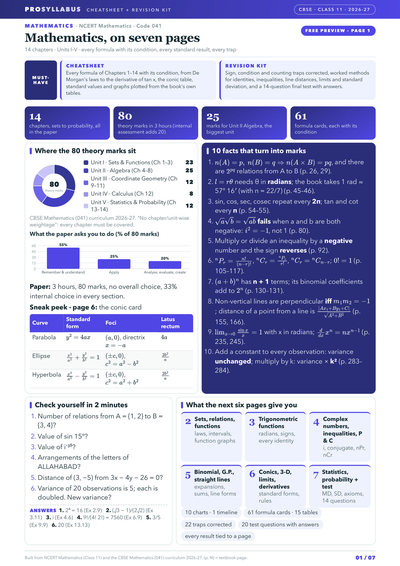
Every formula of Ch 1–14, with its condition- Marks booster + cheatsheet: key concepts in 2 lines each, common traps
- 25 marks: Unit II, Ch 4–8
- 23 marks: Unit I, Ch 1–3
- Common traps, corrected
- Conic table and standard values
- Graphs plotted from the book's own tables
Summary
Many real situations are described not by equations but by inequalities using the symbols \(<,\ >,\ \le,\ \ge\). This chapter studies linear inequalities in one variable. A solution is any value of the variable that makes the inequality true, and the collection of all such values is the solution set, which may be found over \(\mathbb{N}\), \(\mathbb{Z}\) or \(\mathbb{R}\). The rules mirror those for equations: equal numbers may be added to or subtracted from both sides, and both sides may be multiplied or divided by the same positive number — but multiplying or dividing by a negative number reverses the inequality. Solutions over the real numbers are written as intervals such as \((-2,\infty)\) and shown on a number line, with an open circle for a strict inequality and a closed circle for \(\le\) or \(\ge\). Word problems — averages of marks, mixing acid solutions, consecutive odd integers, temperature conversion — are translated into inequalities and solved, illustrating wide use in science, statistics and economics.