Adolescent Health and Wellbeing
Class 10 Health and Physical Education · Chapter 11
173 members in the CBSE community
View all








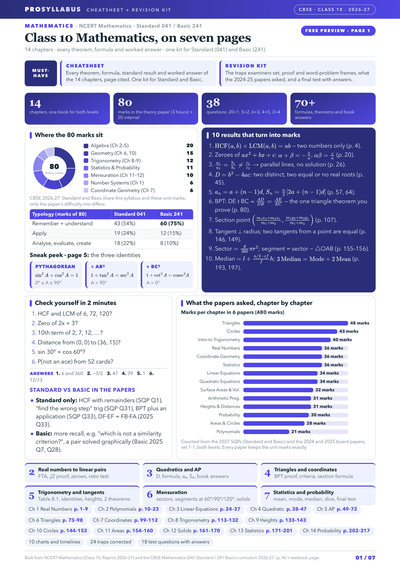
CBSE Class 10 · Mathematics (Standard and Basic)
70+ formulas and theorems, all 14 chapters- Marks booster + cheatsheet: key concepts in 2 lines each
- 24 exam traps, listed
- 20 marks: Algebra
- Board-paper counts, chapter by chapter
- 12 marks: Trigonometry
- 11 marks: statistics and probability
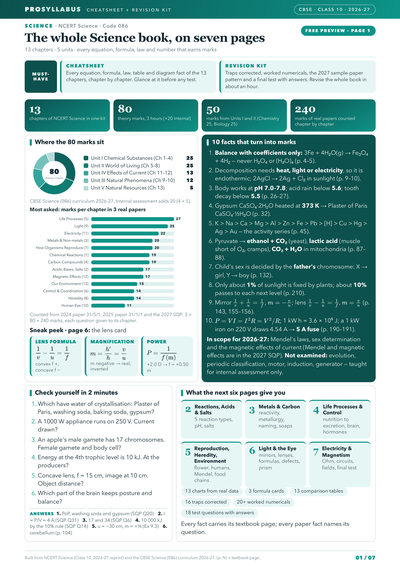
CBSE Class 10 · ScienceTrending
Every equation and law of all 13 chapters- Marks booster + cheatsheet: key concepts in 2 lines each, common traps
- 25 marks each: Units I and II
- 13 marks: electricity and magnetism
- Common traps, corrected
- 12 marks: light and the human eye
- NCERT tables turned into charts
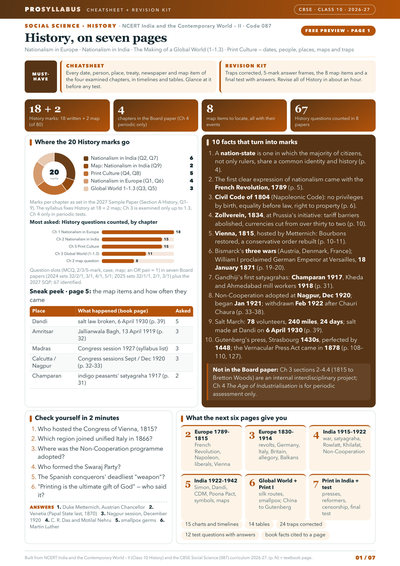
CBSE Class 10 · Social Science: History
Four History chapters: dates, people, maps- Marks booster + cheatsheet: key concepts in 2 lines each, common traps
- Timeline: Europe, 1789 to 1914
- Timeline: India, 1915 to 1942
- Common traps, corrected
- Full CBSE map list
- Board questions, 2024–27 papers counted
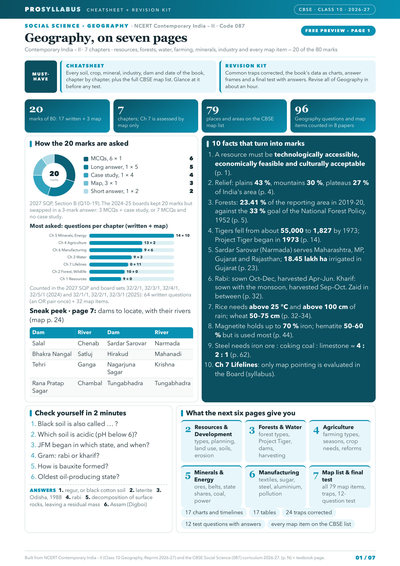
CBSE Class 10 · Social Science: GeographyTrending
All 79 CBSE map items, with locations- Marks booster + cheatsheet: key concepts in 2 lines each, common traps
- 20 of the 80 marks: all 7 chapters
- Crop table: conditions and states
- Map traps, corrected
- Mineral belts and state shares
- The book's data drawn as charts
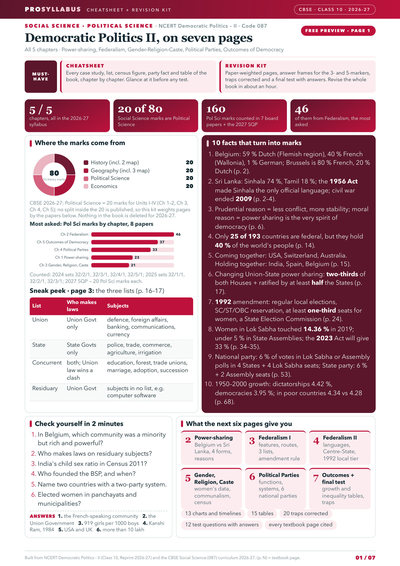
CBSE Class 10 · Social Science: Political Science
Belgium, Sri Lanka, three lists, six parties- Marks booster + cheatsheet: key concepts in 2 lines each, common traps
- Census tables and the data on women
- Four forms of power-sharing
- Common traps, corrected
- Federalism: language policy, third tier
- Party systems, challenges and reforms
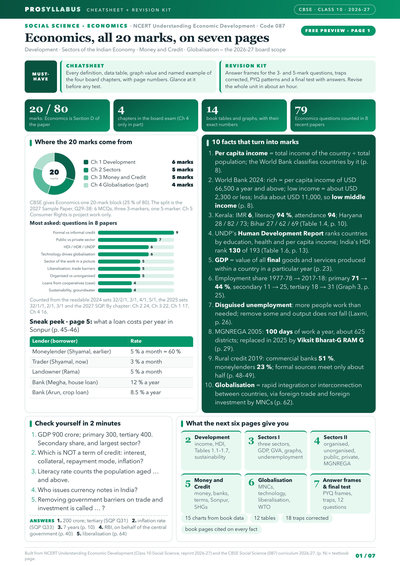
CBSE Class 10 · Social Science: Economics
All 20 Economics marks, four board chapters- Marks booster + cheatsheet: key concepts in 2 lines each
- 18 exam traps, listed
- What the board asked, 2024–27 papers counted
- Book tables and graph values as charts
- Answer frames for 3- and 5-mark questions
- Ten must-know facts
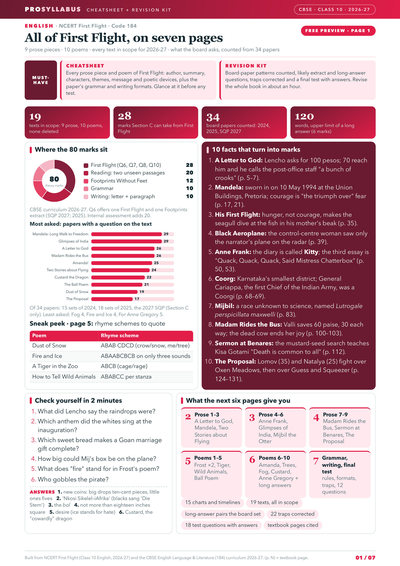
CBSE Class 10 · English
First Flight: what 34 board papers asked- Marks booster + cheatsheet: key concepts in 2 lines each, common traps
- 9 prose pieces, each summarised
- 10 poems with their poetic devices
- Common traps to avoid
- Long-answer pairs the board has set
- 10 marks each: grammar and writing formats
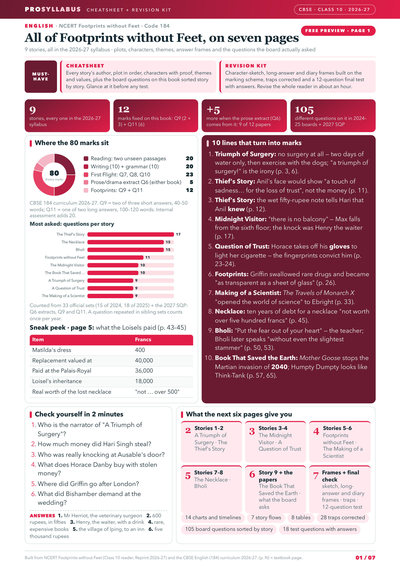
CBSE Class 10 · English
105 board questions, counted story by story- Marks booster + cheatsheet: key concepts in 2 lines each, common traps
- 9 stories: plot, characters, themes
- Character-sketch frames
- Common traps to avoid
- Diary-entry and long-answer frames
- Values in all 9 stories
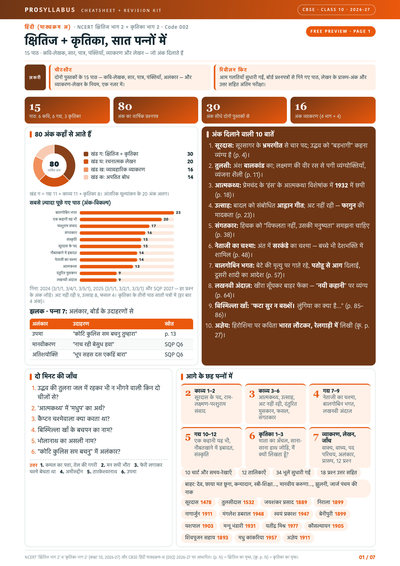
CBSE Class 10 · Hindi A
Kshitij + Kritika: all 15 पाठ, key lines- Marks booster + cheatsheet: key concepts in 2 lines each
- 20 marks: writing formats (खंड घ)
- 16 marks: grammar (खंड ख)
- 8 marks (4+4): Kritika's three पाठ
- Poets and authors of every पाठ
- Alankar in the poems
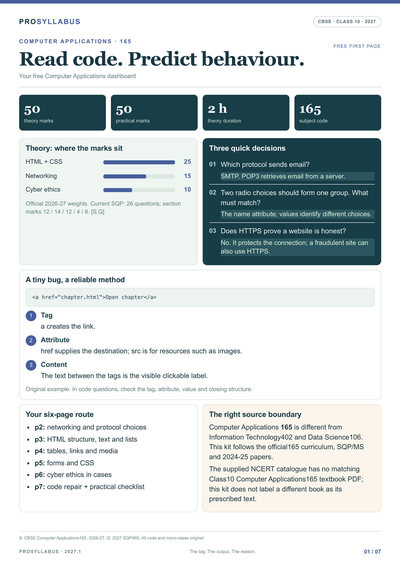
CBSE Class 10 · Computer Applications 2027
HTML, CSS and networking, with code to debug- Marks booster + cheatsheet: key concepts in 2 lines each
- Protocol tables: purpose matched to protocol
- HTML skeleton, headings, lists, attributes
- Tables with spanning cells, links, media
- Form inputs and CSS style properties
- Cyber ethics: licences, privacy, fraud
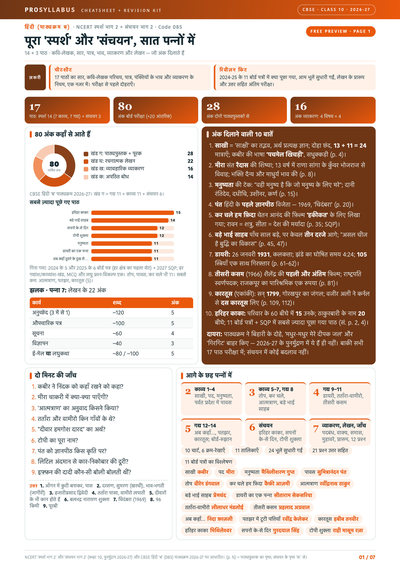
CBSE Class 10 · Hindi B
बड़े भाई साहब: the most-asked prose पाठ- Marks booster + cheatsheet: key concepts in 2 lines each
- 22 marks: writing (खंड घ)
- 16 marks: grammar (खंड ख)
- 11 marks each: poetry and prose sections
- 6 marks: Sanchayan, 2 of 3 questions
- Board trends, 2024–27 papers counted
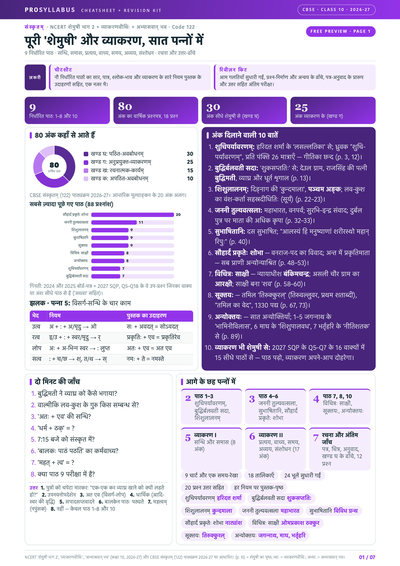
CBSE Class 10 · Sanskrit
9 Shemushi पाठ + sandhi, samasa, pratyaya- Marks booster + cheatsheet: key concepts in 2 lines each
- 17 marks: pratyaya to error correction
- 15 marks: rachna, with answer frames
- 10 marks: apathit
- 8 marks: sandhi and samasa
- Question-making, anvaya, event order
Summary
Adolescence is the period of transition from childhood to adulthood, marked by rapid physical, mental, emotional and social changes, and this chapter explains how to stay healthy during these years. It describes the physical growth and developmental changes of adolescence and the importance of good nutrition, regular exercise, adequate sleep and personal hygiene to support this growth. The chapter discusses the emotional and social challenges adolescents face, such as mood changes, peer pressure and the need for identity and acceptance, and how to manage stress and emotions in healthy ways. It stresses the importance of avoiding harmful habits such as the use of tobacco, alcohol and other substances, and of seeking guidance from parents, teachers and counsellors when needed. It also highlights the value of a positive self-image, good communication and constructive use of time. By understanding the changes of adolescence and adopting healthy habits, students can develop into confident, responsible and balanced adults.