
Checked 13 October 2026. Test structure, level descriptions and assessment criteria are from oph.fi and the University of Jyväskylä, read on 13 October 2026. The plan, its hours and its order are ours. Finnish tests are digital from the start of 2027; the demonstration tasks show the paper test.
YKI-testiin valmistautuminen: what four weeks can and cannot do
OPH, the Finnish National Agency for Education, says two things about preparing that pull in different directions. You do not have to pass a language course before the test, and there is no official textbook. But “you should prepare for the YKI test in advance”, because “the people grading the YKI test performances do not know you”: the only thing they assess is how well you speak, write and understand in the test situation [official: oph.fi, read 13 October 2026].
That tells you what a short plan is for. Four weeks will not move anyone from one level to the next; that is our view, not a published figure, and nobody publishes how long a level takes. What four weeks can do is make sure that the Finnish you already have is the Finnish the assessors see: you know every task type, you finish every task, you write three kinds of text without thinking about layout, and you keep talking when the recording says start. This page gives you that plan week by week, a tool that fits it to your hours and your test day, and the material OPH itself points to. ProSyllabus is an independent study site. We are not affiliated with, or endorsed by, the Finnish National Agency for Education (OPH), the University of Jyväskylä or the Finnish Immigration Service (Migri). Every rule here is quoted or summarised from their published pages; OPH decides everything about the test and Migri decides every citizenship application.
Official: oph.fi and the framework “Yleisten kielitutkintojen perusteet 2011”, sections 4 to 6.
Before week 1: three decisions
A plan that tries to raise four skills equally in four weeks spreads too thin. Settle these three points first; each has its own guide in this series.
| Decision | What the official pages say | Where to settle it |
|---|---|---|
| Which subtests you need | For citizenship, at least grade 3 in two subtests that form an accepted pair: speaking + writing, listening + writing, or reading + speaking. For a job or a place of study, ask the employer or the institution what it requires | YKI for Finnish citizenship: the three accepted pairs |
| Which test day | Finnish intermediate tests are listed to June 2027. Registration periods are short and the places “are often booked up quickly” | YKI test fee, dates and registration |
| Paper or computer | On 7 November 2026 the Finnish intermediate test is digital at four pilot centres and on paper elsewhere. All Finnish tests in spring 2027 are digital, taken on a computer at the test centre | Practise writing the way you will be tested: by hand for paper, on a keyboard with ä and ö for digital |
The citizenship pairs are explained in Kansalaisuus ja kielitaito: grade 3 and the three accepted pairs, and the fee, every test day and the registration rules in YKI-testin hinta: fee, test dates and whether a course is worth it. One point from that guide matters for any plan: a paid registration is binding and cannot be moved to another day, so the plan has to fit the day you booked.
What no plan can be built on, because it is not published
- Minutes for each subtest. OPH gives the length of the day only: 5 hours with breaks for the intermediate test.
- The number of tasks or questions in a subtest, apart from the three texts in writing.
- A word limit for the writing tasks.
- How many points in reading or listening give grade 3.
- A pass rate. We found no grade distribution on the oph.fi or jyu.fi pages we read.
So this plan sets no “target score”. It uses the level descriptions and the assessment criteria, which are published, as the target.
The four weeks at a glance
| Week | Focus | What you finish with | Official basis |
|---|---|---|---|
| 1 | Formats and a baseline | Every task type seen once; one written text and one recorded talk kept for comparison | OPH: get to know the structure of the test and the types of questions used in it |
| 2 | Writing and speaking | Seven short texts across the text types; seven recorded talks | Framework 6.2 and 6.4; the assessment criteria for speaking and writing |
| 3 | Reading, listening and opinions | Fourteen real texts and recordings summarised; seven spoken opinions with reasons | Framework 6.1 and 6.3: questions on main points, details and the whole |
| 4 | Run-through and logistics | One sitting of all your subtests; ID, route and start time checked | OPH’s instructions for the test day |
Build your four-week YKI plan
Choose what you are aiming at, how many hours a week you really have, and the subtest you find hardest. The tool splits your hours and, if you pick a test day, puts dates on the four weeks.
The split is our rule of thumb, not an official one: three parts for each subtest in your target pair, one part for each of the others, two extra parts for your hardest subtest (two parts each if you aim at all four), rounded to half hours. Test days and registration periods are OPH’s, read on 13 October 2026. Nothing you choose is stored.
The same split as a table
For readers without JavaScript, the tool’s rule is: three parts for each subtest in your target pair, one part for each other subtest, two extra parts for the subtest you find hardest; two parts each if you aim at all four. Two worked examples at 8 hours a week (our arithmetic, rounded to half hours, so a total can differ by half an hour):
| Aim and hardest subtest | Speaking | Writing | Listening | Reading |
|---|---|---|---|---|
| Speaking + writing; writing hardest | 2.5 h | 4 h | 1 h | 1 h |
| Reading + speaking; speaking hardest | 4 h | 1 h | 1 h | 2.5 h |
| All four; listening hardest | 1.5 h | 1.5 h | 3 h | 1.5 h |
Week 1: learn the formats and take a baseline
OPH’s first piece of advice is to “get to know the structure of the YKI test and the types of questions used in it”, and it links to two things for that: the University of Jyväskylä’s descriptions of the subtests and the demonstration pages [official]. The demonstration pages are on a University of Jyväskylä server, and the university’s Centre for Applied Language Studies trains the assessors. The site states plainly that it is not the test itself but a presentation for practising task types. The Finnish intermediate section has a page for each subtest: tekstin ymmärtäminen, kirjoittaminen, puheen ymmärtäminen and puhuminen.
| Day | What to do | Why |
|---|---|---|
| 1 | Reading demonstration: do both sets of example tasks. Note the three question types: multiple choice, true/false, open questions | The instructions say to answer every question and that wrong answers are not penalised |
| 2 | Listening demonstration: do both sets. Read each question before the recording starts | The instructions say there is always preparation time before a task |
| 3 | Writing demonstration: write the e-mail task by hand or on a keyboard. Keep it | This is your baseline text for week 4 |
| 4 | Speaking demonstration: record yourself on the talk, one conversation and the five situations. Keep the recording | The instructions say to say something in every task and to speak on the topic given |
| 5 | Read the grade 3 and grade 4 descriptions for your subtests and mark which sentences describe your baseline | These are what the assessors’ criteria are built on |
| 6 | List the task types that surprised you. They become week 4’s repeats | A surprise in the instructions costs time in the test |
| 7 | Rest, or listen to Finnish radio while doing something else | Ours: a plan you can keep beats a plan you abandon |
The level descriptions for each subtest, in Finnish and English, are in YKI-testin tasot: level 3 vs level 4. If you want original practice tasks instead of the demonstration ones, there is one for each subtest in YKI keskitaso practice by subtest.
Week 2: writing and speaking, one of each every day
Every accepted citizenship pair contains speaking or writing, and these are the two subtests you cannot mark from an answer key. They are assessed against criteria, not against other candidates [official: framework, section 7]. The framework says the writing subtest asks for three texts of different types, for example a message, a letter, an opinion text, a complaint or an application, and that speaking tasks have you take part in simulated conversations, react in given situations, and give an opinion or talk about a given topic [official: framework 6.2 and 6.4, in Finnish; our translation].
So week 2 is volume across types. The prompts below are ours, one speaking prompt and one writing prompt for each of the nine official topic areas. Use seven of the nine pairs this week, one pair a day, and keep the other two pairs for week 3.
| Topic area (framework) | Speaking prompt (ours) | Writing prompt (ours) | In English |
|---|---|---|---|
| A Minä ja taustani | Kerro, miksi muutit nykyiseen kotikaupunkiisi. | Kirjoita viesti uudelle naapurille ja esittele itsesi. | Say why you moved to the town you live in now. / Write a message to a new neighbour and introduce yourself. |
| B Koti ja asuminen | Naapurisi soittaa musiikkia myöhään illalla. Mitä sanot hänelle? | Kirjoita taloyhtiön ilmoitustaululle ilmoitus: myyt sohvan. | Your neighbour plays music late in the evening. What do you say? / Write a notice for the housing company’s notice board: you are selling a sofa. |
| C Kauppa ja palvelut | Ostit kaupasta vanhentunutta maitoa. Mitä sanot kassalla? | Kirjoita verkkokaupalle viesti: pakettisi ei ole tullut perille. | You bought milk that was past its date. What do you say at the till? / Write to a web shop: your parcel has not arrived. |
| D Kulttuuri | Kerro juhlasta, joka on sinulle tärkeä. | Suosittele ystävällesi elokuvaa tai kirjaa ja perustele, miksi. | Talk about a celebration that matters to you. / Recommend a film or a book to a friend and say why. |
| E Matkustaminen | Olet myöhästynyt junasta. Kysy asemalla, mitä voit tehdä. | Kirjoita hotelliin viesti: saavut vasta myöhään illalla. | You have missed your train. Ask at the station what you can do. / Write to a hotel: you will arrive late in the evening. |
| F Terveys ja hyvinvointi | Kerro, mitä teet, kun olet flunssassa. | Kirjoita mielipide: pitäisikö työpaikalla olla taukojumppaa? | Say what you do when you have a cold. / Write an opinion: should workplaces have exercise breaks? |
| G Työ | Kerro tavallisesta työpäivästäsi tai opiskelupäivästäsi. | Kirjoita työkaverille viesti ja kysy, voiko hän vaihtaa vuoroa kanssasi. | Describe an ordinary day at work or in your studies. / Write to a colleague and ask whether he or she can swap shifts with you. |
| H Ympäristö | Kerro, miten lajittelet jätteet kotona. | Kirjoita mielipide: pitäisikö muovipussien maksaa kaupassa enemmän? | Say how you sort your waste at home. / Write an opinion: should plastic bags cost more in shops? |
| I Yhteiskunta | Vertaa koulua Suomessa ja omassa kotimaassasi. | Kirjoita mielipide: pitäisikö vaaleissa voida äänestää puhelimella? | Compare school in Finland and in your home country. / Write an opinion: should it be possible to vote by phone in elections? |
Two habits make this week count. Rewrite before you write. Each day starts with yesterday’s text: join two short sentences with koska, mutta or joten, and fix one thing you now see. Listen before you record. Play yesterday’s talk once and write down the word you could not find; learn it, then record today’s. The criteria for grade 3 speaking describe someone who “is able to keep going effectively without help” despite pauses [official: OPH assessment criteria for speaking], and keeping going is a habit you can train in a week.
Model texts to compare your own with: four new writing tasks, each with a grade 3 style model and what would lift it, are in YKI-testin kirjoittaminen: four model texts, and speaking tasks with two model answers each are in YKI speaking and writing: example tasks with model answers.
Week 3: reading and listening volume, and one opinion a day
The comprehension subtests reward a wide diet. The framework lists the reading text types as letter, message, notice, advert, news item and story, and the listening material as conversations, interviews, voicemail messages, announcements, news, bulletins and adverts [official: framework 6.1 and 6.3]. The University of Jyväskylä adds that questions are written so that answering “is not based only on understanding single words” [official: JYU, our translation]. Word lists alone will not carry you; reading whole texts will.
| Each day in week 3 | How | Time (ours) |
|---|---|---|
| One short real text | A notice, an advert, a message from an office or a news item. Write the main point in one Finnish sentence and two details | 20 minutes |
| One recording in standard Finnish | A radio or TV news item, heard twice without pausing. After the first hearing write the main point; after the second, two details | 20 minutes |
| One spoken opinion | Take a writing prompt from the table above and answer it aloud: your view, two reasons, one example | 10 minutes |
| Twice this week: a full practice set | Two reading texts and two listening scripts with sixteen questions and a grader | 45 minutes each |
The practice sets are in YKI: luetun ja kuullun ymmärtäminen, two practice sets. On how often you hear a recording, the official sources do not agree, so train for the stricter case. The framework says tasks are heard “once or twice”; the University of Jyväskylä’s description says “usually twice”; its demonstration page for the intermediate level says all listening tasks are heard twice at basic and intermediate level [official, all three]. Get what you can on the first hearing and use the second to check.
Why an opinion every day? The grade 4 description for speaking includes presenting and justifying an opinion understandably, and the opinion text is the example the University of Jyväskylä gives of an intermediate writing task. Even if grade 3 is all you need, a reasoned opinion is the task type most unlike everyday small talk, so it is the one that most needs rehearsal.
Week 4: a full run-through and the test-day rules
The last week is not for new material. It is for doing your subtests back to back once, repeating the task types that surprised you in week 1, and removing every non-language reason for a bad day.
| Rule or fact | What OPH says | What to do in week 4 |
|---|---|---|
| Arrive on time | “You will not be able to take the YKI test if you are late.” | Check the centre’s message for the start time and travel the route once |
| Identity document | A valid passport, identity card, alien’s passport, refugee travel document, residence permit card or Defence Forces photo ID. A driving licence is not accepted, and a picture of a document is not enough | Check the expiry date now |
| No devices | Phone, watch, laptop and tablet are collected for the whole day, breaks included | Do your run-through with phone and watch in another room |
| No dictionary | “You are not allowed to use a dictionary or study materials in the YKI test.” | Stop using one in practice this week |
| Length of the day | The intermediate test takes 5 hours, with breaks; you can bring your own snacks | Plan food and sleep as you would for a long shift |
| Answer everything | “Always complete all tasks and answer all questions. Always try to answer something!” | In the run-through, leave nothing blank and nothing silent |
| Cancelling | Possible until 8:00 on the morning of the test; the fee is refunded only for your own illness, with a certificate and an application within two weeks | If you fall ill, cancel before 8:00 and keep the certificate |
One caution on the identity document. OPH’s page lists the residence permit card among the accepted documents. The “Instructions for test-takers” on the Jyväskylä demonstration site say the opposite, that residence permit cards are not official identification [official, both, read 13 October 2026]. OPH is the authority that runs the test, so we follow its list, but if a residence permit card is the only document you have, ask your test centre before the day.
For the run-through itself, compare your new text with the baseline from week 1 and your new recording with the old one. Then use the checklist in Why people miss level 3, and how to avoid it: it turns the official level 2 and level 3 criteria into questions you can answer about your own work.
Free practice material, named
OPH’s pages on preparing and on the results point to the following. The first five are published by OPH or the University of Jyväskylä and we read them on 13 October 2026. The last three are other organisations’ material that OPH links to; we name them as OPH does and did not check their contents.
| Resource | Published by | Language | Use it in | Status |
|---|---|---|---|---|
| Descriptions of the subtests and levels | University of Jyväskylä, Centre for Applied Language Studies | Finnish | Week 1 | Official |
| Demonstration pages: example tasks for each subtest and level | University of Jyväskylä | Finnish tasks; site menus also in English and Swedish | Weeks 1 and 4 | Official; “not the official test questions” |
| Assessment criteria for speaking and for writing | OPH (PDFs on “After the YKI test”); the University of Jyväskylä’s page lists Finnish and Swedish versions too | English on oph.fi | Weeks 2 and 4 | Official |
| The framework (2011) with level descriptions, topic areas and language functions | OPH | Finnish is the text we read; OPH’s English page attaches a version under an English title | Week 1 | Official |
| Instructions for filling in the answer sheet | OPH | English | Week 4, if you sit on paper | Official |
| Ykitreenit | Yle, the Finnish public broadcaster | Finnish | Weeks 2 and 3 | Reported: linked by OPH, contents not checked by us |
| Instructions and exercises for the YKI test | Institute of Adult Education in Helsinki | Not checked | Weeks 2 and 3 | Reported: linked by OPH, contents not checked by us |
| Finnishcourses search engine | Not checked (OPH calls it the Finnish Courses search engine) | Not checked | If you decide you want a course | Reported: linked by OPH |
OPH adds that you can “look for suitable practice material online or, for example, ask your language teacher for tips”, and that you can practise standard language at work or at home [official]. Whether paying for a course is worth it is weighed in the fee and dates guide. If you would like the whole test in one English overview before you start, read YKI test in English: the complete guide.
What a single session looks like
Ours, and deliberately plain. Forty-five minutes is enough if nothing in it is passive.
| Minutes | What you do | What it trains |
|---|---|---|
| 0–5 | Re-read or replay yesterday’s work and fix one thing | Noticing your own errors, which is what turns practice into progress |
| 5–25 | Today’s production task: write a text or record a talk, no dictionary | Producing under test conditions |
| 25–40 | Today’s comprehension task: one text or one recording, main point and two details | Reading and listening for the whole, not single words |
| 40–45 | Write down three words you needed and did not have | Vocabulary from your own gaps |
The same test on seven printable pages
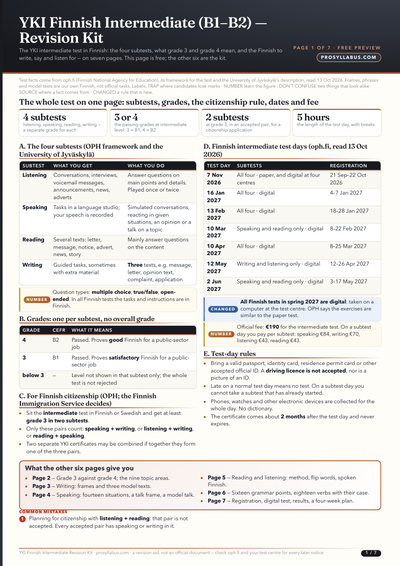
A plan needs a reference beside it. The kit puts the frames for the three writing text types, fourteen speaking situations and the grammar points on seven pages you can keep open while you work. Its last page carries a shorter four-week table arranged around the kit’s own pages; that table and this plan are both ours, so follow one of them, not both.
The YKI Finnish Intermediate revision kit is a seven-page PDF in English with the Finnish you need: the four subtests, grade 3 against grade 4, frames and three model texts for writing, fourteen speaking situations and a model talk, a method for reading and listening, sixteen grammar points and eighteen verbs with the case each one takes. Its test facts come from oph.fi; its model texts are our own, never official tasks. Page 1 is free to read in full before you decide.
Frequently asked questions
How long does it take to prepare for the YKI test?
No official figure appears on the pages we read. OPH says you should prepare in advance and get to know the structure and question types. Our four-week plan is for learning the format and practising production, not for moving up a whole level.
Do I need a course to take the YKI test?
No. OPH says you do not have to pass a language course before taking the test and that you can practise standard language at work or at home.
Is there an official YKI textbook?
No. OPH says there is no official textbook. It links to the University of Jyväskylä’s descriptions and demonstration pages and to a few other organisations’ exercises.
What is Ykitreenit?
Practice material in Finnish published by Yle, the Finnish public broadcaster. OPH lists it among examples of exercises on its page about preparing for the test. We name it as OPH does and have not checked its contents.
Which subtests should I prepare first?
The ones your purpose needs. For citizenship, at least grade 3 is needed in two subtests forming an accepted pair, and every pair contains speaking or writing, so start with those two.
How many hours a week should I study for YKI?
The pages we read give no official figure. The plan builder on this page takes the hours you actually have and splits them between the subtests by a rule of thumb that we state openly.
Are the demonstration tasks real YKI questions?
No. OPH says the links show examples of the questions and that they are not the official test questions. The demonstration site says it is a presentation for practising task types.
Should I practise on paper or on a computer?
On whichever you will be tested. The 7 November 2026 Finnish intermediate test is digital at four pilot centres and on paper elsewhere; all Finnish tests in spring 2027 are digital.
Can I use a dictionary in the YKI test?
No. OPH says dictionaries and study materials are not allowed, so practise without one, at least in the last week.
What should I do in the last week before the YKI test?
Do one run-through of all your subtests, repeat the task types that surprised you, check your identity document and the centre’s message, and stop new material two days before. That advice is ours.
How many times will I hear each listening task?
The official sources differ: the framework says once or twice, the University of Jyväskylä says usually twice, and its demonstration page says twice at basic and intermediate level. Practise getting the answer on the first hearing.
More in this series
- Practice set for all four subtests, with answers and a self-marking tool
- Fee, test days, registration and whether a course is worth it (cost planner)
- YKI for Finnish citizenship: grade 3 and the three accepted subtest pairs (checker)
- Levels 3 and 4: what each grade on the certificate means (level reader)
- Speaking and writing: five example tasks with grade 3 and grade 4 style model answers
- Reading and listening: strategies and practice sets with 16 questions (grader)
- YKI test in English: the whole test in one overview (timeline tool)
- Why people miss level 3: level 2 against level 3 in the official criteria (self-check)
- Writing: two messages, a complaint and an opinion text with model texts (checklist tool)
- YKI Finnish intermediate notice board — official updates
Sources
- official — OPH — Before the YKI test: the test day, ID, what is not allowed, cancelling, tips for practising
- official — OPH — Selecting the right YKI test, the test days (levels, subtests, test days and registration periods for autumn 2026 and spring 2027)
- official — OPH — Registering for the YKI test (terms, refund conditions, test fees, waiting list, special arrangements)
- official — OPH — After the YKI test (results, certificate, assessment, reassessment and its statistics)
- official — OPH — Yleisten kielitutkintojen perusteet 2011 (the framework: subtests, assessment, level descriptions, topic areas, language functions; in Finnish, attached on oph.fi)
- official — University of Jyväskylä, Centre for Applied Language Studies — Yleiset kielitutkinnot (description of the subtests and levels, in Finnish)
- official — University of Jyväskylä — YKI demonstration pages, Finnish intermediate level: instructions and example tasks for the four subtests (a demonstration, not the test)
- official — University of Jyväskylä — YKI demonstration pages, “Instructions for test-takers”
- official — OPH — Assessment criteria for speaking (YKI), PDF attached to “After the YKI test” (levels 1 to 6, six criteria)
- official — OPH — Assessment criteria for writing (YKI), PDF attached to “After the YKI test” (levels 1 to 6, general criteria and text types)
- official — OPH — Instructions for filling in the answer sheet (YKI), PDF attached to “Before the YKI test”
- official — OPH news — Digital YKI tests will be piloted in November 2026
- official — OPH — Proving your language skills for the Finnish citizenship application
- reported — Yle — Ykitreenit (in Finnish). Named because OPH links to it from “Before the YKI test”; we did not audit its contents
official = a document published by the conducting body. reported = a news or coaching site we could not check against an original. Where sources disagree this page says so rather than picking one.