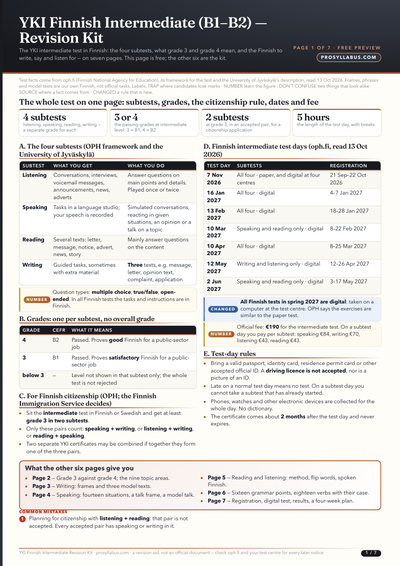
Checked 13 October 2026. Task types and level descriptions are from the OPH framework (2011) and the University of Jyväskylä’s description, read on 13 October 2026. All tasks and model answers are our own illustrations; none is an official task and none carries a promised grade. The official pages we read publish an overall test length but no minutes per subtest and no word limits. The Jyväskylä demonstration prints example answer times for single speaking tasks; they are quoted in this guide as that demonstration’s examples, not as official timings.
YKI puhuminen ja kirjoittaminen: what the two subtests ask for
Speaking and writing are the two subtests in which you produce Finnish, and every pair of subtests accepted for a citizenship application contains one of them. They are also the two that are hardest to mark by yourself, because there is no answer key. This page gives you five tasks, three for speaking (puhuminen) and two for writing (kirjoittaminen), each with two model answers: one written in the style of the official grade 3 description and one in the style of the grade 4 description, with a table after each showing what separates them.
Read this before you use the models. Every task and every answer here is ours. They are illustrations of the official level descriptions, not official tasks, and no assessor has graded them, so we do not promise that a text like them would receive that grade. We also keep the Finnish in both models correct on purpose: a real grade 3 answer usually contains mistakes, and the description allows for them, but printing mistakes would teach them. What we vary is what the descriptions vary: range, linking, register and how much the answer says. ProSyllabus is an independent study site. We are not affiliated with, or endorsed by, the Finnish National Agency for Education (OPH), the University of Jyväskylä or the Finnish Immigration Service (Migri). Every rule here is quoted or summarised from their published pages; OPH decides everything about the test and Migri decides every citizenship application.
Official: framework 2011, sections 6.2 and 6.4; University of Jyväskylä. The last tile is our finding from reading those pages on 13 October 2026.
| Subtest | Kind of task (framework and Jyväskylä) | On this page |
|---|---|---|
| Puhuminen | Taking part in simulated conversations | Speaking task 2 |
| Puhuminen | Reacting in given situations; saying a line in a described social situation | Speaking task 1 |
| Puhuminen | Giving an opinion or talking about a given topic | Speaking task 3 |
| Kirjoittaminen | Three texts of different types, for example a message, a letter, an opinion text, a complaint, an application. The tasks are guided and may include extra material | Writing task 1 (informal message) and writing task 2 (opinion text) |
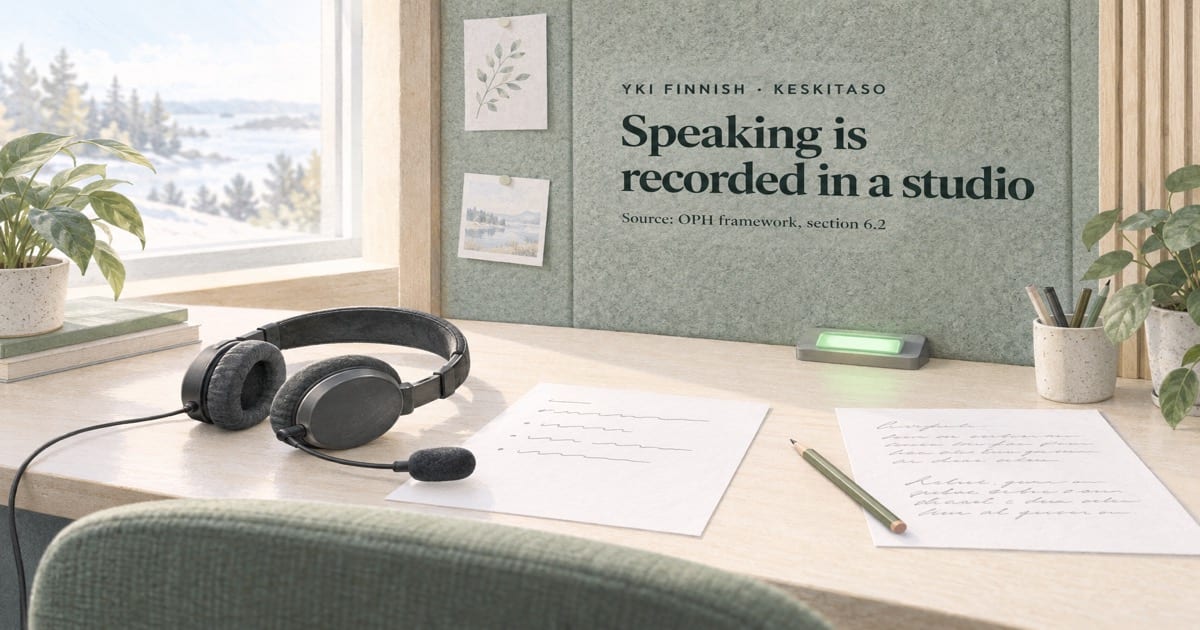
There is no face-to-face interview at this level. The framework says the speaking test at basic and intermediate level is done in a language studio, and that an interview belongs to the advanced level (and, for Finnish and Swedish, to the basic level) [official]. You speak to a recording and are recorded. From the start of 2027 every Finnish test is taken on a computer at the test centre, and OPH says the exercises are similar to those of the paper test [official].
Set up your practice: a timer you control
Read a task, start the timer, record yourself on your phone, and only then read the model answers. The settings are yours. No minutes per subtest are published; the Jyväskylä demonstration shows example answer times per speaking task (set out in the question below), and the suggestions in the table are ours, there only to stop you preparing a script.
Speaking practice timer
Set a thinking time and a speaking time, press start, and record yourself on your phone while it runs. The times are yours to choose and are ours, not official: no minutes per subtest are published, and the Jyväskylä demonstration’s examples (1 minute to think and 1½ minutes to speak; 20 or 30 seconds per short situation; 2 minutes for an opinion) are among the options.
Our practice settings, not official timings (the demonstration’s examples are only examples). In the test you follow the recorded instructions; here the point is to keep talking until the time ends and then listen to yourself.
| Kind of task | Thinking time we suggest | Speaking time we suggest | Why |
|---|---|---|---|
| Reacting in a situation (task 1) | 20 seconds | 30 seconds | Long enough for the problem, a request and a question |
| One turn of a conversation (task 2) | 10 seconds | 20 seconds | A real reply comes quickly; do not plan it word for word |
| Opinion or talk on a topic (task 3) | 1 minute | 1 minute 30 | Room for a view, two reasons, the other side and an end |
Puhumisharjoitus 1: reacting in a situation
The task · Tilanne
English: You have ordered a winter coat from an online shop. The coat is too small. You call customer service. Say what the problem is and what you want.
Model answer in a grade 3 style
English: Hello. I bought a coat from you last week. It is too small. I would like to change it for a bigger one. I have the receipt. How can I return the coat?
Model answer in a grade 4 style
English: Hello, this is Ravi Kumar. I ordered a winter coat from you last week, but unfortunately it is a size too small, even though I chose the size from your size chart. I would like to change it for a bigger size, if it is still in stock. If not, I would rather have my money back. Could you tell me how the return is made and whether I have to pay the postage myself?
The caller is invented.
| What to compare | Grade 3 style | Grade 4 style |
|---|---|---|
| Does it do the job? | Yes: problem, wish and a question, in six short sentences | Yes, and it adds a second option (money back) and a second question (postage) |
| Linking | Sentences stand side by side | mutta, vaikka, jos join them into one account |
| Register | Polite enough: teiltä, Haluaisin | Formal throughout: teidän kokotaulukkonne, Voisitteko kertoa |
| Description behind it | “Copes in the most common practical speaking situations” | “Copes fairly well in both official and unofficial speaking situations” |
Both answers would get you your coat exchanged. That is the point of grade 3: the message arrives. Do not hold back a simple, complete answer while you search for an impressive one.
Puhumisharjoitus 2: a simulated conversation
In a simulated conversation you hear the other speaker’s lines and answer in the gaps. Here a colleague speaks to you in the break room. Cover the right-hand columns, read each line aloud or have someone read it, and answer before you look.
| You hear | A reply in a grade 3 style | A reply in a grade 4 style |
|---|---|---|
| 1. Hei! Mitä teit viikonloppuna? | Olin kotona. Siivosin ja katsoin elokuvan. | Kävin lauantaina perheen kanssa mökillä, ja sunnuntaina vain lepäsin, koska viikko oli ollut aika raskas. |
| 2. Me menemme perjantaina työkavereiden kanssa syömään. Tuletko mukaan? | Kiitos, tulen mielelläni. Mihin aikaan te menette? | Kiitos kutsusta, tulen mielelläni! Pääsen tosin vasta kuuden jälkeen, koska minulla on sitä ennen hammaslääkäri. Sopiiko se? |
| 3. Mikä ravintola olisi sinusta hyvä? | Minusta pizzeria on hyvä, koska se on halpa. | Ehdottaisin sitä uutta nepalilaista ravintolaa aseman vieressä. Siellä on hyvää kasvisruokaa, joten kaikille löytyy jotain. |
The same conversation in English
| You hear | Grade 3 style reply | Grade 4 style reply |
|---|---|---|
| 1. Hi! What did you do at the weekend? | I was at home. I cleaned and watched a film. | On Saturday I went to the summer cottage with my family, and on Sunday I just rested, because the week had been quite heavy. |
| 2. We are going out to eat with colleagues on Friday. Will you come along? | Thanks, I would be glad to come. What time are you going? | Thanks for the invitation, I would be glad to come! I can only make it after six, though, because I have the dentist before that. Is that all right? |
| 3. Which restaurant do you think would be good? | I think a pizzeria is good, because it is cheap. | I would suggest that new Nepalese restaurant next to the station. They have good vegetarian food, so there is something for everyone. |
Look at reply 2 in the grade 3 column: it answers and then asks a question back. That is the phrase in the grade 3 description that candidates overlook: “can take the initiative in everyday situations of language use”. A conversation task is not an interrogation. The grade 4 replies do one more thing each time: they add a condition, a reason or a suggestion that the other speaker did not ask for, which is how people actually talk. The colleague uses sinä, so both sets of replies stay informal; answering a colleague’s “Tuletko mukaan?” with te forms would be the wrong register.
Puhumisharjoitus 3: giving an opinion
The task · Mielipide
English: Should children be allowed to use a mobile phone at school? Give your opinion and justify it.
Model answer in a grade 3 style
English: In my opinion children should not use a mobile phone at school. At school you have to study. The phone disturbs, because children play games and watch videos. My son is ten years old. He uses the phone too much. At break it is better to play with friends. But a child can call mum or dad if there is a problem. That is important.
Model answer in a grade 4 style
English: I am of the opinion that phones should be collected for the duration of lessons, but they do not need to be banned from school altogether. First, a phone easily takes attention away from the teaching, even if it is on silent. Second, breaks are important for children, because that is when they move about and learn to get along with one another. In my own family I have noticed that a child concentrates on homework much better when the phone is in another room. On the other hand I understand parents who want to reach their child after the school day, and sometimes a phone can also be used for studying. That is why I think the best solution is for the school and the parents to agree together on clear rules.
| What to compare | Grade 3 style | Grade 4 style |
|---|---|---|
| Opinion | Stated in the first sentence | Stated with a limit: collected for lessons, not banned altogether |
| Reasons | One reason with koska, one example from the speaker’s own life | Two ordered reasons (ensinnäkin, toiseksi), then an observation from experience |
| The other side | One sentence, added with Mutta | Introduced with Toisaalta and answered with a proposal (Siksi ...) |
| Sentences | Short main clauses; easy to say without getting lost | Subordinate clauses with että, vaikka, koska, kun, jotka |
| Description behind it | “Speech may be fairly slow, but there are not very many unnatural breaks” | “Can present and justify an opinion understandably and describe what he or she has seen, heard and experienced” |
If the grade 4 answer is beyond you today, do not memorise it. Take the grade 3 answer and add one thing: a second reason, or a sentence that begins with Toisaalta. That is one step along the scale, and it is a step you can take in a week.
Kirjoittamisesimerkki 1: an informal message
The task · Tehtävä
• Kerro omasta asuinalueestasi.
• Mainitse yksi hyvä ja yksi huono puoli.
• Ehdota tapaamista.
English: Your friend Leena is moving to the same town as you and asks which area is worth living in. Write her a message. Tell her about your own neighbourhood. Mention one good and one bad side. Suggest meeting.
Model answer in a grade 3 style
Kiva, että muutat tänne. Minä asun Koivumäessä. Se on hyvä alue. Kaupat ovat lähellä ja bussi menee keskustaan usein. Vuokra ei ole kallis.
Huono asia on, että keskustaan on pitkä matka. Bussilla matka kestää 25 minuuttia.
Tule katsomaan aluetta lauantaina! Voin näyttää sinulle paikat.
Terveisin
Asha
English: Hi Leena! Nice that you are moving here. I live in Koivumäki. It is a good area. The shops are close and the bus goes to the centre often. The rent is not expensive. The bad thing is that it is a long way to the centre. By bus the trip takes 25 minutes. Come and look at the area on Saturday! I can show you around. Regards, Asha
Model answer in a grade 4 style
Olipa mukava kuulla, että olet saanut työpaikan täältä ja muutat tänne jo keväällä. Asun itse Koivumäessä, noin kuuden kilometrin päässä keskustasta, ja olen viihtynyt täällä hyvin.
Parasta täällä on luonto: metsä alkaa melkein kotiovelta, ja järven rannalle kävelee kymmenessä minuutissa. Lisäksi vuokrat ovat selvästi halvempia kuin keskustassa. Huono puoli on se, että iltaisin bussit kulkevat harvoin, joten ilman autoa tai pyörää liikkuminen voi olla hankalaa. Jos haluat asua lähempänä palveluja, kannattaa katsoa asuntoja myös aseman läheltä.
Tulisitko käymään jonain viikonloppuna ennen muuttoa? Voisimme kiertää yhdessä pari aluetta, niin näet itse, mikä tuntuu omalta. Kerro, mikä päivä sinulle sopii!
Terveisin
Asha
English: Hi Leena! How nice to hear that you have got a job here and are moving here already in the spring. I live in Koivumäki myself, about six kilometres from the centre, and I have been very happy here. The best thing here is nature: the forest begins almost at the front door, and you can walk to the lake shore in ten minutes. In addition, rents are clearly cheaper than in the centre. The downside is that in the evenings the buses run rarely, so getting about without a car or a bike can be awkward. If you want to live closer to services, it is worth looking at flats near the station too. Would you come for a visit some weekend before the move? We could go round a couple of areas together, so you can see for yourself which feels like yours. Tell me which day suits you! Regards, Asha
The people and the neighbourhood are invented.
| What to compare | Grade 3 style | Grade 4 style |
|---|---|---|
| Task points covered | All three: the area, one good and one bad side, a meeting | All three, and it answers the friend’s real question with advice (aseman läheltä) |
| Detail | Facts in a row: shops, bus, rent | Facts with a consequence: buses run rarely, so getting about is awkward without a car |
| Register | Informal and consistent: muutat, sinulle, Tule | Informal and warm: Olipa mukava kuulla, Tulisitko käymään |
| Shape | Greeting, short paragraphs, close | Three paragraphs, each with one job, linked by Lisäksi, joten, Jos |
| Description behind it | “Can write simple, coherent text on ordinary topics” | “Can write both private and semi-official texts and present thoughts as a coherent whole” |
Kirjoittamisesimerkki 2: an opinion text
The University of Jyväskylä names the opinion text (mielipidekirjoitus) as an example of an intermediate-level writing task. It suits grade 4 well in our reading, because the grade 4 description speaks of expressing a point of view fairly broadly and stressing the key points.
The task · Tehtävä
English: The local paper asks its readers: should the town’s libraries be open on Sundays too? Write an opinion piece for the paper. Give your opinion and justify it.
Model answer in a grade 3 style
Mielestäni kirjaston pitää olla auki sunnuntaisin. Monet ihmiset ovat töissä maanantaista lauantaihin. He eivät ehdi kirjastoon. Sunnuntaina on aikaa.
Minä käyn kirjastossa lasten kanssa. Lapset lukevat kirjoja ja minä luen lehtiä. Kirjastossa voi myös käyttää tietokonetta. Se on tärkeää, koska kaikilla ei ole tietokonetta kotona.
Toivon, että kaupunki pitää kirjaston auki sunnuntaisin.
Kirjaston käyttäjä
English: Library open on Sundays. In my opinion the library must be open on Sundays. Many people are at work from Monday to Saturday. They do not have time for the library. On Sunday there is time. I go to the library with my children. The children read books and I read newspapers. In the library you can also use a computer. That is important, because not everyone has a computer at home. I hope the town keeps the library open on Sundays. A library user
Model answer in a grade 4 style
Lehdessä kysyttiin, pitäisikö kirjastojen olla auki myös sunnuntaisin. Olen ehdottomasti sitä mieltä, että ainakin pääkirjaston pitäisi olla auki.
Ensinnäkin sunnuntai on monelle perheelle viikon ainoa yhteinen vapaapäivä. Arkisin kirjasto menee kiinni juuri silloin, kun työssäkäyvät pääsevät töistä. Toiseksi kirjasto on paljon muutakin kuin kirjoja: siellä voi tehdä läksyjä, käyttää tietokonetta ja tavata muita ihmisiä maksutta. Erityisesti opiskelijoille ja yksin asuville tämä on tärkeää.
Toisaalta ymmärrän, että sunnuntaityö maksaa kaupungille enemmän ja että henkilökunnankin pitää saada levätä. Siksi ehdotan kokeilua: kirjasto voisi olla sunnuntaisin auki neljä tuntia, ja lainaus toimisi automaateilla. Jos kävijöitä on tarpeeksi, kokeilua jatketaan.
Kirjasto on kaupunkilaisten yhteinen olohuone, ja sen ovien pitäisi olla auki silloin, kun ihmisillä on aikaa tulla.
Ahkera lainaaja
English: Sunday is the right day for the library. The paper asked whether libraries should be open on Sundays too. I am absolutely of the opinion that at least the main library should be open. First, Sunday is for many families the only shared day off in the week. On weekdays the library closes just when working people get out of work. Second, a library is much more than books: there you can do homework, use a computer and meet other people free of charge. This is especially important for students and for people who live alone. On the other hand, I understand that Sunday work costs the town more and that the staff too must be able to rest. That is why I propose a trial: the library could be open for four hours on Sundays, and lending would work through self-service machines. If there are enough visitors, the trial continues. The library is the townspeople’s shared living room, and its doors should be open when people have time to come. A keen borrower
| What to compare | Grade 3 style | Grade 4 style |
|---|---|---|
| Opening | The opinion, straight away | Says what it is replying to, then the opinion, narrowed to the main library |
| Argument | One reason and the writer’s own example | Two ordered reasons, who benefits, the counter-argument, and a concrete proposal |
| Key point stressed | Repeated as a wish in the last line | Carried by the title and the closing image (yhteinen olohuone) |
| Register | Neutral, personal: Minä käyn ... | The semi-formal voice of a letter to a paper: Olen sitä mieltä, että ...; Siksi ehdotan ... |
| Description behind it | “The content is mostly understandable” | “Can express a point of view fairly broadly and emphasise the key points” |
One more semi-formal task, a message to a course teacher, with a model answer and a five-point check, is in YKI keskitaso practice by subtest. Between that page and this one you have three of the text types the framework gives as examples (it also lists a letter, a complaint and an application): an informal message, a semi-formal message and an opinion text.
Check your own writing
Writing check: length, sentences and connectors
Paste or type your Finnish answer. The tool counts words and sentences and lists the connecting words it finds, because joining ideas is what separates the grade 4 description from the grade 3 one.
A rough count that splits on spaces; that method is ours. The official pages we read give no word limit for the writing tasks, so follow the instructions printed with each task in the test. Nothing you type leaves this page or is stored.
What the check is looking for
| Job | Finnish connectors | Used in the models above |
|---|---|---|
| Reason | koska · sillä | Se on tärkeää, koska kaikilla ei ole tietokonetta kotona. |
| Contrast | mutta · vaikka · toisaalta · kuitenkin | Toisaalta ymmärrän, että sunnuntaityö maksaa kaupungille enemmän ... |
| Result | siksi · joten | ... joten ilman autoa tai pyörää liikkuminen voi olla hankalaa. |
| Order and addition | ensinnäkin · toiseksi · lisäksi · lopuksi | Lisäksi vuokrat ovat selvästi halvempia kuin keskustassa. |
| Condition and time | jos · kun | Jos kävijöitä on tarpeeksi, kokeilua jatketaan. |
Connectors are not decoration. The grade 3 description speaks of simple, coherent text; the grade 4 description of thoughts presented as a coherent whole. The words in this table are the visible joints of that whole. A text can have all of them and still be weak, so the tool counts them only to show you when you have none.
The differences in one table
Across all five tasks the same few things moved between the two columns. This summary is ours, built on the framework’s descriptions for speaking and writing.
| What the description names | Grade 3 style on this page | Grade 4 style on this page |
|---|---|---|
| Situations | Everyday and practical: a return, a weekend, a neighbourhood | The same situations, handled with options, conditions and proposals |
| Initiative | Asks one question back | Suggests, limits, proposes a trial |
| Opinion | A view and one reason | A view, ordered reasons, the other side, a conclusion |
| Formal and informal language | One safe register per answer | Clearly informal to a friend, clearly semi-formal to a paper or a company |
| Coherence | Short sentences in a sensible order | Paragraphs with one job each, joined by connectors |
| Mistakes | The description allows gaps that sometimes make understanding harder | The description allows only occasional unnatural expressions |
Mistakes that cost more than grammar
Our list, from the task instructions and OPH’s test-day advice
- Leaving a task point out. The writing tasks are guided: the task tells you what the text must cover. Tick each point off before you stop.
- Saying nothing. OPH: “Always complete all tasks and answer all questions. Always try to answer something!” A subtest done incompletely can end up as one that cannot be assessed.
- Mixing sinä and te. Decide who you are talking or writing to before the first word, and stay there.
- Whispering in the studio. OPH: “Use your normal speaking voice in the speaking test.” The recording is what the assessors hear.
- Writing spoken forms. mä, sä, oon belong to speech with friends; in a written answer use minä, sinä, olen.
- Stopping after one sentence in an opinion task. A view without a reason gives the assessors nothing to place on the scale.
Remember who reads and hears your answers: trained assessors who do not know you and who compare your performance with the level criteria, not with other candidates [official: framework, section 7, and oph.fi]. They cannot credit Finnish you know but did not use. What the grades mean subtest by subtest is in YKI levels 3 and 4; which pairs of subtests count for a citizenship application is in YKI for Finnish citizenship.
The same test on seven printable pages
These five tasks show the difference between the two grades. The kit gives you the frames to produce your own answers: by register for messages, in four paragraphs for an opinion text, and in seven steps for a talk.
The YKI Finnish Intermediate revision kit is a seven-page PDF in English with the Finnish you need: the four subtests, grade 3 against grade 4, frames and three model texts for writing, fourteen speaking situations and a model talk, a method for reading and listening, sixteen grammar points and eighteen verbs with the case each one takes. Its test facts come from oph.fi; its model texts are our own, never official tasks. Page 1 is free to read in full before you decide.
Frequently asked questions
What are the speaking tasks in the YKI intermediate test?
The framework gives three examples of speaking tasks: taking part in simulated conversations, reacting in given situations, and giving an opinion or talking about a given topic. They are done in a language studio and recorded.
Is there an interview in the YKI intermediate speaking test?
No. The framework says the intermediate speaking test is done in a language studio. A face-to-face interview is part of the advanced level, and of the basic level in Finnish and Swedish.
How many texts do I write in the YKI writing subtest?
Three texts of different types, for example a message, a letter, an opinion text, a complaint or an application.
How long should a YKI writing answer be?
The official pages we read on 13 October 2026 give no word limit. Follow the instructions printed with each task and cover every point the task asks for.
How long do I get to speak in each YKI speaking task?
No minutes per subtest are published on the official pages we read, but the University of Jyväskylä’s Finnish intermediate speaking demonstration (ykitesti2.solki.jyu.fi, read 13 October 2026) prints example times per task. These are the demonstration’s examples, not official figures for your test: “Kertominen” has “1 minuutti aikaa miettiä” and “1½ minuuttia aikaa puhua”; in the two “Keskustelu” tasks each turn has its time in brackets, between 10 and 25 seconds (“10 sek”, “15 sek”, “20 sek”, “25 sek”); in “Tilanteita” you get “20 sek” to read the situation and then 20 seconds for situation 1 and 30 seconds for each of situations 2 to 5; in “Mielipide” you get “2 minuuttia aikaa puhua”. The demonstration adds that each task has a preparation time and that you see the answer time in the task booklet. In the test you follow the recorded instructions. The timer on this page uses settings you choose yourself.
Are these model answers official?
No. Every task and model answer on this page is our own illustration of the official level descriptions. No assessor has graded them and no grade is promised.
What is the difference between a grade 3 and a grade 4 answer in writing?
By the framework, grade 3 is simple, coherent text on ordinary topics that is mostly understandable. Grade 4 is private and semi-official texts presented as a coherent whole, with a view expressed fairly broadly and formal and informal language kept apart.
What is the difference between grade 3 and grade 4 in speaking?
Grade 3 copes in the most common practical situations, perhaps slowly, and is understood. Grade 4 copes fairly well in formal and informal situations and can present and justify an opinion understandably.
Should I use sinä or te in the YKI test?
Follow the task. A friend or colleague who says sinä gets sinä; in a formal situation, such as a message to an office or a call to a company, te is the safe choice. Keep to one form of address throughout the answer.
Can I write spoken Finnish such as mä and oon in the writing subtest?
Use the written standard forms in written answers. The grade 4 description for writing mentions separating formal from informal language.
How are YKI speaking and writing assessed?
Against criteria built directly on the level scale. Your performance is compared with the level criteria, not with other candidates’ performances, by trained assessors.
Will the digital YKI test change the speaking and writing tasks?
OPH says the exercises in the digital test are similar to those in the pen-and-paper test. You type the writing answers, so practise ä and ö on a Finnish keyboard layout.
More in this series
- Practice set for all four subtests, with answers and a self-marking tool
- Fee, test days, registration and whether a course is worth it (cost planner)
- YKI for Finnish citizenship: grade 3 and the three accepted subtest pairs (checker)
- Levels 3 and 4: what each grade on the certificate means (level reader)
- A 4-week YKI preparation plan built on the four subtests (plan builder)
- Reading and listening: strategies and practice sets with 16 questions (grader)
- YKI test in English: the whole test in one overview (timeline tool)
- Why people miss level 3: level 2 against level 3 in the official criteria (self-check)
- Writing: two messages, a complaint and an opinion text with model texts (checklist tool)
- YKI Finnish intermediate notice board — official updates
Sources
- official — OPH — Yleisten kielitutkintojen perusteet 2011 (the framework: subtests, assessment, level descriptions, topic areas, language functions; in Finnish, attached on oph.fi)
- official — University of Jyväskylä, Centre for Applied Language Studies — Yleiset kielitutkinnot (description of the subtests and levels, in Finnish)
- official — OPH — Before the YKI test: the test day, ID, what is not allowed, cancelling, tips for practising
- official — OPH — After the YKI test (results, certificate, assessment, reassessment and its statistics)
- official — OPH — Selecting the right YKI test, the test days (levels, subtests, test days and registration periods for autumn 2026 and spring 2027)
- official — OPH news — Digital YKI tests will be piloted in November 2026
- official — OPH — Proving your language skills for the Finnish citizenship application
- official — University of Jyväskylä — YKI demonstration pages (examples of task types, not official test questions)
official = a document published by the conducting body. reported = a news or coaching site we could not check against an original. Where sources disagree this page says so rather than picking one.